
Toilets
Weak toilet flush: mechanism problem or blockage?
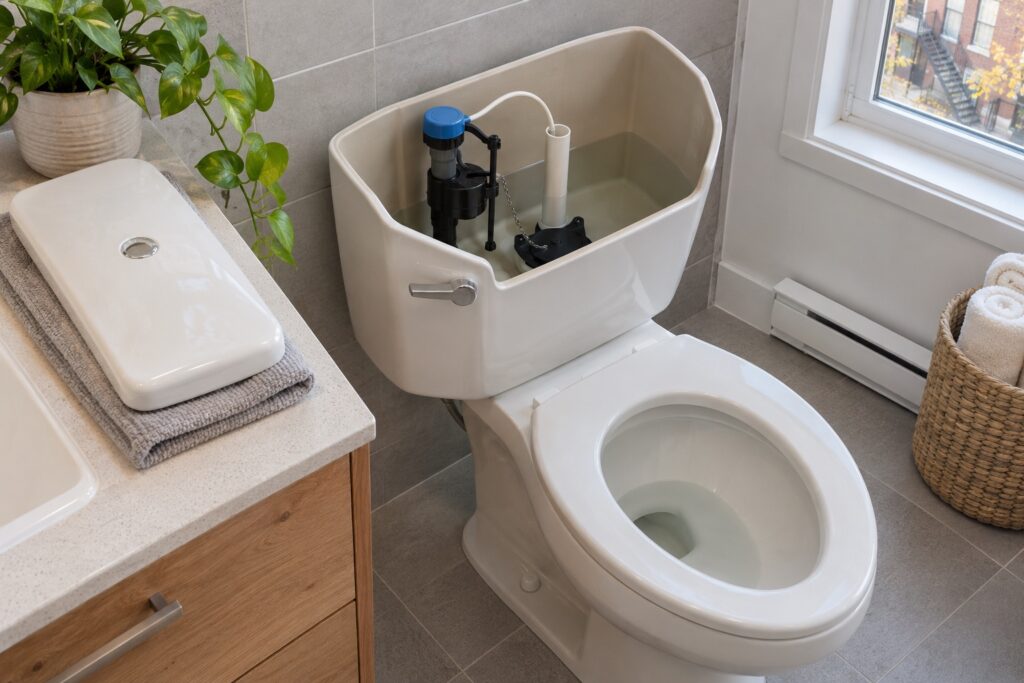
A weak toilet flush does not automatically mean you need drain clearing. If the handle moves but releases little water, start by observing the tank. If the bowl rises and drains slowly, stop flushing: restricted drainage becomes a stronger possibility. Both faults can exist together. Separating what the tank does from what the bowl does helps you request the right assessment without buying parts at random.
First check for water escaping, a bowl approaching the rim, or other fixtures backing up. Keep the toilet out of use if any of those signs appear. This guide then explains six possible branches, safe observations and useful information for a plumber. It mainly concerns accessible household gravity toilets. Pressure-assisted toilets, concealed tanks and electrically powered models require their own instructions and should not be treated as ordinary open tanks.
Stop here if overflow or another hazard is possible
Do not flush again when the bowl rises unusually high. Tell everyone in the home and keep children away. If the toilet shutoff is safely accessible from a dry position, you can gently close it without forcing a seized valve. That limits new water entering the tank. It does not clear the drain or prevent wastewater from backing up through a shared line.
A leak around the base, visible cracked porcelain or an unstable toilet also calls for stopping use. Avoid contact with wastewater. Do not enter a flooded area near electrical equipment. When several drains back up, reduce water use in the dwelling and arrange an assessment. Replacing a handle will not address that situation. Protect people first if there is an immediate danger, then deal with the plumbing.
In a rental or condominium, notify the owner, manager or condominium representative promptly. Describe which fixtures and floors are affected, if known. Do not operate a shared shutoff or open common plumbing access without coordination. A picture from a safe dry location may help explain the situation. Entering contaminated water or disturbing a shared connection to obtain a better picture creates a different problem.
Understand the tank and bowl before choosing a fix
The tank stores water for a flush. A handle or button releases that water, and the bowl and trapway carry it towards the drain. Weak performance can therefore involve an incomplete water reserve, poor actuation, restricted water delivery or an obstruction farther along. A particular sound cannot identify the cause on its own. Watch the sequence instead of assuming the loudest component is defective.
If there is no leak, instability or sign of overflow, observe one normal operating cycle. Was the tank ready before use? Did the control respond normally? Did the bowl empty, rise, or take an unusually long time to settle? Wait for refilling to finish before comparing performance. A second flush too soon draws on an incomplete reserve and can make an occasional timing issue look like a persistent failure.
Only lift a conventional loose tank lid if you can handle it comfortably and place it flat on a protected stable surface. Porcelain is heavy and brittle. Some lids have buttons connected to the mechanism, so do not pull them away blindly. If access requires disassembly, use the correct manual or leave the inspection to a professional. Replace the lid securely when the observation is finished.
1. The handle or button does not transmit movement
A loose, jammed or unusually stiff control points towards the actuation mechanism. Some gravity toilets use a chain between a lever and a flapper. Others use rods, buttons or a canister assembly. Simply observe whether the normal movement reaches the intended part. Do not assume that the mechanism in an online video matches yours, even when the tank looks similar from outside.
A control moving without releasing water is useful information, but it does not establish which part needs replacement. A connection may have shifted, a setting may be wrong or a component may be damaged. Record the model and compare the visible arrangement with its instructions. Avoid bending rods or tightening a fitting until the control cannot move. Unexpected resistance is a reason to stop rather than apply more force.
Our guide to a loose toilet handle covers that specific branch. The question here is whether ordinary actuation releases water as intended. If the control works yet the bowl remains slow, move the assessment towards drainage instead of repeating the same adjustment. Correcting one fault can expose another that was already present. That does not mean the first repair caused the second problem.
2. The tank does not have its normal water reserve
A tank still refilling cannot provide the same reserve as a ready tank. Compare the visible level with the marking and instructions for the actual model. Avoid copying a universal height from a video or another bathroom. Tank shapes and settings differ. KOHLER’s troubleshooting guide includes checking the waterline against the model’s mark as one of several possible observations for poor flushing.
Notice whether the weak toilet flush only follows closely spaced uses or also happens after a long wait. This distinction is useful when arranging service. Also mention filling that never seems to stop or restarts without anyone using the toilet. There is no need to disconnect a supply line or dismantle a fill valve to describe that pattern. Recording what happens during an ordinary cycle is enough.
Read the guide to a toilet tank that fills slowly if refilling itself is the concern. Adding a brick, moving a float at random or raising water above the intended mark is not a diagnostic shortcut. The aim is to restore the specified operation, then assess the flush. Compensating for an unexplained fault with an improvised modification can obscure what actually needs attention.
3. Water is released incompletely or for too short a time
A tank can look full without releasing its water properly. A control that fails to open the mechanism fully, an incompatible part or a changed assembly may need assessment. Pay particular attention to a problem beginning immediately after a repair. Keep the replacement part’s packaging and number, even if it appeared identical to the old one. Similar appearance alone does not establish compatibility with the toilet.
Holding the handle for every flush or changing several settings may seem to improve performance. However, that behaviour can hide the symptom without explaining it. Describe how the toilet behaves when operated normally. Do not turn a troubleshooting manoeuvre into a permanent instruction for everyone in the home. The fixture should operate according to its manufacturer’s directions without a special technique improvised to overcome a fault.
If the tank mechanism needs work, toilet repair or installation is the relevant service branch. Say that the tank releases little water or that performance changed after a particular part was installed. This separates the request from a bowl blockage. It can also help prepare for suitable parts, while leaving the actual diagnosis to the assessment rather than promising an answer over the phone.
4. Water does not reach the bowl as intended
Flushing also relies on the passages that direct water into the bowl. Visible deposits may deserve attention, but their presence does not explain every performance issue. Observe accessible surfaces without pushing rigid objects into openings. A photograph and the model number are more useful than aggressive scraping that could damage the finish. A visibly cleaner bowl is not proof that the drainage path is clear.
For maintenance, follow products and methods approved for the fixture. Do not pour a homemade mixture into the tank to see whether it helps. Internal parts and finishes have different tolerances. A cleaner intended for the bowl is not automatically suitable for the tank. Keep the product instructions and avoid adding one treatment after another when the first has failed to change the symptom.
Health Canada advises following labels and never mixing household chemical products. This matters particularly when something is already in the toilet. Tell the plumber the product name, approximate amount and time of use. Do not attempt to neutralize a drain cleaner with another liquid. The need to disclose a product remains even if the water now looks clear or the smell has faded.
5. The toilet or its drainage path is partly blocked
A bowl that rises then drains very slowly suggests a restricted passage more strongly than a simple handle problem. A recently dropped object or sudden onset can support that possibility without locating the obstruction. Stop repeated flushing. Each attempt adds water and may cause the overflow you are trying to avoid. Do not pour in a bucket to force an additional test when drainage is already questionable.
The guide on what to try when a toilet is clogged explains this branch and its limits. Any possible mechanical attempt first requires safe conditions and no hazardous chemical product in the fixture. If a hard object is suspected, the toilet leaks or the situation is uncertain, request help. Pushing an improvised tool into the bowl may move an object farther along without resolving the obstruction.
For an obstruction needing professional attention, toilet unclogging matches the request. Clearing a blockage and repairing the tank are different tasks. Explain the water movement, previous attempts and any suspected object. A camera or complete replacement is not automatically the next step. The assessment should establish what information and method are appropriate for the actual location and symptoms.
6. More than this toilet is affected
If a shower gurgles, a floor drain backs up or several toilets slow together, report the wider pattern. A shared portion of the installation may be involved. Those observations do not establish a municipal blockage or a ventilation defect. They do show why repeatedly adjusting the handle could waste time while water accumulates elsewhere. Avoid diagnosing a particular buried component from one noise or one slow fixture.
Ask other occupants what they have already noticed without asking them to run several fixtures as an experiment. In a multi-unit building, provide the start time, affected units and known recent work. The manager can coordinate access. Do not remove a cleanout cap or climb onto the roof to inspect venting. Those actions go beyond the household observations in this guide and can introduce additional hazards.
In Montreal, Laval, the South Shore or the North Shore, the street address alone does not identify the fault. Actual configuration, access and symptom history matter more than assumptions about an area. If several properties appear affected, also report the situation to the appropriate municipal service for the location. Responsibility and work boundaries need to be established from facts rather than assigned from a brief online description.
Compare symptoms without committing to a replacement part
A loose control with a full tank suggests starting with movement transmission. A low tank after a long wait suggests looking at refilling. An unusually rising bowl shifts attention towards drainage. These are ways to organize a conversation, not final diagnoses. Several faults can produce a weak toilet flush, and two different symptoms do not necessarily have the same cause. Keep the distinction between observation and explanation clear.
Make a short note with three items: what you see, when it started and the conditions in which it happens. Separate a fault that began after a part change from one that followed a dropped object. Mention whether another toilet works normally. Avoid labels such as collapsed sewer or low pressure unless an assessment has confirmed them. A precise description gives the plumber more freedom to identify the right cause.
If operation seems to return after a pause, do not immediately assume the problem has resolved. A partly restricted bowl may simply settle between uses, then rise again with the next flush. Keep it out of service when overflow remains plausible and arrange the next step. A photograph showing a normal water level at one moment does not capture what happened during the full cycle.
Prepare for a useful service visit in Quebec
Gather the brand, model reference, general pictures and a list of recent changes before calling. The number may be on the fixture or in purchase documents; do not dismantle anything to find it. Explain access constraints, whether this is the only available toilet and whether any product has been used. This helps prepare the visit without making a remote promise about the repair.
Ask what the assessment includes and how additional work will be authorized. Costs depend on the diagnosis, parts, access and actual scope. This guide supplies no ProDrain price or guaranteed repair method. A useful quotation separates mechanism repair, clearing and any additional work instead of combining everything into a vague promise. Mention building access arrangements early, especially where another person must unlock a service area.
After the visit, retain part references, the invoice and maintenance recommendations. Ask what operation was checked and which signs should prompt another call. If a separate concern remains possible, have that distinction explained clearly. Knowing what was resolved helps you recognize a later change. Do not interpret a limited repair as a blanket guarantee about every pipe or fixture in the building.
Reduce recurrence without modifying the fixture
Use the toilet as intended and allow the tank to finish refilling. Keep a convenient waste bin available so personal-care items stay out of the bowl. The City of Montreal specifically warns against flushing wipes and hygiene products. Packaging language does not replace that local prevention advice. Explain the household rule clearly to visitors and anyone helping with cleaning.
When a part is replaced, keep its exact reference for future maintenance. Avoid accessories that change water volume or movement without the manufacturer’s approval. If the toilet regularly requires multiple flushes, have the cause assessed instead of accepting that as normal. Repeated use can waste water while delaying a useful repair. A change in everyday performance deserves attention even before a complete failure occurs.
Tell occupants how to recognize an abnormal rise in the bowl and who to notify. A clear instruction avoids repeated attempts by different people. In a shared home, a temporary note on the bathroom door may be enough to keep the fixture unused until service. Coordination matters as much as the hardware: one person assuming the previous user simply forgot to flush can undo everyone else’s precautions.
Frequently asked questions
Does a weak flush always mean the toilet is clogged?
No. An incomplete tank reserve or an actuation fault can also cause weak flushing. Bowl behaviour helps direct the assessment. If it rises unusually high or drains slowly, stop testing and consider the drainage branch. Do not select a repair based only on how the flush sounds. Tell the plumber what happens before, during and after the cycle.
Can I keep using it if the water eventually goes down?
Water dropping does not prove that the passage is clear. A partial obstruction may allow slow drainage and still cause an overflow at the next use. Keep the toilet out of service if the bowl rises abnormally, a leak appears or other drains react. Arrange an assessment instead of repeated flushes to see whether the next one behaves differently.
Does the entire toilet need replacing?
Not necessarily. The choice depends on porcelain condition, available parts, the confirmed cause and expected result. Some mechanism faults can be repaired, while an obstruction requires a different approach. Ask for the diagnosis and options before authorizing replacement. Knowing that a fixture is old, or that a new model exists, does not by itself explain today’s problem.
Sources and the next step
KOHLER’s bilingual troubleshooting guide distinguishes several mechanism types and model-specific checks. It explains why matching the actual instructions matters; it does not authorize applying every adjustment to another brand. The Health Canada and Montreal sources linked above support the chemical and waste precautions. Their guidance complements an assessment of the actual fixture rather than identifying the fault in your bathroom.
To arrange help, contact ProDrain with separate descriptions of the tank and bowl behaviour. You can also browse the other toilet advice guides according to the symptom you observed.