Drains and sewers
French drain camera inspection: what does the price include?
FRENCH DRAIN INSPECTION
To compare the cost of a French drain camera inspection, start with the scope: which drain will be inspected, through which access point, and what record will you receive? A visit through usable existing access and work to create that access are different services. A price without those details does not let you compare two proposals.
Start with the question you need answered
A useful request begins with a clear purpose: you want to know which part of the foundation drain can be inspected and how the findings will be documented. Explain why you are asking. You may have noticed moisture, received an earlier recommendation or planned landscaping near the building. The contractor can then discuss whether a camera inspection answers that particular question.
Describe the location and timing of the symptom. For example, note whether moisture appeared at a joint, on a wall or at floor level, and whether you noticed it after rain. Those observations help frame an assessment without establishing the cause. Dated photographs and an earlier report are more useful than an assumption that the entire drain needs replacement.
If water is reaching electrical equipment, keep out of the wet area. Do not walk through water to photograph an opening or move an appliance. Active water entry first calls for appropriate safety measures and help. Comparing inspection quotes comes afterward; it should never delay protecting the people in the building.
Is the quote for foundation drainage or a sanitary sewer?
A French drain, also called a foundation or perimeter drain, concerns drainage around the foundation. It is different from the sanitary pipe carrying wastewater from plumbing fixtures. A request for a “drain inspection” can leave that distinction unresolved.
Describe what you have observed and identify the system you want assessed. Basement moisture alone does not establish that the foundation drain is defective. If your question concerns a sanitary pipe instead, read our guide to drain camera inspection costs and limitations.
Is usable access already available?
Ask where the inspection would begin and which part of the drain that access could reach. A cleanout or inspection riser does not guarantee that a camera can travel through the entire system. The actual connection, changes in direction and obstructions matter too.
If usable access has not been confirmed, distinguish finding an existing opening from creating a new one. Do not assume that a camera inspection includes excavation, or that an access point you cannot see necessarily means digging. Any proposed access work should have its own description, price and authorization, separate from running the camera.
When excavation is actually proposed, the scope should address infrastructure locating, site protection and surface restoration. Our page on access and preparation for plumbing excavation explains these considerations. Info-Excavation’s locating service concerns its members’ infrastructure; private or non-member networks may require separate arrangements. These sources are in French. Do not enter a trench to help with the inspection: the CNESST describes the risk of collapse in its French-language safety guidance.
What can the camera show, and what remains unknown?
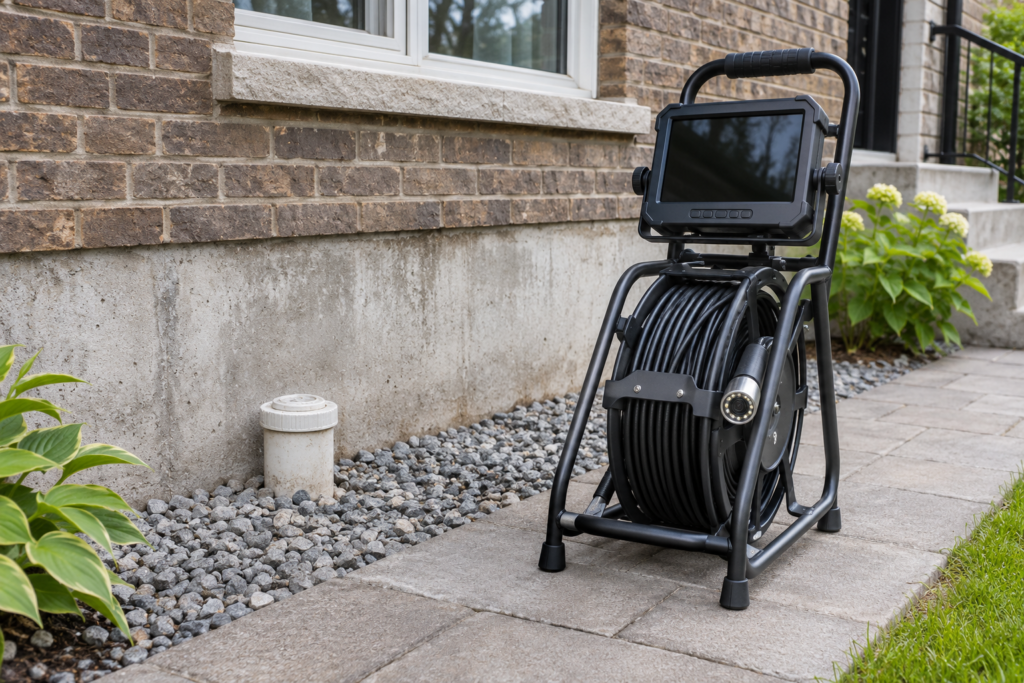
A camera shows the inside of the sections it can reach and view. Clear images and uninterrupted passage are not guaranteed. Water, deposits, a dirty lens or an obstruction can limit observation. SeeSnake’s manufacturer guidance highlights obstruction-related risks and states that the camera should not be used to clear blockages.
A clear image at one location therefore does not certify every section. Nor does it establish the performance of the whole drainage system, surrounding soil conditions, foundation waterproofing or structural condition. Those questions go beyond the view inside the pipe.
Ask for a distinction between observations, interpretations and uninspected sections. If the camera stops, that stopping point is not automatically proof of a collapsed pipe. Clarify what is actually visible and what still needs investigation before choosing an intervention.
Which items should the quote specify?
Compare equivalent services rather than isolated totals. The following are questions to clarify, not a list of guaranteed ProDrain inclusions:
- System and coverage: which drain, access points and sections are included? What happens if a section cannot be reached?
- Time and travel: what duration or billing basis is proposed? Is travel included, and how would additional time be authorized?
- Inspection record: will you receive an on-site explanation, video, still images or a written report? In what format and under which conditions?
- Locating: is identifying an observed point above ground included or separately priced? Do not equate it with a distance displayed in a video.
- Separate work: are cleaning, access creation, excavation and restoration excluded or described as separate items?
- Total and changes: are taxes identified? Who approves an extra charge before the work proceeds?
A video and an interpreted written report are not necessarily the same deliverable. If a buyer, insurer or another party needs documentation, confirm its requirements before the visit; the word “report” does not guarantee acceptance. For the broader breakdown of charges, see what to compare in a plumbing quote.
What should you ask after an incomplete inspection?
Clarify the access used, sections actually viewed, visibility limits and reason for stopping. Then ask what would allow the assessment to continue, why that step would help and what it would cost separately. A partial inspection should remain described as partial, even when some images are clear.
Cleaning, another attempt from a different opening or work to create access should not automatically be treated as part of the original inspection. The next proposal should address an unresolved question, rather than promise a result that the images do not establish.
How can you prepare without assuming a repair is needed?
Gather available plans or reports, describe known access points and explain when the problem occurs. Photos taken from a safe location can help describe the situation; they do not replace an assessment. Before booking a drain camera inspection, confirm the intended scope, deliverables and exclusions.
If a drainage defect is subsequently confirmed, foundation drainage work is a separate decision based on findings and site constraints. An inspection alone does not commit you to a complete replacement. Browse our other guides in Drains and sewers.
Why French drain inspection cost can vary
The agreed coverage is a major part of French drain inspection cost. One proposal may cover a single opening and limited observation. Another may allow for several starting points and more detailed documentation. Have those differences written down before comparing totals. Prices that look far apart may describe substantially different services.
First, clarify mobilization: travel, setup, surface protection and expected time on site. Ask what happens if the access point you described cannot be used. Is the charge based on a visit, a period of time or a defined service? You should understand how an attempt will be billed if the camera cannot travel through the intended section.
Next, define the observation work. Identify the proposed starting points and ask how inspected sections will be described. There is little benefit in demanding an arbitrary length before the layout is known. It is more useful to understand how the contractor will explain where the camera travelled and which portions remain unverified.
Documentation is another item to compare. An explanation during the visit, selected photographs, a video file and a written interpretation are different deliverables. Specify what you need when requesting the quote. If no files are included in the proposal, ask whether they are available and what they would cost before making the appointment.
Keep possible physical work separate. Cleaning, another access opening and surface restoration can change the scope substantially. Ask when the contractor will contact you for approval before additional spending. Keep a record of the accepted price or billing method and the specific work it covers. This gives both sides a practical reference if conditions change.
Compare proposals on the same basis
Give each company the same description, photographs and known access constraints. A comparison becomes misleading if one contractor assumes a clear opening while another expects to search for access first. Resolve those assumptions before selecting the lowest total. A brief clarification can reveal more than a long list of prices without defined coverage.
Make a comparison sheet with five headings: purpose, access, observation, documents and exclusions. Copy what each proposal actually says. Leave a space blank when the information is missing, then ask for it. This prevents a broad phrase such as “complete inspection” from becoming a promise that nobody has explained.
For a work project, the Office de la protection du consommateur’s estimate guidance provides a useful principle: a written description and comparable information make a decision easier. Apply that approach to the inspection assignment and request a separate proposal for later work. Specific consumer remedies depend on the agreement and circumstances.
Separate an option from an inclusion. A company may offer locating or a detailed report without including it in its basic proposal. Conversely, a higher total may already contain the documentation you need. Ask for a price for your actual requirements, with taxes and the conditions for changing the assignment clearly identified.
Do not evaluate a quote only by how confident its wording sounds. Ask what happens when the original assumptions prove wrong. A proposal that explains an incomplete inspection and the next approval point gives you a more usable decision framework. The purpose is to understand what you are authorizing, rather than to obtain a prediction that ignores unknown conditions.
Choose useful video, photographs and reporting
The record should let you connect the original question with the findings. Ask how the property, date, system and starting points will be identified. If there are several attempts, a clear description of each recording makes the results easier to follow. A long video without context can be difficult to use when you return to it months later.
Still images can help you discuss a particular observation, but they may not show the route leading to it. Video provides visual continuity without automatically providing an interpretation. A written report can summarize observations and limitations. Confirm what will actually be delivered rather than assuming that all of these formats are included together.
Ask how an incomplete result will be described. A useful record identifies the access used, the sections viewed and the limitations encountered. It distinguishes what was visible from what is only suspected. That separation lets you understand why a recommendation follows the images and what information is still missing before committing to work.
If a buyer, another professional or an insurer needs the documents, ask that recipient about its requirements first. Then communicate those requirements to the inspection provider. A document may be informative without meeting a third party’s needs. A report title alone cannot guarantee acceptance, insurance coverage or a particular transaction outcome.
Clarify practical delivery details as well: the file format, how you will receive it and whom to contact if it cannot be opened. Download and check the material when it arrives. Keep your own copy with the quotation and invoice. Do not assume a temporary download link will remain available indefinitely or that a future contractor will have access to the original recording.
Three situations that benefit from a clearer request
You can see an opening but do not know its connection
Describe its location and provide a photograph taken from a safe position. Ask how its suitability will be confirmed during the visit. Do not present the opening as proof that the full perimeter is accessible. The proposal should explain what happens if it connects to a different system or does not allow the intended observation.
An older report recommends replacing the drain
Provide the complete report, its images and any stated limitations. Ask which unresolved question another inspection would address. The purpose might be to examine an unseen section or document a specific condition. A second visit deserves its own clear assignment; it should add useful evidence rather than simply repeat a conclusion without explaining its basis.
You plan landscaping close to the foundation
Explain the project and which areas may become harder to reach afterward. Ask whether observing the existing drainage would help with preparation. Coordinate the people involved before work begins. A camera inspection does not automatically establish that a proposed landscape design is suitable, but its findings may contribute to a broader evaluation of the project.
Prepare for the appointment without doing risky work
Gather available plans, earlier invoices, reports and photographs of known openings. Describe alterations you actually know about, while separating confirmed information from an earlier occupant’s recollection. You do not need to reconstruct concealed piping from memory. Clear labels about what is known help the contractor avoid relying on an uncertain assumption.
Move only ordinary stored items in a dry, accessible area. Keep children and pets away from the work zone. Do not remove a heavy cover, enter a sump pit or start digging to save time. Ask which simple preparation would be useful and which tasks the provider needs to handle as part of the visit.
For a condominium or occupied rental building, make sure the appropriate person can authorize access and any proposed changes. Arrange keys and building communications beforehand. An inaccessible room can delay a visit even when the equipment is ready. Explain realistic access restrictions while booking, so that they can be considered in the proposed scope.
Make yourself or another authorized decision-maker available during the appointment. If a finding changes the plan, ask for an explanation tied to the original objective. You can then approve a specific additional step, ask for a separate quotation or pause the expanded work. The choice should follow the information available at that point.
Turn the findings into a sensible next decision
Before the visit ends, repeat your understanding of the result. Which section was viewed? What observation supports the recommendation? What question remains unanswered? Ask what further information would help and why. You do not have to select a complete replacement immediately when the extent or meaning of the finding is still uncertain.
If another investigation is recommended, ask how it differs from the work already done. It might address a different part of the drainage system or a question outside the pipe’s interior. Have the next assignment described in its own terms. A useful follow-up explains its purpose, rather than treating every uncertainty as a reason to repeat the same visit.
When repair is proposed, request an explanation connecting the observed condition to the intended correction. Ask what the repair includes, what remains outside its scope and what documentation will follow. Keep the inspection decision separate from the construction decision. That separation makes it easier to compare repair proposals using the same findings.
Store the quotation, approved changes, invoice and delivered files together. Check that the documents identify your property and are readable. If an agreed item is missing, request it promptly. A coherent record will be more useful for future maintenance or another professional’s assessment than an isolated image or a remembered comment from the visit.
Common questions about price and inspection scope
Can I get a precise price over the phone?
A provider can explain billing and propose a scope using the information you supply. Ask which assumptions support the price. If access or the system remains uncertain, clarify what will be confirmed on site and what could change the agreement. A meaningful price stays connected to a service you can understand.
Is a partial inspection necessarily useless?
It can provide useful observations about the sections actually viewed. Its value depends on the original question and the documented limits. Ask what the result supports and which decisions it cannot resolve. A partial visit should remain described as partial, even if the images from one section are clear and helpful.
Does the drain need cleaning before the camera visit?
That depends on conditions and the purpose of the assessment. Ask the professional whether preparation is needed, why and how it would be authorized. Do not pour chemicals or push an improvised tool into an opening to prepare for the appointment. Cleaning and observation should each have a clearly explained scope.
Will a camera explain every basement moisture problem?
It provides an internal view of accessible sections. Establishing the source of moisture may require other checks of the building and its surroundings. Describe the symptom and ask how the drain observations fit into that investigation. A pipe image alone is not a complete assessment of the building envelope or foundation.