Maintenance, prevention and water damage
How to reduce water use at home
The most useful way to reduce water use at home is to stop water that runs when nobody needs it, understand the uses you can measure, and then improve the habits and fixtures that matter in your household. A shorter shower or a full dishwasher helps, but neither makes up for a toilet that quietly runs all day. Your priorities depend on the number of people at home, your fixtures and your routine. This guide offers a practical order of work without claiming that every home will save the same number of litres or dollars.
In Quebec, treated drinking water remains a shared resource even when a household does not receive a bill based on an individual meter. Supplying it requires public infrastructure; heating it also requires energy at home. The Government of Quebec's household water guide recommends fixing leaks, changing habits and choosing efficient equipment where it fits. Those are sound priorities, but your results have to be observed in your own home.
Find water that runs without a purpose
Start with continuous or repeated losses. Listen after a toilet tank finishes filling, check whether a closed faucet still drips, and look under accessible sinks after normal use. Outdoor taps, hose connections and irrigation fittings deserve a look as well. The aim is to identify water moving when nobody has requested it. A damp cabinet is a clue, not a diagnosis: the water might come from a supply fitting, a drain, condensation or a spill. Dry the accessible area, document it and see whether moisture returns during ordinary use.
If water is escaping rapidly, reaching electrical equipment, dripping through a ceiling or threatening property, deal with safety first. Keep people clear. Shut off the relevant water supply only if you can reach it safely. Do not step into water near live electrical equipment or open a pressurized fitting as a test. Persistent leakage, a valve that will not close or a spreading wet area calls for professional assessment. Saving water is worthwhile, but it cannot take priority over limiting an active hazard.
A toilet can leak silently into its bowl. Quebec's water conservation guidance describes a food-colouring check in the tank to see whether coloured water reaches the bowl without a flush. Follow the source instructions and avoid products that might stain or damage components. A positive result shows water passing through; it does not identify the faulty part. The flapper, fill valve, chain and water level can produce different symptoms. Our separate guide on a toilet that keeps running goes deeper into that diagnosis.
For a dripping tap, note whether the flow stops completely when closed, returns after a delay, or appears below the fixture rather than at the spout. Record the model if you can see it. Repairs depend on the faucet design. Turning a handle harder can damage the mechanism. A shower tap that drips after shutoff also differs from a showerhead releasing a small amount of trapped water for a short time. Knowing the symptom keeps a water-saving project from turning into the wrong repair.
Measure a baseline you can compare
If your home has an accessible meter and you are allowed to read it, record readings at comparable times. Include the interval, household size and unusual uses such as guests, extra laundry, watering or time away. A municipal bill or consumption portal may show a longer trend where available. Check the unit and billing period before comparing numbers. A change between two bills cannot automatically be credited to a new showerhead. Metering and billing practices differ by municipality and building, so do not assume that another Quebec household's bill will resemble yours.
Where an appropriate meter is available, a short period with no intentional water use can help flag a possible leak. Make sure taps and normal water-using appliances are off and nobody flushes or starts a cycle, then observe whether the flow indicator still moves. Do not disable equipment needed for safety or interrupt an essential system to perform this check. Some devices, such as treatment equipment, run automatically. Movement merits investigation but does not locate a leak. No movement during a short observation does not rule out an intermittent one. Without an individual meter, ask the owner, condominium association or water supplier what consumption information exists and rely on documented symptoms in the meantime.
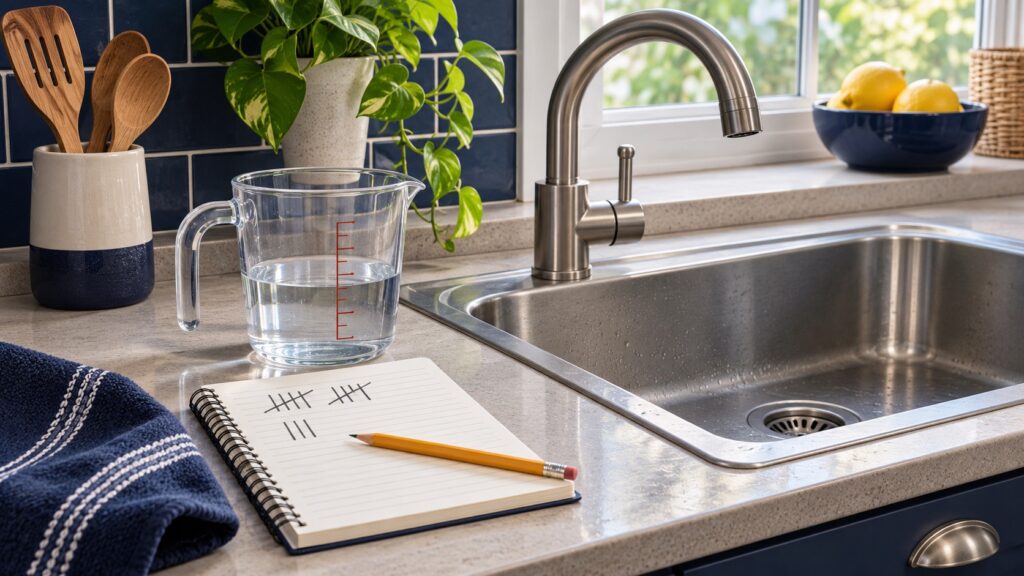
To understand a showerhead or faucet, collect water safely in a graduated container for a measured interval and divide the collected litres by the minutes. Avoid hot water that could scald or a setup likely to splash onto electrical equipment. Use the setting normally chosen by the household; maximum flow may not represent an ordinary shower. Hydro-Québec's hot-water calculator helps explore how flow and duration affect hot-water use. It notes that its calculations are approximate. It does not directly measure your plumbing or your municipal water bill.
Keep a simple record: the issue, the action, the date and one indicator you can revisit. This might be a meter reading, shower duration, measured fixture flow or appliance cycle count. Check again after a few weeks under reasonably similar conditions. Note a new family member, an unusually hot week or a change in work-from-home routine. A confirmed repair and a measured drop in fixture flow are more informative than an unverified claim of annual savings.
Showers: balance flow, time and comfort
Shower water use is a combination of flow and time. Learn the household's usual pattern, then choose a shorter routine that people can actually keep. Having towels and toiletries ready before opening the water helps. Turning water off while soaping can be useful if the mixer returns reliably to a safe temperature. Avoid leaving it running while doing another task. A longer shower may be necessary for health or accessibility; if so, look for opportunities elsewhere instead of making hygiene difficult.
A lower-flow showerhead can reduce the water used for the same shower duration if it suits the fixture and the people using it. Read the flow rating and manufacturer instructions, and check the connection before buying. WaterSense certification, when present on a suitable model, is a useful product signal; verify the actual model rather than assuming any similar-looking head is certified. Extremely low flow that makes rinsing take much longer may be a poor practical choice. The separate guide to replacing a showerhead without harming the connection covers installation. Here the priority is choosing a suitable product and checking its effect in use.
Baths serve different needs, and their water volume depends on the tub and how far it is filled. A shower is not automatically the lower-water choice if it runs for a long time at high flow. Measure a representative shower and compare it with your usual bath level before making a claim. Hydro-Québec points out that a shorter shower also means less replacement water to heat. Do not casually lower water-heater temperature as a water-saving tactic: safe temperature guidance and the setup of the system matter. This article concerns water volume, not a universal heater adjustment.
Turn off the faucet while brushing teeth, shaving or applying soap when the task allows. A cup for rinsing or a small amount of water in the basin may replace a continuous stream. Repeated across a household, an easy habit can be more durable than a complicated rule. Keep proper handwashing and food hygiene intact. A practical reduction is one that fits people's daily needs and does not encourage unsafe shortcuts.
Kitchen work and dishwashing
In the kitchen, water often runs while hands are doing something else. Scrape food scraps with a spatula or brush when appropriate, then wash or rinse as actually needed. For a small task, a container of water may be enough. For dishes, compare your own handwashing method and dishwasher use rather than assuming either is always better. Load size, program, machine design and the amount of pre-rinsing all affect the result. A habit that requires washing everything a second time is unlikely to help.
Run the dishwasher with an appropriate load so you avoid unnecessary cycles, while leaving enough space for water to circulate. Consult its manual for the economy program and whether pre-rinsing is needed. The Quebec government recommends filling the dishwasher before starting it. If dishes will sit for a while, scraping them may be more useful than holding each under a running tap. Follow the manufacturer's instructions and basic hygiene; do not overload the machine to chase a hypothetical saving.
When washing produce, use a suitable amount of clean water in a bowl when the food and preparation method permit. Do not reuse dirty water on ready-to-eat food. Keeping a pitcher of drinking water in the refrigerator can avoid running the tap solely to cool it. If your water supplier or public-health authority instructs residents to flush taps or treat water, follow that guidance first. Boil-water and do-not-consume advisories take precedence over general conservation tips.
A faucet aerator may make sense when it is compatible and the current flow is greater than the task needs. Check the thread, size, condition and cleaning instructions. Do not force a seized part or modify a specialized faucet without its manual. A sudden drop in flow might indicate a clogged aerator, a supply issue or mineral buildup; it is not evidence of improved efficiency. Restoring normal operation is a different goal from reducing unnecessary water use.
Laundry and other appliances
A washing machine's water use depends on its design, selected program and load. Wait for an appropriate load when fabrics allow, but respect the capacity limit. Match the program to the fabric and soil level. Overloading can leave clothes inadequately washed and lead to another cycle. Load-sensing and economy settings vary between models; the manual is more reliable than a single rule for every machine. A small household and a large family will also have different reasonable laundry patterns.
Check visible hose connections and the floor around the washer. A small leak during a cycle is both a water-use issue and a property concern even when the machine otherwise works. Stop using it and close the supply if a hose is damaged or water accumulates, provided you can do so safely. Do not move a heavy plugged-in appliance alone to reach a hidden area, and never open an electrical panel to conduct a water check. Have the source evaluated instead of assuming a new appliance is the answer.
When an appliance is nearing the end of its useful life, compare stated water use for models that fit your household. Make sure an efficiency label applies to the specific product and measure you are comparing. Replacing a working machine early involves purchase cost and materials, so there is no universal payback period. First use the existing equipment well and repair leaks; include water efficiency when a replacement is already warranted. The best decision may differ greatly between a home that runs one load a week and one that runs several.
Toilets: fix the leak before shopping
Toilets are used every day, and a leak may be unnoticed for a long time. A lower-consumption or WaterSense-certified toilet can be worth considering during a replacement, but check dimensions, flushing performance, drain compatibility and installation requirements. Quebec's public guidance presents example savings for certain replacement scenarios. They are examples, not a guarantee for your home. Read the existing tank or product documentation for its stated flush volume, then consider how often the fixture is used and whether its mechanism is sound.
Repair a known leak before treating a purchase as the solution. A new bowl attached to a faulty supply connection does not correct that connection. Improvised objects placed in a tank may interfere with the flush or damage parts; follow the manufacturer's instructions. If the toilet frequently clogs or has a weak flush, diagnose that problem separately. Limiting water should not make a sanitation fixture unreliable or lead to repeated flushing.
After repair, watch several ordinary cycles. Does filling stop, is water still entering the bowl, and does the floor remain dry? If the weak flush or leak returns, revisit the cause. A compatible, properly adjusted part has more value than ignoring a constant trickling sound. Simple observations also give a plumber useful details when the problem lies beyond safe homeowner checks.
Outdoor use depends on weather and local rules
Outdoor watering can raise demand in summer, but soil, plants and weather change what is needed. Apply water close to the soil, avoid windy conditions and check whether it soaks in instead of running across pavement. A broom often replaces a hose for cleaning a hard surface. Rainwater collected for plants can reduce the need for treated water when the system is set up and used appropriately. Collected rainwater is not automatically safe to drink or connect to indoor drinking-water plumbing.
Check your municipality's current notices and bylaws before choosing a watering hour or filling a pool. Quebec's household guide recommends consulting local rules and reducing evaporation, but a permitted schedule in one municipality does not apply to another. Restrictions can also change during dry weather or water-system work. Keep the correct municipal page bookmarked instead of relying on an undated neighbourhood post.
Inspect hose connections, outdoor taps and visible irrigation fittings when putting them into use. An area that stays wet or a flow that does not stop warrants leak investigation. Do not make a direct connection between a non-potable source and a drinking-water system. Backflow protection and connection rules depend on the installation and jurisdiction. If you are considering a plumbing modification, get qualified advice for that project instead of following a generic diagram online.
Make a household plan people can maintain
This week, look for accessible leaks and choose one easy habit everyone understands. Next, measure a frequent use: shower time, showerhead flow or the number of laundry cycles. Consider a fixture upgrade only after checking its condition, compatibility and actual use. This flexible sequence keeps you from buying an accessory while a toilet continues to run. It also gives you a way to see whether the action helped.
Give each action an owner and a simple check. One person might time a representative shower; another may check that dishwasher loads are appropriate; the person handling maintenance can observe the repaired toilet. A short conversation is more useful than a list of rules nobody can follow. Children can learn to turn off a tap, while an adult remains responsible for leaks, hot water and plumbing connections. Allow for the household's health and accessibility needs.
Review the plan after a seasonal change, a move, an appliance replacement or a change in household size. A higher reading may reflect extra watering or guests; a lower one may reflect an absence. If a meter still shows unexplained flow, dampness keeps returning or a shutoff valve fails, the next step is diagnosis rather than another shower rule. If the issue goes beyond safe observation, contact ProDrain to describe what you have seen and request an appropriate assessment.
More topics are available under Maintenance, prevention and water damage.
Frequently asked questions
What should I do first to use less water at home?
Look for water flowing when nobody needs it, especially a running toilet, dripping tap or damp connection. Then target frequent uses you can measure, such as showers and appliance cycles. The right order depends on your home. Buying a new fixture is rarely the first priority while a leak remains active.
How can I check for a silent toilet leak?
Watch the bowl after the tank finishes filling. The Government of Quebec also describes adding food colouring to the tank to see whether colour reaches the bowl without flushing. Follow its instructions and identify the faulty part if water continues to pass. This check does not establish that every other pipe is leak-free.
Can I measure progress without my own water meter?
You can track shower duration, appliance cycles and measured faucet flow. Ask your landlord, condominium association or municipality what data is available for your unit. Without comparable whole-home readings, avoid attributing an exact number of litres or dollars to one habit change.
Is a shower always more water-efficient than a bath?
No. Shower volume depends on flow and duration; bath volume depends on the tub and fill level. Measure a representative shower and compare it with your usual bath. Health, accessibility and safety needs remain part of the decision. A very long shower can use substantial water.
Should I replace every tap and appliance now?
No. Fix leaks, use existing equipment properly and review its actual specifications first. When replacement is already justified, compare water-use information and compatibility. Household use, product condition and purchase cost make a single payback promise unreliable.
Can I freely connect a rain barrel to household plumbing?
No. Rainwater collected for plants is not automatically drinking water. Connecting it indoors raises water-quality, backflow and local-rule questions. Do not attach an improvised tank to drinking-water lines; have the proposed system and applicable requirements checked.
When is a plumber needed?
Request an assessment for a recurring leak, unexplained meter movement, a toilet that will not stop running, or a faulty connection or shutoff valve. If water reaches electrical equipment or an active leak threatens property, get people to safety first and shut off water only when access is safe.