Pipes and water supply
Plumbing pipe materials: uses, benefits and limits
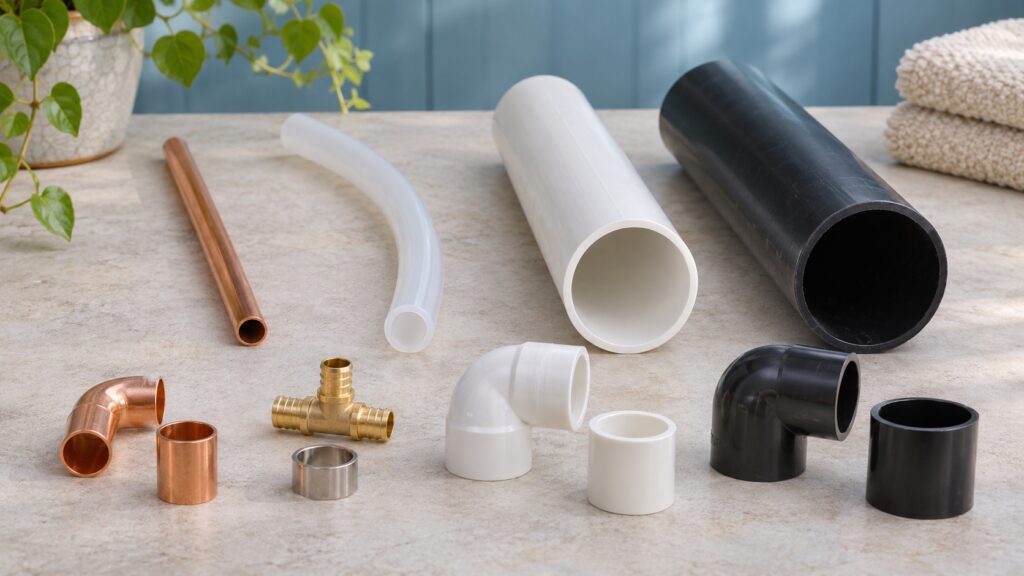
Choose a pipe by the job it must do before comparing materials. A line carrying drinking water under pressure has different requirements from a pipe draining wastewater by gravity or a pipe venting that drainage system. Copper and approved PEX systems are among the choices for domestic water supply. ABS and PVC systems are familiar choices for drain, waste and vent work. Other approved products may suit particular applications. A material name alone cannot establish that a particular tube and fitting are suitable. The product marking, certification, service conditions, connections and applicable Québec rules all matter.
This guide helps you interpret visible plumbing and prepare a repair or renovation discussion. It cannot certify concealed pipe or tell you how to join products from a photograph. If water is escaping quickly, sewage is backing up, or water is near electrical equipment, move people away from the hazard first. Close an accessible water shutoff only when it is safe to reach. Never enter water near electrical equipment or take apart a pressurized joint to identify it. Address the active problem before comparing pipe options.
Start with what the piping carries
Water supply piping brings cold or hot water to fixtures. It is commonly under pressure even while the tap is closed. The pipe and every component in contact with water intended for drinking must be appropriate for that service. Drainage piping carries used water away from fixtures. Its layout, slope and venting are part of its performance. The venting system helps maintain conditions that allow traps and drains to function. Two pipes made of plastic, or installed close together in the same wall, are not therefore interchangeable.
Québec’s Régie du bâtiment (RBQ) explains that Chapter III, Plumbing, of the Construction Code governs plumbing installations. The version based on the 2020 National Plumbing Code came into force in 2024. Its requirements concern complete systems rather than the colour of a tube. The RBQ’s current regulatory overview is a useful starting point; the details of an individual project need a qualified assessment. The National Research Council’s 2020 Plumbing Code overview explains that the code covers new systems and work on existing ones. Do not assume that a rule recalled from another province applies unchanged in Québec.
What a look under the sink can tell you
The small lines leading toward the tap and shutoff valves generally belong to the water supply. The larger pipe leaving the trap is associated with drainage. Following the direction of flow helps you ask a better question, but it does not reveal everything behind a cabinet or wall. Concealed branches, vent connections, past repairs and transitions to other materials may be out of sight. A flexible connector at the fixture may not match the material of the branch in the wall. Take a wide photo and a close photo of any legible printing before describing the installation. Avoid claiming that the entire home uses the material visible in one cabinet.
Identify the material without relying on colour
A copper-coloured tube may point toward copper. A flexible white, red or blue tube may suggest a member of the PEX family. A rigid black drain pipe may suggest ABS and a white one PVC. These are clues, not proof of composition, rating, approval or use. Manufacturers use different colours, and paint, dust, age and lighting can change what you see. A fitting may be made of something other than the tube next to it. Buying a replacement part or choosing a solvent on colour alone is an avoidable mistake.
Look for accessible print lines without scraping or disturbing the pipe. Record the manufacturer, material designation, nominal size, standard, certification mark and service markings where legible. Printing may repeat along a run, so a second visible spot may help. Note the room, the fixture served and where the line appears to go. If the marking is hidden or worn, say that it is unknown. A qualified plumber can compare the marking with the location and connections, then decide whether further inspection is needed. Do not remove suspect insulation or cut a line merely to identify it.
Even clear printing on one piece cannot prove the compatibility of every fitting, the condition inside the pipe, or the approval of an older repair. A short visible length may be new while the upstream branch is older. Several materials can coexist after successive renovations. If the concern is a leak or pressure change, the material is one part of the investigation rather than a diagnosis. Our separate guide on pipe condition and replacement decisions discusses what to assess over time. Here the focus is where materials belong and what limits their use.
Copper for water supply
Copper has long been used for water supply where the particular tube, fittings and installation match the application. Its rigidity can suit visible straight runs. Products come in different forms and sizes, and more than one approved joining method exists. Seeing copper does not tell you how an existing joint was made or how a new one should be made. When a renovation meets an existing copper branch, a copper replacement may be a sensible option if the route, access, approved components and water conditions support it. The choice is specific to the system, not a blanket preference.
Copper also has practical constraints. A complicated route may require changes of direction and more fittings. Water chemistry, neighbouring materials and the environment can affect corrosion. A stain on the outside does not measure remaining wall thickness. A line exposed in a cold area still needs attention to freeze risk. Connections to other metals and materials need properly selected components. Copper’s reputation does not replace checks on supports, protection, accessible shutoffs and the rest of the installation.
If you see green or white deposits, a wet joint or a pitted surface, record where the sign appears and whether it is changing. Do not scrub a questionable joint aggressively or tighten it at random. Moisture may be from an active leak, an old repair, condensation or another source. The sign alone cannot tell you which. For an active leak, limit the damage safely and have the joint and adjacent pipe examined before deciding whether a local repair is enough.
PEX: flexible tubing within a defined system
Cross-linked polyethylene, usually called PEX, is a family of tubing used in approved water supply systems. Its flexibility may allow some routes to be made with fewer direction changes. That advantage does not make all PEX tubes or connections interchangeable. Products, fittings and joining methods differ. An Uponor design and installation manual is an example of manufacturer guidance. It discusses fittings, service temperature and pressure, UV exposure and support for its system. It is not an endorsement of the brand, and its instructions cannot be applied automatically to another product.
Evaluate the tube together with the exact fittings, joining system and location. A fitting that appears to fit inside the tube is not necessarily approved. Neither are parts from different brands or product generations necessarily compatible. Heat, exposure to sunlight before installation, nearby chemicals and passages through building assemblies can affect the specification. Flexible tubing still requires suitable support and protection. A plumber should verify all the components when a new branch connects to existing work, especially where the joint will later be concealed.
Read the markings, not just the colour
Red and blue PEX may serve as convenient hot and cold identifiers in a particular system, but colour does not prove the tube’s temperature limit, potable-water certification or fitness for a specific fixture. White PEX can also serve supply applications when its markings and approval support them. Read the actual product information. If a line is already installed and its origin is unclear, preserve the visible printing before buying a fitting. Avoid an improvised joint behind a wall that will become inaccessible after the finish is replaced.
PEX and copper are therefore not competing answers to every plumbing question. They address water supply under conditions defined by the products and code. Neither is a substitute for a drain or vent merely because the diameter looks convenient. In a renovation, the correct transition to an older branch matters at least as much as the new run. Ask for the full proposed system, including valves, fittings and protection, rather than asking only whether the new tube is copper or PEX.
PVC and ABS for drain, waste and vent systems
PVC and ABS are families of rigid plastics offered in complete drain, waste and vent systems. In a home, a larger pipe connected to a trap may suggest drainage, but its print line and actual route remain important. Drainage performance depends on slope, sizing, direction changes, venting, support and correct connections. A drain pipe does not become a pressurized drinking-water pipe because it is clean or recently installed. Nor does every product labelled PVC share the same certification and purpose.
These plastic systems offer product families of pipes and fittings for defined drainage uses, without metallic corrosion of the plastic itself. Their limitations include service temperature, movement, protection and joining compatibility. The IPEX drainage systems guide addresses visual identification, expansion, support and assembly for its products. Its level of detail shows why an installer checks a system rather than just a material label; it does not license applying that manufacturer’s method to every brand. A repeatedly clogged drain calls for assessment of the cause and layout, rather than an automatic switch from one plastic to another.
Transitions between ABS and PVC deserve particular care. Their solvents, fittings and approvals cannot be selected by intuition. The accepted transition depends on the exact products, location, applicable rules and manufacturer directions. Do not glue two pieces together because their outside diameters look similar. Verify the real systems before modifying them instead of assuming that similar-looking pipes join in the same way.
A white pipe is not necessarily a PVC drain
White can also appear on products designed for other uses. Certain PVC or chlorinated PVC, often called CPVC, systems are designed for potable-water distribution with their own certifications and components. Others are not. The IPEX AquaRise product instructions illustrate a specific CPVC potable-water system with its own fittings and installation requirements. That example does not mean any white pipe or any CPVC pipe suits a home water supply. It reinforces why the exact product and application matter more than appearance.
Materials you may find in existing buildings
An existing home may also contain galvanized steel, cast iron or other materials, depending on when different branches were installed. Galvanized steel may appear in older supply systems, while cast iron may appear in drainage. Their presence does not automatically require replacement of an entire home, and it does not justify extending a branch with a part chosen by visual similarity. The actual condition, use, connections and project requirements need assessment. Paint or a covering can hide the surface. Newer branches often coexist with older work, making a whole-home label misleading.
Internal roughness, corrosion, joints and access can make a small local repair less attractive than it first appears, even when the outside looks sound. Conversely, an old-looking pipe alone is not a complete case for extensive replacement. Ask which materials were observed and which remain assumptions behind walls. A plumber can explain whether the observed problem concerns one connection, one branch or a broader system, and how uncertainty affects the work. This is more useful than a quote that treats a concealed run as fully known.
Some products may have served different purposes under different editions of codes or in different locations. Identifying an old product is not the same as approving it for a new installation. Keep a record of what is visible, including any print lines, and have the proposed repair assessed under the current Québec requirements. If a product has no readable marking, do not assume it is the modern version that looks similar. Avoid disturbing unknown coatings or insulation during a casual inspection.
Potable water: check the complete product
Safety for drinking-water supply depends on more than calling a material copper, PEX or plastic. The pipe, fittings, valves and other parts contacting drinking water must meet the applicable requirements for the application. Health Canada explains how contact materials can affect water quality and describes health standards such as NSF/ANSI 61 and the role of accredited certification bodies. This is a public-health framework, not a certification for a specific item on a store shelf or in your wall.
Check the exact product’s certification mark and technical information with the manufacturer or certification body, alongside Québec’s requirements for approved plumbing products. A vague advertisement, colour or reference to a standard is not enough. Confirm suitability for hot water, pressure and installation conditions as well. If the existing line’s printing is unreadable, identify that gap when requesting an assessment. A drainage fitting of similar diameter cannot stand in for an approved potable-water fitting.
Material selection also cannot solve every water-quality concern. A product may be approved for contact with potable water while an existing branch has other issues related to stagnation, cross-connections or conditions outside the component. Likewise, a visible plastic line tells you nothing about the water quality at the tap. Keep the question precise: is this particular product approved for this function, and does the proposed system protect the water as required? A qualified assessment may involve more than replacing the most visible pipe.
Repair a section or replace a branch?
A leak at one joint can look simple, but the right scope depends on the condition of the neighbouring pipe, access and underlying cause. A targeted repair on a sound branch differs from repeated leaks, a poor layout or an older transition whose components cannot be verified. Ask whether the proposed work addresses only the observed point, whether walls must be opened, and which portions will remain unknown. A new section may use another approved material if the transition is designed for both systems and the application. That is a system decision, not a matter of finding two parts that seem to mate.
For a renovation, document the sequence of visible materials from an accessible shutoff toward the fixture. For a drain, trace from the trap toward the larger branch as far as access allows. Photos before a wall is closed and records of the products used can help future repairs. Think also about access to valves, supports, penetrations, movement and other work near the plumbing. A proposal should identify its boundary: a short section, a branch, or multiple rooms. Without that boundary, two quotes that name different materials may not be quoting the same work.
Do not replace piping solely because a generic chart names a service life. Water, installation, connections and exposure vary. On the other hand, do not postpone an active leak because a material has a reputation for durability. Our pipe lifespan and replacement guide discusses condition-based clues. For this material comparison, the more useful question is whether the proposed system performs the required function and connects properly to the installation that actually exists.
Compare proposals on the same basis
For a water supply line, ask which exact pipe and fittings are proposed, how potable-water approval is checked, how the system joins the existing branch and what installation limits apply. For drainage, ask how route, slope, venting, support and transitions will be handled. Comparing copper with PEX will not choose a drain. Comparing ABS with PVC will not explain your water quality. Keep the function clear when discussing alternatives.
Accessibility after the work also matters. A concealed joint can be harder to inspect than one in a cabinet, without the material itself being defective. Finishes, insulation, structure and other services can change the work required. A useful quote should specify what it includes, which openings are anticipated, which products are proposed, what is still hidden and how the installation will be checked before it is closed. More than one compliant solution may be possible. Ask why a choice fits your site instead of accepting a universal claim that one pipe is always best.
Cost follows the scope, access, length, number of connections, finishes and site conditions, not just the store price per metre of tubing. A price range without an inspection or defined scope can be misleading. If comparing bids, note whether each includes opening and restoring surfaces, handling old connections and documenting the final products. The least expensive tube is not automatically the most suitable system; a more expensive material alone does not guarantee a better installation.
Prepare for a qualified Québec assessment
Gather photos of accessible pipes and markings, the location of leaks or backups, any known renovation dates and available product records. Describe the suspected purpose of a line as an observation, not a certainty. Note whether a problem occurs when a tap runs, when a fixture drains, or continuously. Those details can help distinguish supply and drainage, but they do not prove the cause. If you rent or live in a condominium, inform the responsible owner or association before authorizing work on a shared element.
The RBQ says plumbing work in Québec requires an appropriate licence and explains the CMMTQ’s role in qualifying plumbing contractors. Verify the licence and scope for the proposed work. This article does not assign a licence, technique or guarantee to ProDrain. Ask specific questions: Which system will be changed? What exact products and connections are proposed? How will compatibility be documented? What hidden conditions could change the scope? What checks occur before a wall is closed? An answer that separates observed facts from uncertainty is more valuable than a material recommendation based on a single photo.
If you want to discuss a repair or project, contact ProDrain with those observations. More related guides are collected under Pipes and water supply.
Frequently asked questions
Is copper always better than PEX?
No. Either may be suitable for an approved water supply application with the right product and fittings. Route, water conditions, access, transitions and installation method all affect the decision. Ask for a comparison based on your actual system rather than a universal ranking.
Does white pipe always mean PVC drainage pipe?
No. Several product families can be white. Some are designed for potable water, others for drainage or other applications. Read the markings and certification and confirm what the line serves. Colour alone is not a basis for buying a fitting or choosing a joining method.
Is red PEX always for hot water?
No. Colour may be a convenient identifier in some systems, but it does not establish a tube’s temperature limits, potable-water approval or suitability for a particular fixture. Check the exact pipe marking, its documentation and the compatible fittings.
Can ABS and PVC be connected directly?
A transition may be possible with products and methods approved for the particular location and systems. Never assume that a solvent or same-size coupling is suitable. Have the actual products, applicable rules and manufacturer instructions checked before a modification.
Assessing replacement and product approval
Does one leaking section mean every pipe must be replaced?
Not necessarily. A local leak can have a limited cause. Repeated leaks or a degraded system may justify a broader scope. The accessible condition, history and hidden constraints guide the choice. One photo of a joint cannot decide a whole-home renovation.
How do I know whether a pipe is approved for drinking water?
Identify the exact product, its certification markings and technical documentation, including the fittings. A broad claim such as plastic or lead-free is not a complete approval. A qualified plumber can check the application against current Québec requirements.
Can a drain and a supply line use the same plastic?
A broad polymer name does not answer that question. Related products can have quite different certifications and applications. Verify the complete system. Do not reuse drainage pipe for potable water or the reverse simply because the pieces resemble each other.
What photos help when requesting a quote?
Take an overall view, the accessible route, legible markings, fittings, the wet area or other symptom, and access to shutoffs. Do not open a wall or dismantle a joint just to obtain a photo. Say what remains hidden and when the problem appears.