
Drains and sewers
Clogged shower drain: safe checks and when to stop DIY
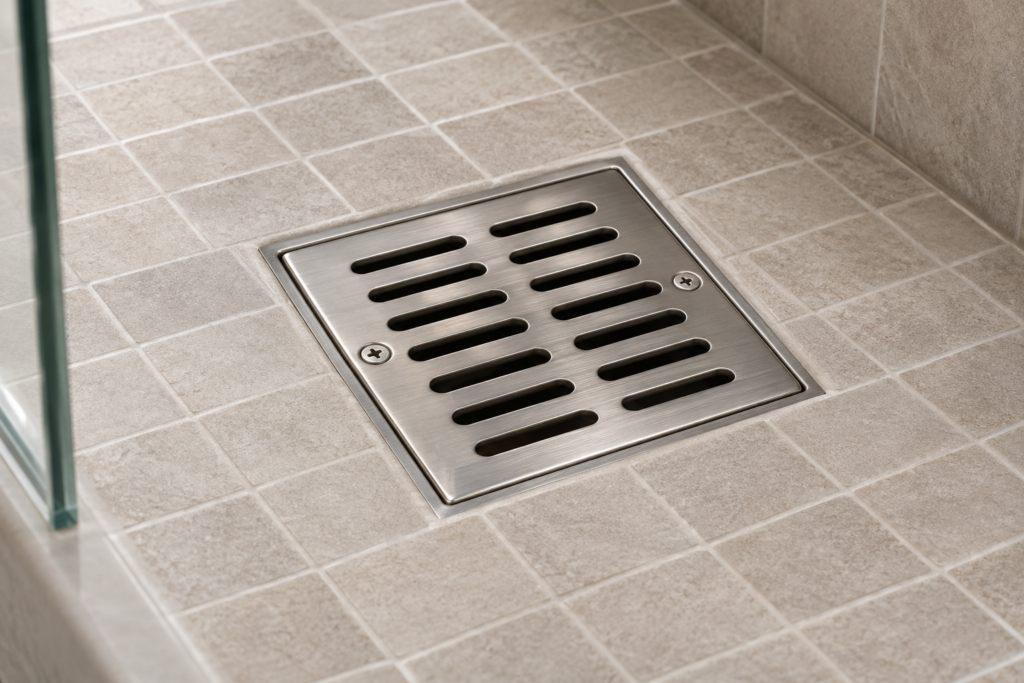
For a clogged shower drain, start by turning off the water and checking what is safely accessible. Hair on a removable strainer may explain slow drainage. Water rising from other fixtures, a leak beneath the shower or a recurring blockage needs a different response. Remove only debris from parts intended for routine care, following the drain manufacturer’s instructions. If flow remains restricted, stop adding cleaners or trying more tools.
This guide helps you decide between sensible surface care and an assessment. It explains how to identify a removable grate, describe the symptoms and recognize when a homeowner check has reached its limit. It cannot identify a hidden pipe defect from one symptom. Instructions for the actual installed drain take priority over a general cleaning procedure.
Clogged shower drain: when to stop using the shower
If wastewater is backing up, stop activities feeding the affected drainage system, including automatic appliances. Keep people away from contaminated water. A leak beneath the shower or into the room below is also a reason to stop using it. Do not keep running water to see whether the problem will clear itself. Stay out of water that could contact electrical equipment.
Water of unknown origin should not be treated as an ordinary shower puddle. Keep children and pets away. Strong fumes after a cleaning product was added require leaving the area and obtaining appropriate guidance. Call emergency services for immediate danger or serious illness. Clearing a blockage is secondary to keeping occupants safe.
A broken grate, a moving frame or a tool already stuck in the opening also changes the decision. Do not stand on the drain to test whether it is secure. Leave the shower unused and describe what happened. Surface cleaning alone may no longer be appropriate when a component has been damaged or displaced.
Is the shower the only fixture draining poorly?
Describe what you have already seen: gradually slower drainage during a shower, water remaining after it stops, or water rising when a washing machine empties. Do not run additional water to recreate a backup. A photograph taken from a dry location can show an existing water level without adding to the problem.
If only the shower appears slow, looking for accessible debris may be reasonable. When several fixtures react together, our guide to telling a local clog from a shared drain problem explains the broader decision. Symptoms guide an assessment; they do not establish the precise location or condition of the pipe.
Record when the change began. A gradual reduction in drainage and a sudden stoppage after an object fell through the opening are different histories. Mention recent renovation, a replacement grate or previous clearing work. These observations are more useful than presenting an unconfirmed diagnosis, such as insisting that the trap must be blocked.
In a multi-unit building, ask the manager whether related symptoms have already been reported. Do not ask neighbours to run fixtures simply to test a theory. A lower shower can receive a backup associated with use elsewhere. That observation does not automatically make the municipal sewer responsible. Coordinated information helps determine the next appropriate assessment.
Understand the parts visible at floor level
The grate is the surface through which water enters the drain. A removable strainer or basket may sit below it. The drain body and connection carry water away, while other components can form part of the waterproofing system. Their functions differ, and they are not all intended to be removed for ordinary cleaning.
Some water visible below the opening does not by itself prove a blockage. Depending on the arrangement, the trap retains water. Conversely, a clean grate does not establish that the line below is clear. Consider the drainage behaviour you have actually observed, the other fixtures involved and any sign of leakage. Avoid drawing conclusions from a photograph of the opening alone.
Floor slope can also affect where puddles remain. If water sits away from the drain while water at the opening clears, describe those as separate observations. Putting a cable into the pipe does not correct a surface slope. Do not alter grout, tile or seals while searching for an explanation of pooling.
Which part is actually removable?
Identify the drain model and find its care instructions. A screwed grate, lift-out cover and removable hair basket do not all come apart the same way. Remove only components intended for routine maintenance, using the specified tool. Stop if a part resists or its fastening is unclear. Prying against the frame is not a cleaning method.
Schluter’s KERDI-DRAIN instructions illustrate the distinction between a removable grate and a drain connected to waterproofing. This example is specific to that product family. It is not permission to dismantle a similar-looking shower drain. Your own model’s instructions remain the reference for removal and reassembly.
If the instructions are missing, check renovation records, invoices or information left by the installer. Photographs of the grate, fasteners and visible markings may help the manufacturer identify it. You do not need to pry up a cover to search for a hidden number. Matching a picture found online is not enough to confirm the model.
Prepare for surface care
Work only where access is stable and safe and no drain-cleaning chemical has already been added. Have a container for small parts, a bag for hair and appropriate protection against dirty material. Keep loose tools out of the opening. Dropping a screw into the drain can turn simple cleaning into a retrieval problem.
Photograph the permitted removable component before taking it out. Keep its screws and accessories together. Do not loosen a ring or flange merely because it becomes visible below the grate. If you find a broken part, missing fastener or arrangement that differs from the instructions, stop and seek advice before continuing.
Remove accessible hair without pushing it deeper
Where conditions are safe, collect visible hair from the grate or designated removable strainer. Put it in the garbage rather than pushing it into the pipe. Clean and refit the removable components as directed. Leave the drain body, seals and parts integrated into the floor undisturbed. The goal is limited maintenance, not opening the whole assembly.
Remove only what can be reached without force. A clump may be caught around an internal component that you cannot see. If pulling produces unusual resistance, do not keep tugging to gain another few centimetres. You may not know what is holding the debris. A professional can select an appropriate access when surface retrieval is insufficient.
Clean the removed grate and basket only as their manufacturer permits. A stiff brush or incompatible product can damage a finish. Do not scrape deposits with a blade against a seal or finished surface. Instead, use the opportunity to photograph any crack, distortion or other visible damage that may need attention.
During reassembly, confirm that the pieces return to their normal position and remain stable. Do not add adhesive or sealant to compensate for a part that no longer sits properly. If you cannot refit the grate as intended, leave the shower unused. An uncertain fastening is a reason for a check before ordinary use resumes.
Is a manual tool suitable for this drain?
A small hair-retrieval strip is not the same as a cable drain snake. Compatibility with the opening, internal components and materials must be clear before anything is inserted. Do not use an improvised metal coat hanger to scrape a finish or fish blindly for an object. Stop if a tool catches, and do not keep twisting it.
The RIDGID POWER SPIN+ manual (multilingual PDF) describes application limits and cable hazards. A tool marketed for certain drains does not automatically suit your installation. Access size, internal components and pipe condition matter. This guide does not provide a powered drain-cleaning procedure or imply that ProDrain uses a particular product.
Do not improvise with a drill, electrical equipment in a wet area or a pressurized flushing arrangement. Plunging is not an automatic next step either. It can cause splashing and should not agitate water containing drain cleaner. A list of possible techniques does not establish which approach is safe for a particular shower.
If an object fell through the opening, describe it and when the incident occurred. A ring, bottle cap and screw may require different retrieval decisions. Do not add water to move the object farther along. Mention whether an attempt displaced it or left a tool stuck in the drain. This information changes preparation for the visit.
What if a drain cleaner has already been added?
Do not add another preparation, including one described as natural. Do not try to neutralize a cleaner with vinegar or another product. Health Canada advises never mixing household chemical products and following their labels. Keep the container so the product can be identified accurately.
Avoid handling the drain contents or inserting a tool until the product-specific precautions are understood. Tell the plumber the name, approximate amount and time of use. A lack of smell does not establish that the chemical has disappeared. For an exposure, follow the first-aid information and contact a poison centre for guidance.
Do not pour boiling water down the opening to force it clear. Compatibility involves the drain, seals, finish and shower base as well as the pipe. Schluter specifies neutral cleaning products for its grates and excludes abrasive tools and certain acidic or alkaline cleaners. Follow the instructions for your own installation rather than a universal recipe.
How can you tell whether cleaning helped?
A limited check is appropriate only after correct reassembly, with no unknown chemical present, no leak and no indication of a shared backup. Follow the manufacturer’s checking instructions and remain present. Stop immediately if the level rises. Do not leave the tap running while you go elsewhere to see whether the drain eventually catches up.
Compare the result with the starting condition. Is the visible hair gone? Does water leave without unusual accumulation? Is a leak visible around the installation or reported below it? Record what happened without treating one satisfactory check as a certification of the entire drainage system. Improved flow is useful evidence, with limits.
If slow drainage returns after a few uses, keep that information. Recurrence can justify an assessment even when the shower eventually empties. Repeating the same treatment every day adds little useful information. The time before symptoms return, and what was actually removed, can help prepare a more targeted next step.
When should you request a professional assessment?
Ask for help if water remains blocked, symptoms recur after accessible hair removal or the required access goes beyond routine care. To prepare for professional drain cleaning, describe affected fixtures, recent work and previous attempts. A photograph of the grate and the drain model can help clarify what access may be available.
Ask which section will be assessed, how it can be reached and what would justify further investigation. A camera is not automatically necessary for every collection of hair. Equally, restored flow may not resolve a recurring issue. The recommendation should follow the observed problem rather than assume a method before the installation has been assessed.
Prepare for the visit without further dismantling
Clear the route to the shower and move personal belongings away from the work area. Mention a fragile door, unusual grate or access located in another room. In a condominium, coordinate access with the manager. Do not open a ceiling or remove a shower base in anticipation of a repair that has not been established.
A short factual message is helpful: “The shower has drained slowly for several days. I have not noticed changes at the other fixtures. I removed hair from the permitted basket, but the problem returned. No cleaner was added.” Adapt every part to the actual situation. Accurate observations are more useful than a technical explanation presented as certain.
Clarify travel charges, the planned assessment and how additional work will be authorized. Ask how clearing, replacing a component and repairing a pipe would be distinguished. Keep the observations and recommendations you receive. There is no universal price that can be inferred from the phrase “clogged shower drain” without considering access and the actual work required.
Reduce hair buildup without a universal cleaning schedule
Use a compatible strainer that passes water without displacing drain components. Remove hair as it collects and clean accessible parts according to their instructions. An accessory placed over a grate should not become an obstruction itself. Check that it sits correctly after cleaning instead of stacking several filters over the opening.
Base attention on what you observe. A frequently used shower may collect hair faster than an occasional-use shower. That does not create a mandatory professional cleaning interval. Our guide to drain maintenance based on observed problems explains planning beyond the shower grate without prescribing the same intervention for every household.
Keep a simple record of cleaning, the result and any return of symptoms. Where several people use the shower, explain where removed hair goes and whom to tell if drainage changes. An easy routine is more useful than a succession of cleaners whose history no one can reconstruct when help is needed.
Three situations and a sensible next step
Hair covers only the removable basket. If the instructions permit removal, no cleaner has been added and no urgent warning is present, accessible cleaning may be reasonable. Refit the components properly and observe the result. Cleaning the basket does not require dismantling the drain connection or disturbing waterproofing below it.
The grate is clean, but slow drainage returns. Keep the cleaning date and the time before symptoms reappeared. A quick recurrence mainly tells you that surface care was insufficient. Request an assessment with those details. It does not establish that the pipe has collapsed, or that excavation or replacement will be necessary.
Water rises while the shower is not running. Stop activities feeding the affected area and notify the other occupants. This goes beyond collecting visible hair. In a building, contact the responsible manager promptly to coordinate the response. Do not force a heavy object into the opening to contain pressure from an unknown source.
These examples describe decisions, not diagnoses. Similar surface symptoms can accompany different causes. Your useful role is to recognize a limit, retain observations and avoid adding water or damaging a component through another experiment. The professional can then explain the findings and options that fit what is actually observed.
Clogged shower drain questions
Why does the shower eventually empty after a long wait?
A restricted passage is possible, but the delay does not identify the cause. Record recurrence, affected fixtures and the effect of accessible care. If accumulation returns, have the drainage assessed rather than accepting a shower that regularly fills with standing water.
Does a clean grate rule out a blockage?
No. The grate is only the visible part. A problem may remain farther along or involve a shared line. A clean grate with poor drainage mainly indicates that surface cleaning was insufficient. Choose the next step from observed symptoms rather than the appearance of the cover.
Can I remove every visible screw?
No. Identify the fasteners intended for grate removal in the model’s instructions. Other parts may belong to the connection or waterproofing assembly. Resistance, a moving frame or an arrangement you do not understand is a reason to stop and seek advice.
Does recurring blockage mean the drain needs replacement?
Not necessarily. Recurrence warrants finding the cause, but it does not prove that replacement is needed. Ask what was found, where the problem is and why the proposed solution fits. Explore related guides in Drains and sewers.