
Drains and sewers
Slow draining bathtub: causes and useful checks
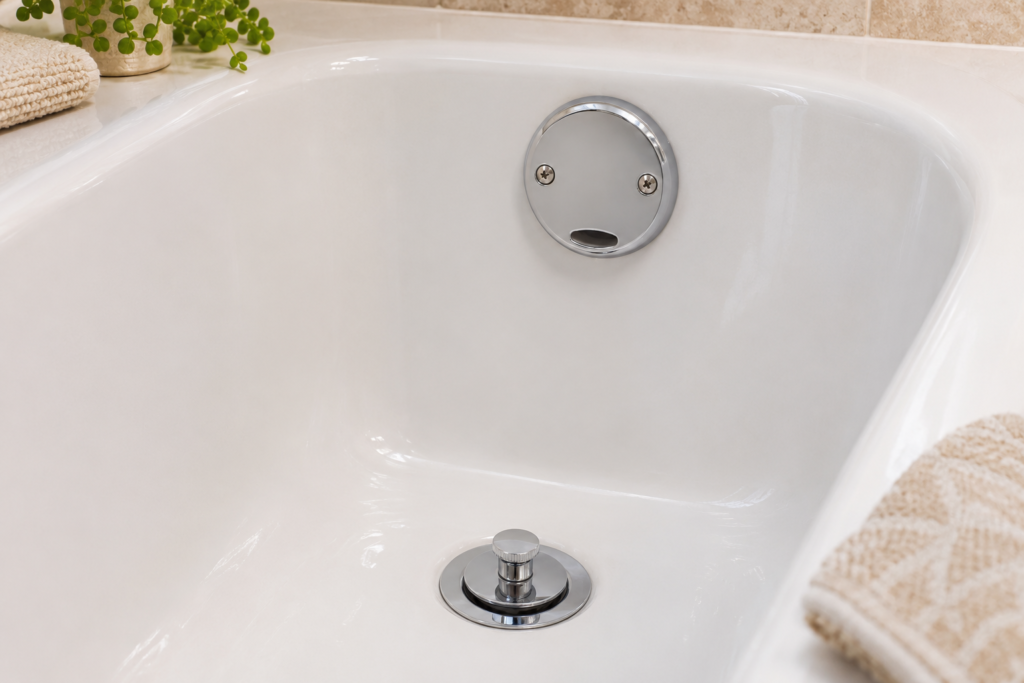
A slow-draining bathtub does not necessarily need a drain opener. The stopper may sit too close to the opening, hair may hold water around the drain, or a restriction may lie farther along the pipe. Start by separating the waste fitting’s operation from the condition of the drain line, without dismantling the assembly beneath the tub.
If water leaks beneath the bath or sewage backs up, stop the affected uses. Do not refill the tub to recreate the problem, and keep people away from contaminated water. If someone has already added a chemical, keep its container and pause hands-on work until its handling precautions are known.
Does the control actually open the stopper?
The control may be on the stopper itself or on the overflow plate. Identify the waste fitting’s brand and model, which may differ from the faucet’s. Check its instructions before deciding that a part should lift, turn or unscrew.
- A lift-and-turn stopper has its control at the bottom of the bath.
- With a push-operated mechanism, pressing changes its position.
- A lever or knob at the overflow may operate a component farther away.
Gerber’s bath drain guide includes designs with a plunger inside the overflow pipe and others with a cable. A visible opening at the bottom therefore does not prove that the entire mechanism is clear. Observe only the movement described in the instructions. Do not force a stiff control or adjust unfamiliar linkage.
A recently replaced stopper or a control that no longer holds its position is useful information. A bath that loses water with its stopper closed has a different water-retention problem from a tub that empties slowly. Be clear about which behaviour you have noticed.
Cleaning a stopper is not unscrewing the drain flange
With the tub empty and no hazardous cleaner present, look for accessible hair and deposits around the stopper. Remove visible debris without pushing it into the pipe. Only remove a component if the instructions for that model identify it as removable for maintenance; looking like a part in a video is not enough.
Keep small parts away from the opening and clean them as directed. Do not loosen the flange attached to the tub to reach more hair. It belongs to the watertight connection, not just the stopper. Stop if a fastener resists, the finish starts to flake or you are unsure how to refit the parts.
A hair-catching accessory must fit the waste assembly without obstructing the stopper’s movement. Do not fish blindly for a lost object with a coat hanger or pull on a trapped tool. Record what fell in and when drainage changed instead.
Why leave the overflow and its seal undisturbed?
The overflow is more than a decorative cover. It forms part of the drainage assembly and may also contain the stopper control. A suitable professional access point depends on that assembly, its internal parts and the connected pipe.
Removing its plate, shifting its gasket or feeding in a cable is not an automatic follow-up to cleaning a stopper. A plumber needs to choose suitable access and check for watertightness after the work. Do not permanently block the overflow to hold more bathwater, either. A generic plunging recipe that involves sealing the overflow does not establish whether that method suits your tub.
Match cleaning to the finish, seals and temperature instructions
A surface that holds bathwater is not automatically approved for a kettle of boiling water. Do not use that as a clearing method. The tub and waste-fitting instructions should govern products and temperatures, rather than a rule based solely on the pipe you can see.
MAAX’s maintenance guidance excludes abrasives and metal brushes on the surfaces it covers. It also separates surface care from whirlpool-system cleaning. A temperature specified for a particular cleaning cycle is not a universal drain-clearing temperature.
A surface cleaner is not automatically suitable inside a drain. Do not add vinegar, bleach or another product to neutralize an opener already used. Health Canada’s household chemical guidance calls for following labels and not mixing products. Give the plumber their names and when they were used.
What remains to assess once the stopper works?
If accessible components are clean and correctly refitted but drainage remains slow, further dismantling does not establish where the fault lies. Explain whether it began before a replacement part was fitted, returns after each cleaning or affects other fixtures too.
Water rising while another fixture empties broadens the assessment to shared drainage, without identifying the precise pipe involved. Read our guide to telling a local clog from a shared drain problem.
When poor drainage persists or extends beyond the tub, professional drain cleaning provides a route to assessing the appropriate next step. Prepare a photo of the stopper and its control, any known model reference and the location of an existing access panel. You do not need to open a wall or cut the bath surround to prepare the request.
Keep the opening clear after cleaning
Remove hair from the stopper or a compatible filter as it collects. Check that the filter does not hold the stopper partly closed. Follow the manufacturer’s precautions for oils, salts and other bath products rather than assuming they suit every finish.
If slow drainage returns, record the use preceding it and the care already performed. Choose drain maintenance based on observed problems instead of routine doses of opener. Find related guides in Drains and sewers.
Describe the slowdown without creating a spill
First, explain what slow means in everyday use. Does water gather around your feet while showering in the bath? Does a filled bath take longer than usual to empty? Is drainage different when the stopper sits in another position? These observations point to different questions. Compare the behaviour with the tub’s usual performance rather than relying on a universal number of minutes that supposedly proves a blockage.
You do not need to fill the bath to collect useful information. If water still drains and there is no leak, backup or hazardous cleaner, simply observe a limited normal use. Stop if the level rises. Stay in the room while water runs. Continuing a test until the bath overflows adds risk without giving better evidence than the slowdown you have already seen.
Remember that a shower installed over the bath usually uses that same outlet. Two slow uses of one tub do not necessarily mean two separate fixtures are affected. A reaction at a sink, toilet or another drain is different information. Report reactions you have already noticed; do not run every appliance at once to test a theory or deliberately recreate a backup.
Four patterns that call for different next steps
Drainage changes with the stopper position
If changing the control noticeably changes the flow, the stopper mechanism deserves attention. That does not establish that the connected pipe is completely clear. A restricted opening and deposits farther downstream can exist together. Describe each observation separately. A replacement sold as universal may have a different height or travel from the original part; confirm its compatibility with the installed waste fitting before buying or adjusting it.
Removing accessible hair gives a lasting improvement
Visible hair removed from an approved maintenance component may account for part of the slowdown. Once the component is correctly refitted, observe the next ordinary uses. If drainage stays satisfactory, accessible care and reasonable monitoring can guide the next decision. Improvement does not justify dismantling more of the fitting just to be certain, or adding preventive drain opener to an outlet that now works.
The improvement is brief or incomplete
A quick return can mean that only the accessible part of a restriction was removed, the mechanism still limits the opening, or another restriction remains downstream. The timing alone cannot distinguish those possibilities. Record how many uses passed before the slowdown returned, what was actually removed and whether the stopper was replaced. That history is more useful than a long sequence of undocumented products and tools.
Water rises when nobody is using the tub
A tub receiving water while another fixture drains presents a different situation from slow emptying after a bath. Stop the affected uses and request assessment. Do not plug the outlet to force the backup somewhere else. Keep people away from potentially contaminated water. If water approaches an electrical outlet or appliance, keep your distance and contact appropriate help without crossing the wet area or reaching for equipment in it.
Prepare accessible care and put components back correctly
For cleaning expressly allowed by the model instructions, prepare a stable place to hold components and a container for debris. Keep children and pets outside the bathroom while you work. Protect the finish with a clean compatible material without hiding a crack or blocking your view of the opening. Do not rest a metal tool directly on the tub surface or use the faucet as a support.
Good preparation starts with documentation. Photograph the installed stopper and its open position before removing a maintenance part. Keep the instructions available and arrange components in removal order. If you encounter a washer, screw or rod that the instructions do not describe, stop rather than assume it is unnecessary. A missing small part can change the movement or prevent the assembly from going back together correctly.
After cleaning, check that the control makes its intended movement without unusual resistance. Holding water and opening for drainage are different functions. A stopper may seal but fail to rise enough, or open while sealing poorly. If the problem changes to poor sealing, explain that change instead of adjusting several components at once. Extra tightening is not a general solution to a mechanism that behaves differently.
A visible leak following handling changes the priority immediately. Stop using the fixture and tell the plumber exactly what was touched. Do not apply glue, silicone or tape around an unfamiliar assembly to conceal the symptom. A watertight repair depends on the components, their condition and their installation requirements. An improvised surface patch can also make the actual leak harder to inspect and explain during a later visit.
Plungers, cables and household recipes: set a clear boundary
Search results often stack methods into a sequence: plunge, use a barbed strip, insert a cable, add a household mixture and finish with very hot water. That sequence is not an installation-specific procedure. Suitability depends on the waste fitting, available access, chemicals already present and reactions elsewhere. A tool that fits through a simple opening may encounter linkage or another hidden component in a different bath assembly.
This guide therefore limits household care to observations and parts the manufacturer makes accessible for maintenance. It does not provide a cable route through the overflow or instructions for disturbing seals. Owning a tool does not establish that it suits the installation. Resistance, abnormal control movement or a trapped tool means stop. Increasing force can turn a limited drainage problem into a more difficult repair.
Fizzing from a household mixture does not prove that hair or a foreign object has been removed. Water eventually going down also does not establish that the cause has disappeared. Look instead at the observable result and whether it lasts through subsequent normal uses. If chemical opener has already been used, avoid methods that could splash it. Explain the product and its handling precautions before anyone works on the drain.
Rental housing and condominium coordination in Quebec
A precise report helps the person responsible for maintenance arrange suitable help. Start with the slowdown, any components already handled, and whether water is leaking or backing up. In a condominium, notify management when another unit or a shared pipe may be involved. You do not need to determine the legal ownership of a pipe before reporting a useful plumbing symptom or asking how an intervention should be arranged.
Keep a safely taken photograph and the date of your report. Ask how access to the unit, an existing panel or a technical space should be organized if needed. Do not remove the tub surround or open a wall before confirming who authorizes the work and how access will be restored. Responsibilities and costs need clarification for your circumstances; a symptom alone does not automatically assign them.
If a neighbour reports a similar problem, pass that along as information requiring verification. Do not enter another unit to perform tests or adjust shared plumbing. Coordination between occupants and management can help prevent further water use from feeding a backup while help is arranged. Make clear whether water is still rising, has stopped rising, or has drained away since the initial report.
Prepare a useful request for a plumbing assessment
A short description can improve preparation for the visit: tub type, stopper control, when performance changed, whether the slowdown is gradual or sudden and what other fixtures do. Include cleaning already performed and every product used. A wide photo shows the installation; a closer photo shows the stopper. Photograph an accessible model label if present, without moving the tub or removing its enclosure to look for one.
Explain practical access constraints such as parking, who must be present, an existing access panel and building access hours. Distinguish a visible water supply from actual access to the waste assembly. A panel does not guarantee that the entire line can be reached. The plumber can determine which access is useful and whether another permission or a different approach is necessary before proceeding.
Ask what the initial assessment includes and how additional work will be authorized. The work can differ depending on whether the issue involves a control component, an accessible obstruction or a restriction farther downstream. No single price or piece of equipment can be confirmed from the symptom alone. A useful estimate explains the proposed scope, its limits and how an unexpected finding will be communicated before additional work is undertaken.
After the visit: understand the result and keep records
Before treating the matter as resolved, ask what was actually observed. Separate debris removed, a component replaced and a possibility that still needs investigation. If another examination is recommended, ask which question it is intended to answer. This makes the next decision clearer without assuming every slow tub requires a camera inspection, excavation or replacement of a pipe that has not been assessed.
Keep the invoice, any replacement part reference and the care instructions. During subsequent uses, observe the stopper movement, drainage and any visible unusual dampness. Report a recurrence with its timing and circumstances. Avoid immediately dismantling the corrected assembly: a clear description of the returning symptom is more helpful for a coordinated follow-up than several fresh adjustments that obscure the previous result.
Practical prevention without a rigid chemical schedule
Choose a hair catcher that suits the actual outlet rather than the appearance of the tub alone. It should remain stable, allow the control to move and be easy to clean. Empty collected hair into household waste instead of washing it down another drain. If adding the accessory immediately makes drainage slower, remove it for assessment rather than assuming the pipe has suddenly developed a new blockage.
Match checks to use and observable buildup. A frequently used family bath may need attention sooner than an occasional guest bath, but the calendar alone does not reveal its condition. Check the accessible opening after noticing hair accumulation, a changed stopper position or a slower ordinary use. Persistent recurrence deserves investigation rather than progressively stronger cleaners or increasingly frequent dismantling of the waste fitting.
Common questions about a slow draining bathtub
Does a slow bath mean the main drain is clogged?
No. Stopper movement, accessible hair and a local restriction can also reduce flow. Reactions at several fixtures or water rising while the tub is unused broaden the assessment to shared drainage. Those signs help explain the request without automatically identifying a particular defective pipe or proving a structural problem.
Should I replace the stopper before arranging drain cleaning?
Not automatically. First establish how it operates and whether it matches the waste fitting. Replacing a random part will not remove an obstruction farther along the pipe. Explain whether drainage changes with its position and whether a recent replacement or adjustment happened before the slowdown began.
Why does emptying a bath seem slower than taking a shower?
A bath releases stored water, while a shower supplies water progressively. That difference can make restricted drainage more noticeable during emptying. It does not diagnose the cause. Report the conditions you have already observed without filling the tub again just to repeat the test or compare multiple large releases.
Can I wait if the water eventually drains?
An isolated slowdown without leakage or backup usually allows an assessment to be planned instead of an improvised dismantling attempt. Watch for changes and limit uses that make the water rise. A leak, backup or electrical risk calls for stopping affected uses and contacting the appropriate people promptly.
Will cleaning whirlpool jets solve the slow drain?
The jet system and the bath’s waste outlet perform different jobs. A cycle intended to clean the jets does not establish that the stopper opens properly or that the drain line is clear. Follow the specific system instructions for jet maintenance and report slow emptying as a separate symptom needing its own assessment.