
Toilets
Slow-filling toilet tank: causes and useful checks
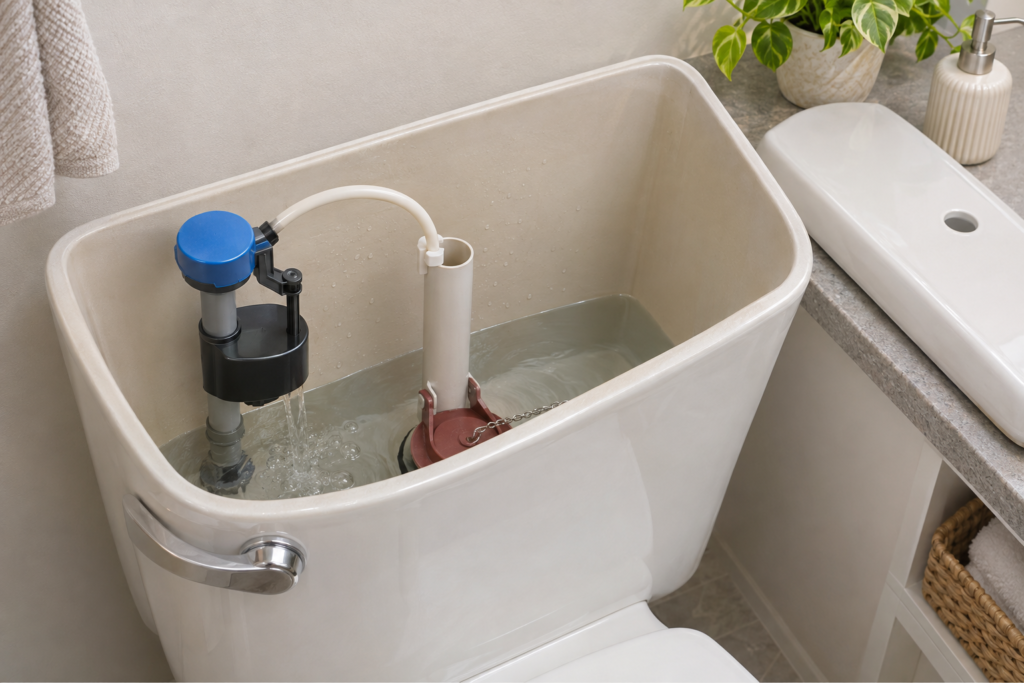
A slow-filling toilet tank may be receiving too little water, or it may be losing water into the bowl while it refills. Start by separating those possibilities. Watch one complete cycle, compare cold-water flow elsewhere and note whether the toilet starts refilling again when nobody has flushed. These observations give a plumber useful information without taking apart an unidentified mechanism.
If water appears on the floor, a connector drips or the shutoff valve leaks, controlling that leak takes priority. Close the toilet supply only if the valve is accessible and operates without force. Stop if it is seized, the pipe moves or water approaches electrical equipment. Do not keep testing an uncertain installation or leave a leaking toilet operating unattended.
Identify which part of the cycle is taking longer
After a normal flush, water leaves the tank and the inlet replenishes its stored volume. Some incoming water also goes through the refill arrangement to restore the bowl level. Hearing water inside the tank does not tell you how much is actually accumulating there. Watch the level rise and observe when the incoming flow stops.
There is no single refill time that applies to every toilet. Tank design, the mechanism and supply conditions affect the cycle. A clear change from this particular toilet’s usual behaviour is often a more useful clue than a number found online. A significantly longer wait deserves attention, particularly when the next flush starts with an incomplete reserve.
Time one ordinary cycle without flushing again before it finishes. Record the final water level, the time of day and any other appliances using water. A test during a shower and another with no other demand are not directly comparable. Describe similar conditions when possible, and avoid wasting water through repeated experiments.
Slow filling, early shutoff and continuous running
A slowly filling tank eventually reaches its intended level after an unusually long wait. A tank that shuts off too early finishes with insufficient water. Continuous running either never stops normally or restarts without another flush. All three may sound similar from the hallway, but each points toward different checks.
A weak flush does not establish that the inlet is restricted. A second flush before the tank has recovered simply starts with less stored water. If the bowl rises abnormally or drains poorly even with a properly filled tank, stop flushing repeatedly. That symptom may involve drainage rather than replenishment. This guide addresses water entering the tank.
Observe the toilet tank before touching anything
Clear the floor and keep your hands dry. If the lid lifts freely and you can handle its weight safely, place it flat on a stable surface. Porcelain is heavy and brittle. Do not pull up a lid attached to buttons or another mechanism. Check the model’s instructions before moving an unfamiliar lid or access cover.
Look inside without disturbing the parts. Identify the inlet assembly, float, outlet to the bowl and overflow tube. Take an overall photograph and another of any readable model reference. These pictures help locate the correct instructions and explain the symptom. They cannot establish the condition of hidden components or prove that an installation meets every requirement.
Flush once only if the bowl drains normally and no external leak is present. Watch whether the level rises steadily, stops low or drops after the inlet shuts off. Note any hiss and when it occurs. A brief sound during filling and a continuing sound after the expected end of the cycle are different observations.
Do not hold the float down to force extra water into the tank. Do not keep the outlet open to create a continuous flow for testing. Such changes obscure the normal behaviour and can leave water running. One carefully described ordinary cycle is more useful than several adjustments whose individual effects are unknown.
Check whether the problem affects one fixture or several
Briefly compare cold-water flow at a nearby basin and, if necessary, another accessible fixture. This is a comparison of behaviour rather than a pressure measurement. A weak-looking tap stream can also involve that tap’s aerator. Use the observation to choose the next question, without diagnosing the municipal supply from a single faucet.
If only the toilet has changed, its shutoff valve, supply connector and fill valve are reasonable points for a competent person to examine. If several fixtures changed together, the investigation needs a wider scope. Our guide to understanding low water pressure or flow explains that separate situation. Replacing the tank mechanism immediately may miss the actual problem.
Record whether the change followed a water interruption, building work or a recent repair. That sequence can help the plumber decide what to inspect. It does not automatically prove that debris caused the fault. Keep any building or municipal notice and distinguish the notice itself from the symptoms you actually observed inside your home.
In a rental unit or condominium
Notify the landlord or building manager through the established process. Do not operate a shared isolation valve to test a theory. A shutdown may affect other units and requires coordination. Mention similar reports from neighbours, while clearly separating their reports from your own observations. The manager can determine whether a common supply check is appropriate.
Take photographs before the visit and keep access to the tank clear. Tell the person arranging the repair if this is the household’s only toilet. That helps with practical planning for occupants. It is more useful than guessing how many minutes a repair should take before the installation has been examined.
Look at the visible supply path
The valve beside or behind the toilet normally isolates that fixture. Observe its position and exterior condition. Quarter-turn models and older multi-turn valves do not all operate in the same way. If you do not know how yours works, the handle resists or moisture appears, stop rather than forcing it.
A handle that moves does not prove the internal waterway is sound. Equally, an old-looking valve is not proof of restricted flow. Describe what you can see without making that diagnosis. A plumber can assess whether the restriction lies upstream of the fill mechanism or within the mechanism itself.
Look at the exposed flexible connector without bending or repositioning it. An obvious flattened bend, tension or exterior deterioration is worth reporting. Do not loosen a pressurized connection to see whether water comes out. That can cause a leak and is not an appropriate household observation test.
A useful investigation separates visible observations from tests requiring isolation, disassembly and restoration of watertight connections. The latter require preparation, appropriate parts and dependable shutoff. Reaching that boundary is a sensible point to stop inspecting and arrange an intervention, rather than expanding a small symptom into an uncontrolled leak.
When the fill valve needs closer attention
The fill valve controls incoming water inside the tank. A restriction there can slow the rise in water level. Fluidmaster identifies debris in the supply system or valve as one possible reason for reduced passage. That explains a mechanism; it does not demonstrate that debris is present in your toilet.
The Fluidmaster slow-filling tank troubleshooting page gives instructions for certain mechanisms from that manufacturer. Those actions should not be transferred to an unrelated valve. Identify the installed brand and model, then find the matching instructions. An improvised cleaning procedure can damage an unfamiliar assembly.
Replacement should not depend solely on an assumed component age. Compatibility with the toilet, condition and supply behaviour also matter. A new fill valve will not necessarily correct a defective shutoff upstream. Ask what finding supports the proposed replacement and what checks will confirm that the original symptom has been resolved.
For a concealed cistern, pressure-assisted toilet or other specialized mechanism, do not copy a video showing an ordinary gravity tank. Access arrangements and service instructions differ. A clear photograph of the manufacturer’s reference is especially useful when preparing the visit. Keep any original manual or previous service record with that information.
Rule out water escaping into the bowl
A tank can seem slow because some incoming water immediately leaves for the bowl. Observe whether the bowl surface keeps moving after the flush and whether the tank starts refilling again without use. Those signs suggest an internal loss, but do not identify the failed part on their own.
A suitable leak-detection dye product can help reveal a passage from the tank into the bowl. Toronto Community Housing describes using a dye tablet and waiting without flushing. Follow the product and toilet manufacturer’s directions. Colour reaching the bowl indicates water movement; it does not replace inspection of the mechanism or establish which component needs replacing.
Toronto Community Housing’s water-leak guidance also encourages residents to report problems promptly. If water keeps escaping, continue with our dedicated guide to a toilet that keeps running. That article addresses continuous loss rather than a restricted inlet alone.
Do not pour drain cleaner into the tank. Avoid adding mixtures to diagnose a leak or clean an unidentified valve. Chemicals are not a substitute for identifying the flow path. Keep a straightforward record instead: falling level, refilling that returns, any dye-test observation and whether water is visible outside the fixture.
Avoid adjustments that conceal the original fault
Arbitrarily raising the tank water level does not fix a slow inlet. The intended level depends on the model. If the reserve is low, the question is why the mechanism stops there. If it already reaches its proper mark, increasing it can create another problem without improving refill speed.
Changing several parts at once also makes the outcome difficult to interpret. Moving a float, shortening a chain and turning a valve during the same trial leaves no clear explanation of what helped. Preserve the original observations and ask for a targeted intervention. Every adjustment should have a reason and a check after service resumes.
If the symptom followed a recent repair, find the invoice and installed part reference. Contact the previous service provider before modifying the assembly again. Explain whether the fault was present on first use or developed later. That distinction can help direct checks of part compatibility, installation and adjustment.
Compare maintenance, repair and replacement sensibly
A slow-filling tank does not automatically justify replacing the whole toilet. A limited repair may suit a fault involving an accessible, compatible component. Cracked porcelain, several defects or unavailable parts change the discussion. Ask for those conditions to be assessed before choosing a larger replacement project.
Compare proposals by scope. Replacing a fill valve, restoring a shutoff and replacing the entire toilet are different jobs. A useful proposal identifies parts, labour, exclusions and final checks. A symptom alone cannot establish a universal repair price. Ask what is included and what would require a separate decision if discovered during the visit.
Access matters too: limited clearance behind the fixture, fixed cabinetry, a difficult shutoff and unusual tank arrangements can affect preparation. Describe those constraints when booking. A room photograph plus a close view of the supply helps distinguish an easily reached installation from one that requires additional planning or building coordination.
Understand the limits of doing plumbing work yourself in Quebec
Observing the fixture and carrying out plumbing work are different activities. Applicable requirements depend on circumstances including the building and who performs the work. The CMMTQ’s explanation of homeowner plumbing work sets out conditions and emphasizes applicable codes and appropriate qualifications.
That guidance is not blanket permission to modify every installation. Check the requirements for your situation before disassembly. Tenants should go through the responsible building contact, and condominium owners should follow their syndicate’s procedures. If the scope or isolation arrangements are unclear, seek advice before opening connections or disturbing the supply.
Prepare a useful repair request
Describe the behaviour in one precise sentence: the level rises slowly but eventually stops, or the tank starts filling again without a flush. Add when it began and what happened when you compared cold-water flow elsewhere. That is more helpful than declaring that the valve is scaled up before anybody has examined it.
- Brand, model and photographs of the tank and supply connection.
- Observed cycle time and final level without another flush.
- Noise, water entering the bowl continuously or an exterior leak.
- Recent repairs or water interruption, with an approximate date.
- Building type, access arrangements and whether another toilet is available.
Ask whether the visit includes evaluating the shutoff and connector rather than only the part inside the tank. Clarify what happens if the anticipated replacement does not fit. A change in scope should be explained before the additional work proceeds, including its effect on the quotation and practical timing.
For an assessment, see our toilet repair and installation service. The appropriate intervention depends on the findings at the fixture. The observations above help support a proportionate decision without assuming that every slow-filling toilet needs the same parts or the same work.
Toilet tank repair: check the result
Ask to see a complete operating cycle. The tank should reach its intended level, stop admitting water and remain stable without unexplained restarting. Look at accessible connections and the floor. Faster filling is encouraging, but does not establish a satisfactory repair if a new leak appears or the flush remains inadequate.
Keep the replaced part references, invoice and instructions. If the symptom returns, record the conditions and contact the service provider with that information. Avoid changing adjustments before that conversation. Comparing the new behaviour with the immediately completed repair helps the follow-up remain focused on observable facts.
Return to ordinary use and pay attention to the first cycles. Stable operation is the goal, rather than the shortest possible refill time. If other fixtures also develop reduced flow, report that additional context. It may warrant a broader investigation than the toilet repair initially required.
Keep a short observation record
A simple record can prevent repeated, inconclusive testing. Write down the date, whether the toilet had finished filling before use, and what happened next. Include the final level rather than only the waiting time. If you make a short video for the plumber, keep the water level and sound clear, without including people or private household details unnecessarily.
Record a change only when it matters: a new leak, a different sound, simultaneous low flow elsewhere or a problem returning after a repair. You do not need to monitor every flush indefinitely. The purpose is to give the service provider a reliable description and a way to compare the result, not to turn normal household use into a diagnostic project.
Frequently asked questions
Why is the tank slow only at certain times?
Note other water demand and compare similar conditions. A change affecting several fixtures calls for a wider supply investigation. If only the toilet changes, retain that observation for examination of its own supply path. Timing is a clue, not proof of a particular cause.
Can drain cleaner make the tank refill faster?
No. Refilling concerns incoming water; drain cleaner addresses a different part of the system and is not an appropriate solution. Do not put it into the tank or combine cleaning products. First distinguish a supply issue from a drainage issue.
Does a faulty fill valve mean I need a new toilet?
Not automatically. A compatible component may be serviceable or replaceable. The decision also depends on porcelain condition, other parts, access and replacement availability. Ask for a clear comparison between a targeted repair and a complete replacement before choosing.
Can I keep using a toilet that fills slowly?
An exterior leak, a rising bowl or uncertain shutoff requires stopping the tests. Without those signs, describe the problem and arrange an assessment instead of flushing repeatedly. Continuous loss into the bowl needs attention too. Having another toilet available can make waiting for the repair easier.
For guidance on other distinct symptoms, browse our Toilets advice category.