
Drains and sewers
Clogged sink or slow basin: practical checks and safer methods
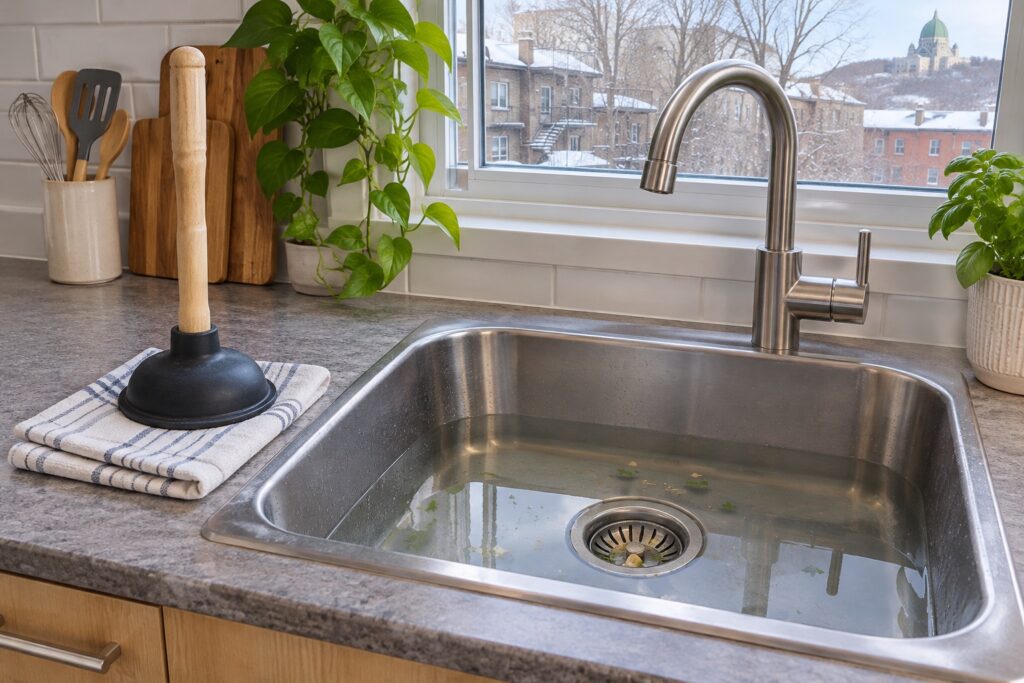
Clogged sink: start with the useful checks
For a clogged sink or a bathroom basin that drains slowly, stop adding water, check whether other fixtures are affected and remove only debris you can safely reach at the opening. A suitable cup plunger may help with a local blockage when no chemical drain cleaner has been used. Stop if water backs up elsewhere, a connection leaks or the blockage returns. The right next step depends on the symptoms, the condition of the connections and anything already poured down the drain.
In a Greater Montreal kitchen or bathroom, the immediate goal is to restore safe use without turning a slow drain into water damage. This guide explains accessible cleaning, the limits of a plunger and when an assessment makes more sense. It cannot identify a blockage remotely. Water moving again after a short attempt is encouraging, but it does not establish that the entire pipe has been cleared or that an underlying problem has been corrected.
First: when to keep everything out of the drain
If someone has used a chemical drain cleaner, do not add vinegar, bleach or a second cleaner. Do not follow it with a plunger, drain cable or trap removal: retained liquid may still contain the product. Keep people and pets away. Save the original container and tell the plumber its name, the approximate amount and when it was used. Do not try to neutralize an unknown mixture with another household ingredient. A seemingly harmless addition can change the hazard.
Health Canada’s household chemical safety guidance explains label precautions and dangerous mixtures. Product-specific directions also matter. For example, the manufacturer’s instructions for Drano Bathroom Gel prohibit plunging during or after use because cleaner can remain in a blocked drain. That reference supports a safety warning; it is not a product recommendation. Do not transfer one product’s directions to a different formula or container.
For exposure or uncertainty about a chemical, the Centre antipoison du Québec provides help at 1 800 463-5060, including service in English. Call 911 for an immediate danger or serious breathing difficulty. Leave an area where fumes are affecting you. Do not enter water that may contact wiring, an outlet or an electrical appliance. Getting plumbing help does not replace medical assistance when someone has been exposed.
Clogged sink: one fixture or a shared drain?
Before deliberately running more water, think about the last few uses. Was the basin already slow yesterday? Did the kitchen sink fill during dishwasher operation? Did a toilet gurgle at the same time? Record what actually happened without turning on every tap to recreate it. Adding water to a poorly draining system can move the overflow to a lower fixture. Observations from ordinary use are enough to begin a useful conversation with a plumber.
A clogged sink in the bathroom with visible hair around its stopper suggests starting with an accessible local check. Two kitchen bowls can share the same blockage. Several affected fixtures, water returning into a shower or a rising level while your own tap is off call for greater caution. Those clues do not locate the obstruction precisely. They do suggest that the problem may extend beyond what can be seen through the sink opening.
Our guide to telling a local clog from a shared drain problem covers that broader decision. This article stays focused on kitchen and bathroom sinks. A main drain issue, venting concern or connection defect cannot be confirmed from a sound alone. The assessment needs to consider how the installation behaves, which fixtures are connected and what can safely be examined. Avoid treating a guess as an established cause.
Kitchen and bathroom sinks need different observations
At the kitchen sink
Look at the basket strainer and the scraps around it. A full basket can restrict water entering the drain even when the pipe is not completely blocked. Remove it only if it is designed to lift out easily. Put collected scraps in the appropriate waste stream rather than the other bowl. Do not push food through the holes with a utensil. A photograph of the opening can help explain what you found and what changed after cleaning.
Residue may also be farther along the drain. Cooking habits involving grease are useful information, but they do not prove the cause on their own. Mention recent renovations, a dropped object and any blockage that returned after previous clearing. A sink that never drained properly after installation deserves a discussion about the arrangement and connections. Repeatedly adding cleaner does not establish whether the installation, an obstruction or another factor is responsible.
At the bathroom basin
First check whether the stopper opens fully. A stuck stopper or poorly adjusted operating rod can restrict the opening. Lift out only a part intended to be removed without force, following its instructions. Wipe away accessible hair using appropriate gloves. If the stopper connects to a mechanism underneath, do not pull hard: that can disturb a connection or drop a small part into the drain. Keep removed pieces together on a towel.
Odour and slow drainage can occur together, but cleaning the top of the stopper does not explain every smell. Avoid adding fragrance and then using the improved smell as evidence of repair. Water movement and any sign of leakage remain more useful observations. After accessible cleaning, a small controlled test gives better information than leaving a tap running unattended. If a smell persists despite normal drainage, describe it separately when asking for help.
Prepare a simple attempt without taking pipes apart
Clear the counter and protect the cabinet with a towel. Keep a stable container nearby for ordinary water only when you know no hazardous product is present. Do not transfer an unknown chemical liquid. Move food and loose objects away from the work area. Use gloves and splash protection appropriate to the task. A clear, dry cabinet makes a new drip easier to notice. Good preparation also lets you stop promptly instead of searching for towels while water escapes.
Visually inspect accessible connections without loosening or moving them. Look for moisture, a crack, a drip or badly corroded components. If the arrangement appears fragile, choose professional assessment. Repeated plunging can stress an installation that already has a defect. Identify any disposal unit or powered equipment under the sink as well. Never put your hand into a disposal or attempt work on its electrical supply. Keep the scope of this check to what is safely visible.
Set a limit before starting: accessible cleaning, followed by a short cautious plunger attempt only if conditions allow. If nothing improves, stop. There is no special number of strokes that proves an attempt is safe. Unusual resistance, a leak or water coming through another opening ends the attempt. Compare the value of an assessment with the possible damage from repeatedly stressing fittings or overflowing a cabinet. Persistence is not the same as progress.
Using a plunger on a clogged sink
A flat cup plunger made for sinks needs a reasonably flat surface around the drain. Its usefulness depends on maintaining contact at that opening. Use a clean tool reserved for this purpose. A contaminated toilet plunger should not be moved into a kitchen sink. Check that the rubber is intact and the cup fits the available surface. If it keeps slipping, applying more force is unlikely to solve the fit problem.
Only proceed when there is no chemical cleaner, electrical hazard, leak or indication of a shared backup. Place the cup over the opening with enough ordinary water to cover its edge, without overfilling the bowl. A bathroom overflow can admit air; the second opening of a double kitchen sink can do the same. Temporarily cover accessible adjacent openings with a stopper or damp cloth. Do not push cloth into a pipe or leave loose material where it can be drawn inside.
Begin gently to reduce splashing, then make a few controlled movements while maintaining contact. Watch visible connections and the other bowl. Remove temporary covers afterward and observe the result. Stop immediately if a leak appears. Collect any debris brought back up instead of washing it down again. RONA’s sink and lavatory drain guide also illustrates why the plunger type and neighbouring openings matter. Keep the attempt brief rather than escalating force.
Methods to avoid treating as universal fixes
Do not use boiling water as a universal answer. You may not know the compatibility of every joint, component and finish in the installation. A full basin also creates a burn and splash hazard. Hot water does not make an unknown chemical mixture safe, nor does it establish that a blockage has disappeared. For a check after basic cleaning, a small quantity of water at a comfortable temperature is a more cautious choice. Stay beside the sink throughout.
Baking soda and vinegar are not a reliable test of whether a pipe is clear: visible fizz does not show where the obstruction is or whether it has gone. Do not combine household recipes with commercial chemicals. Avoid coat hangers, rigid rods and improvised tools that can lodge in a fitting or damage a component. Do not attach a pressure device to an installation of unknown condition. A video showing success elsewhere cannot establish compatibility with your own drain.
A drain cable may look like the obvious next step, but its type and access route depend on the installation. Forcing it through a stopper mechanism can cause damage. This guide therefore does not prescribe routine disassembly or powered cable use. If your clogged sink needs more than the accessible checks described here, ask what intervention fits the situation. The method should follow the assessment. Trying every available tool in sequence can create additional problems without explaining the original one.
Should you open the trap?
The trap is the section of drain that retains water to help keep sewer odours out of the room. It can hold debris, but a slow sink does not prove the blockage is there. A glued, corroded, older or awkwardly placed assembly cannot be treated like a recent removable fitting. Anyone opening it needs to understand how it is assembled and how to check its seal after reassembly. Catching the water is only one part of that work.
If you cannot identify the parts confidently, leave the connections in place. Professional help is especially sensible after chemical use, when the cabinet is already wet or when you rent and do not have authorization for plumbing work. Never leave the drain open while assuming the other bowl remains usable. Connected appliances may share that route. Tell other occupants that the sink and associated appliances are temporarily out of use. An unnoticed dishwasher cycle can undermine an otherwise careful plan.
Double sinks, dishwashers and returning water
When water moves from one kitchen bowl into the other, stop running the tap. The movement shows that the openings communicate, but does not identify exactly where the restriction lies. Check that both strainers are clear and note the level on each side. Do not fill both bowls to push the blockage through. Extra volume can consume the remaining space and spill onto the counter or into the cabinet. A larger test is not necessarily a more informative one.
If the sink fills while the dishwasher is operating, pause the appliance according to its instructions and avoid starting another cycle. Do not open connections or rearrange its drain hose by guesswork. Tell the professional whether the return occurs during draining, whether water appears beneath the cabinet and whether the sink was already slow. Those details help organize the assessment without assuming that the dishwasher itself has failed. Keep its model information available if the appliance also needs attention.
Check your clogged sink in stages
After accessible cleaning or an apparently successful plunger attempt, remove tools and cloths. Make sure all openings have returned to their normal arrangement. Run a small amount of water only if conditions remain safe. Watch both the bowl and the visible connections. Turn the tap off immediately if the level rises or a drip appears. Do not leave the room during the test. A brief observed check is more useful than an unattended flush.
If that first check goes well, resume moderate use and observe the next few ordinary uses. One bowl draining does not justify immediately operating every connected appliance. Record any rapid return of slow drainage. Keep the date and the action that helped: removing a visible hair accumulation tells a different story from improvement without recovered debris. That simple record can help later assessment. It also prevents several occupants from unknowingly repeating the same unsuccessful treatment.
When professional sink unclogging makes sense
Arrange an assessment if the clog returns, basic checks fail or the installation leaks. Backups in several fixtures, an unknown liquid or water arriving from elsewhere are reasons to stop experimenting. For a problem limited to these fixtures, our kitchen and bathroom sink unclogging service explains the intervention process. Describe the symptoms when requesting help so the need can be directed appropriately. Mention any chemical use before someone starts working, even if it happened earlier.
Before authorizing work on a clogged sink, ask what will be checked, what access is needed and what the estimate includes. Time can depend on access, the arrangement and the actual problem found. A camera is not automatically necessary for every slow basin. If one is proposed, ask what question it should answer and what limitations apply. Clearing a blockage aims to restore flow; structural repair addresses an established defect. Ask for the findings supporting either recommendation rather than treating them as interchangeable services.
Prepare information and access
Describe the clogged sink briefly: kitchen or bathroom, one fixture or several, sudden or gradual onset, attempts made and products used. Take a clear photograph of the bowl and visible connections without taking anything apart. Empty the cabinet only if items can be moved without contact with hazardous liquid. Mention broken components, earlier leaks and recent work. An accurate account is more helpful than adopting an online diagnosis that has not been confirmed at your property.
In Montreal, Laval and surrounding communities, explain practical access details: floor, available occupant, entry arrangements and building management instructions. In a rental or condominium, alert the responsible contact when a shared system might be involved. Do not promise access to another unit without agreement. These steps support coordination; they do not determine financial responsibility or insurance coverage. Keep messages and the work report. Ask who should receive updates if more than one person is arranging access.
Prevent a clogged sink without a chemical routine
In the kitchen, scrape dishes and wipe surplus grease before washing. Use an appropriate strainer and empty it regularly. Keep cooking oil, coffee grounds and solids out of the drain; check your municipality’s collection instructions for their proper destination. A sink is not a liquid waste bin. These habits aim to reduce what enters the pipe without promising that a blockage can never occur. Make the routine practical enough that everyone sharing the kitchen can follow it.
At the bathroom basin, remove accessible hair and clean the stopper according to its instructions. Watch drainage and moisture instead of automatically scheduling chemical treatments. Our guide to drain maintenance based on observed warning signs explains a proportionate approach. Browse Drains and sewers for related guides when the symptom points beyond one sink. Match the next step to what you actually observe, and retain a clear stopping point whenever the cause remains uncertain.
Frequently asked questions
Why does a clogged sink still drain a little?
A partial passage may remain, but the symptom alone does not identify the material or depth of the obstruction. Start with the stopper, strainer and behaviour of other fixtures. If slow drainage returns after simple cleaning, request an assessment instead of adding successive products. Temporary improvement is useful information, but it is not a guarantee of a lasting result.
Can I plunge after using drain cleaner?
No. Cleaner can remain in the retained water and splash back. Add nothing, keep the original container and explain the situation to the professional. Follow the manufacturer’s precautions. If someone has been exposed, contact the poison centre or emergency services according to the severity. Protecting people takes priority over restoring drainage.
Does a failed plunger attempt mean the pipe is broken?
No. Poor contact, a farther blockage or a different arrangement can explain the failure. It does not establish a break or automatically justify replacement. Ask what finding supports the proposed recommendation, what options exist and how the result will be checked afterward. A useful explanation connects the recommended work to evidence from your installation.