
Toilets
Clogged toilet: what to try and when to stop
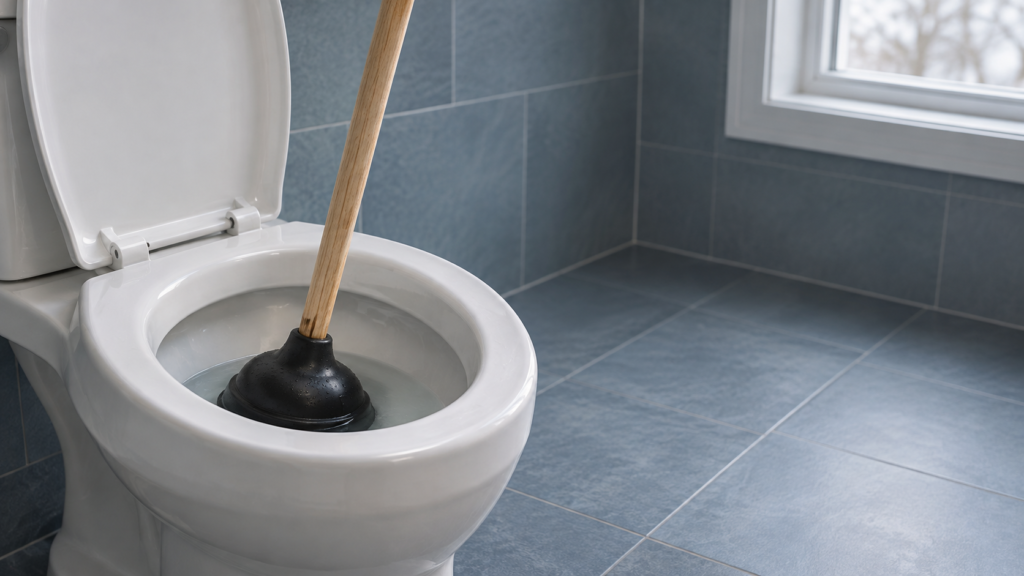
A clogged toilet may clear with a toilet plunger, but preventing an overflow comes first. Do not flush again if the bowl is rising or draining very slowly. If the tank keeps refilling, gently close the toilet supply valve if it turns freely. A single affected fixture with no backup elsewhere may allow one careful attempt. Water appearing in a shower or floor drain, several slow fixtures, sewage on the floor, or a clog that quickly returns calls for professional assessment. These observations help you choose a safe next step; they cannot locate a blockage from a distance.
Clogged toilet: try a plunger or stop?
If the toilet is stable, the water stays inside the bowl, no chemical cleaner has been poured in, and no other fixture backs up, start with a flange plunger made for toilets. Protect the dry floor, wear gloves, and work slowly enough to maintain a seal. If the level falls and the drain behaves normally, check with one supervised flush. Stop if the water climbs again. Repeated test flushes add water to a bowl that may already be close to overflowing; they do not make the blockage safer.
Stop if a rigid object, toy, wipe or hygiene product may be trapped; if reasonable plunging produces no improvement; if the porcelain is cracked or the toilet rocks; or if a caustic cleaner is already in the bowl. Force may push an object farther, damage the fixture or splash a hazardous liquid. ProDrain’s toilet unclogging service page explains how to request help when careful attempts have reached their limit.
Control the water and exposure first
Look at the water level without putting your face over the bowl. When it is close to the rim, plunging may displace enough water to create an overflow. If you can safely remove a little water with a suitable container and avoid splashing or contact with potentially contaminated water, that may create working room. Otherwise, keep children and pets away, close the bathroom door and ask for help. Do not walk through a puddle beside an electrical outlet, cord or appliance to reach a shutoff.
A toilet shutoff valve is often behind or beside the fixture. Turn it gently if you know it works. Old valves can seize or become fragile. Do not force the handle or loosen a connection. If water keeps entering and you know where the main water shutoff is, use it only when access is dry and safe. In a building with several units, alert the responsible person if a leak or backup could affect neighbours. Record when the incident began, which fixtures are involved and whether the water is spreading. A photo can help later if taking one does not delay safety steps.
Water that emerges from a toilet or drain may carry contaminants. Health Canada describes added precautions for sewage-contaminated flooding; Québec’s guidance also discusses electrical risks and cleaning after a sewer backup. Wiping a few droplets after using a plunger is different from cleaning a contaminated flood. If water reaches porous materials or a large area, limit exposure and seek appropriate help. Do not ask children, pregnant people or someone with respiratory problems to handle sewage-contaminated material.
Is the blockage at this toilet or in a shared drain?
A single toilet that slows after an unusual amount of paper may have a blockage in its trapway or immediate branch. That is a possibility, not a diagnosis. A shower, basin or floor drain that gurgles or backs up at the same time suggests the issue may be farther along a shared pipe. Compare what has already happened without running large amounts of water to test the system. If several fixtures are affected, stop using them until the cause is assessed. Our guide to local clogs and shared drain problems explores that distinction.
An unusually low bowl level, weak flush or poorly filling tank does not automatically mean a clog. Note whether the flush starts normally and whether the tank refills, without opening hidden panels or altering parts. A bowl that receives too little water for a normal flush may not benefit from plunging. The article on telling a flush mechanism fault from a blockage helps you describe that different symptom.
A toilet can also seem to clear and then clog again. One successful flush does not prove the entire passage is open. A partly trapped object, buildup, a branch problem or a repeated loading pattern could produce a similar cycle. Write down when it happens and what was flushed, without blaming an occupant based on one incident. Recurrence is a reason to investigate, especially if episodes become more frequent or another fixture begins to respond.
How to use a plunger on a clogged toilet
Choose a flange plunger: the flexible extension can fit into the toilet outlet and help seal it. A flat sink plunger often fits the toilet trapway poorly. Check that the rubber is sound. Put on gloves, move items that could be splashed, and place absorbent protection around the base without hiding an existing leak. The bowl needs enough water to cover the cup, while leaving space below the rim. Never add water to a bowl that is already high.
Lower the flange gently over the outlet to expel some trapped air and make a seal. Keep the handle reasonably upright. Use controlled push and pull strokes while maintaining contact with the porcelain. The goal is moderate pressure and suction, not striking the bowl with the handle. Lift the plunger slowly and observe whether the level falls. A few short sets can be reasonable while the water stays contained and you see progress. American Standard’s toilet guidance also cautions against continuous flushing.
When water starts to drain, wait for the normal level to return. One supervised flush can check the result if there is no sign of backup, leakage, chemical cleaner or electrical risk. Stop if the bowl rises. A flush that finishes but leaves an unusually high level, or makes another fixture gurgle, deserves more attention. Clean the plunger according to its instructions and wash your hands after removing gloves. Keep the toilet tool separate from equipment used around kitchen sinks.
When might a toilet auger make sense?
A toilet auger, sometimes called a closet auger, has a guide intended to reduce cable contact with the porcelain. It may help when an obstruction is within reach and a plunger is insufficient. It is not suitable for every situation. Toilet design, a suspected hard object, a cleaner already in the bowl and the length of the branch all affect the risk. Read the tool manufacturer’s directions and the fixture instructions. If you do not know what is caught, or the toilet is fragile, ask for service rather than testing how much force the cable can take.
Do not substitute a metal coat hanger, rigid rod or drain cable intended for another pipe. Edges can scratch the glaze, catch in the trapway or push an object farther down. Removing the toilet to reach a pipe introduces questions about the seal, flange and contaminated water. A rocking fixture, a damp base or a soft floor needs an assessment of stability and leakage first. Clearing a blockage will not automatically repair a leak beneath the toilet. If a child may have dropped an object, tell the plumber what it could be instead of probing blindly.
Why avoid chemicals and boiling water?
Chemical drain openers are not a safe first choice for a toilet. Health Canada explains the hazards of household chemicals, including drain cleaners. Some fixture or product makers advise against their use, and instructions vary. A caustic liquid can remain in the bowl when the clog does not move. Later plunging or augering could splash it onto skin or into eyes; the person who attends must know it is there. Never mix cleaning products. If a chemical was already poured in, keep its packaging, stop attempts and tell the plumber at the start of the call.
Boiling water can burn skin and may thermally stress porcelain. A heavy pot is difficult to pour without splashing, especially into a nearly full bowl. Some manufacturer tips discuss hot but nonboiling water with dish soap, but that assumes there is room in the bowl and that the obstruction might respond. It does not replace an assessment when the level climbs or an object may be present. You do not need to try every household recipe before calling for help. A safe stopping point is more useful than a long list of experiments.
Baking soda and vinegar can make visible foam, but foam does not show that the toilet trapway is open. The reaction cannot remove a toy, wipe or hard object. Products placed inside the tank are a separate issue: Kohler warns that certain chlorine-containing in-tank cleaners can damage fittings and lead to leaks. Follow the instructions for the particular fixture. Use the bowl level and symptoms at other fixtures to guide the decision, not the amount of bubbling caused by a mixture.
Signs that mean stop immediately
Rapidly rising water, an overflow, a strong sewer odour or wastewater emerging from another fixture changes the priority. Stop flushing and using fixtures connected to the same drainage system. Keep vulnerable people and pets away from soiled water. If water reaches electrical equipment, do not step into it to reach a breaker. Ask a qualified person or utility for the appropriate response. For a separate discussion of an overflow, see what to do when a toilet overflows.
Stop if plunging causes new gurgling in a shower or changes the level of a floor drain. Stop if a second toilet becomes slow. These clues do not prove exactly where the obstruction is, but they make a simple bowl clog less likely. An assessment may need to distinguish the toilet trapway from its branch and the main drain. Do not remove a cleanout cap or backwater valve cover to release pressure: contaminated water could escape unexpectedly. A backwater valve has its own maintenance instructions and is not a quick toilet unclogging tool.
Also stop if porcelain is cracked, the toilet is unstable, the floor is soaked, water can be heard behind a wall or a neighbour reports drainage problems. A clearing tool cannot fix a structural defect. Multiunit buildings may have shared piping and access rules. Tell the landlord or manager promptly, describe observations and avoid claiming that your toilet is certainly the source. If any chemical product was used, say so before someone begins work, even if you think it has drained away.
If water goes down, how should you verify the result?
A falling level after plunging is encouraging, but give it time to settle. Check the floor around the base and nearby fixtures. If there is no backup, leak, chemical product or electrical hazard, make only one supervised flush. Water should leave and return to its usual bowl level without approaching the rim. If you are unsure, skip the test. A plumber can check the drain under conditions suited to the actual installation. A flush that looks normal once is a useful observation, not proof that every part of the system is clear.
Over the following days, note whether flushes remain normal, whether another drain gurgles and whether moisture appears around the toilet base. A toilet that works once and then clogs again during ordinary use deserves a diagnosis. Do not increase the water volume with each flush to compensate. Do not pour several buckets into a toilet that has just overflowed as a flow test. A controlled check seeks normal function; it should not push a remaining object farther along the branch.
When to call, and what information helps?
Request an assessment if the obstruction persists after a careful plunger attempt, returns frequently, appears to involve an object, or coincides with backups elsewhere. Act promptly if sewage spreads, several fixtures are affected or water threatens building materials or another unit. Describe the sequence instead of diagnosing it yourself: the bowl level, what happened after one flush, other fixtures, noise, odour, any known object and the steps already taken. Explicitly mention a chemical cleaner. This information may help prepare the visit but cannot guarantee a diagnosis or price by phone.
If you rent or live in a condominium, notify the person responsible for the building as well. Ask who approves access and how to report an issue outside normal hours. Do not leave a toilet in use by other occupants if it might overflow. Clear a dry path to the bathroom, without moving heavy objects across wet flooring. Keep photos and product packaging available. Mention any earlier incidents, including whether problems followed heavy rain or simultaneous use of several fixtures, while recognizing that timing alone does not identify the source.
A plumber may begin with visible signs and determine whether the problem is limited to the fixture or involves a shared pipe. The method follows what is found. Clearing may suit a local obstruction; a recurrent problem or backup elsewhere can require further inspection. The existence of camera equipment does not mean every clogged toilet needs camera work. Ask what was observed, what checks are proposed, what the quote includes and which discoveries could change the scope. A picture of the bowl alone cannot support a precise repair estimate.
ProDrain serves the Greater Montréal areas listed on the site. To ask about service, visit the toilet unclogging page or contact ProDrain. Explain whether the symptom is limited to one toilet or shared with other fixtures. While waiting, manage any rising water and avoid further experiments. If the bathroom is the only one in the home, mention that practical constraint during the call; it affects occupants even when water remains contained.
Reduce the chance of another clog
Flush only material intended for the toilet and toilet paper. Wipes, even those marketed as flushable, hygiene products, floss, cotton swabs and paper towels can remain intact or accumulate. American Standard recommends flushing only toilet paper. Put a small waste bin within easy reach so the safer choice is convenient for residents and visitors. Explain to children that toys do not belong in the bowl. If an object goes in, avoid fishing blindly with a metal tool that could push it farther.
A large amount of paper in one flush can block a passage even when the fixture has no permanent defect. If this repeatedly happens under ordinary use, do not assume occupants are always using too much paper. The flush, trapway, branch or a partial obstruction may warrant checking. A water-efficient toilet is not automatically faulty, and replacing it without a diagnosis may leave the real issue in place. Surface care and attention to changes in performance help; repeated chemical treatments do not substitute for finding a cause.
Keep a brief record when symptoms recur: the date, whether another fixture reacted, what the bowl did during a normal flush and whether a plunger changed the result. This record can distinguish an isolated incident from a pattern without requiring you to run risky tests. If a plumber clears an obstruction, ask what was actually found and whether any remaining uncertainty should change how the toilet is used or monitored. Avoid promises that any single product or maintenance routine can prevent every future clog.
Frequently asked questions
Can a clogged toilet clear on its own?
Paper-based material may sometimes soften, but there is no guarantee and the bowl can remain at risk of overflowing. Do not keep using the toilet while waiting. Seek help if the water is high, an object may be involved or several fixtures are affected. A level that falls on its own does not prove the entire passage is open.
How many times should I use the plunger?
Try a few controlled sets while the water stays contained and you see progress. No universal number fits every fixture and clog. Stop when nothing changes, effort increases or another drain reacts. Repeated plunging can create splashes without solving the underlying problem.
Is it urgent if this is the home’s only toilet?
Having no alternative makes the issue more pressing for occupants even when water remains in the bowl. Mention this during the call. Overflowing sewage, an electrical hazard or water spreading into another unit demands faster attention. The real priority depends on exposure and conditions, not simply the number of toilets.
Can a plunger damage the toilet?
Gentle use of a suitable tool reduces risk but cannot make a cracked or unstable fixture safe. Avoid striking the porcelain, using rigid substitutes or plunging a bowl containing a corrosive cleaner. A rocking base or visible crack calls for assessment before more force is applied.
Why might the clog return after a service visit?
Material may remain, an object may still be trapped or another problem may contribute. Recurrence alone does not show that the first visit was done incorrectly. Record the interval, normal use and other fixtures involved; then ask which observations confirm the cause and what additional checks make sense.
For more advice about flushing, leaks and toilet care, explore the Toilets category. The practical stopping point is clear: when rising water or further tool use could worsen damage or exposure, stop and have the situation assessed.