
Drains and sewers
Drain and sewer smells: causes, safe checks and next steps
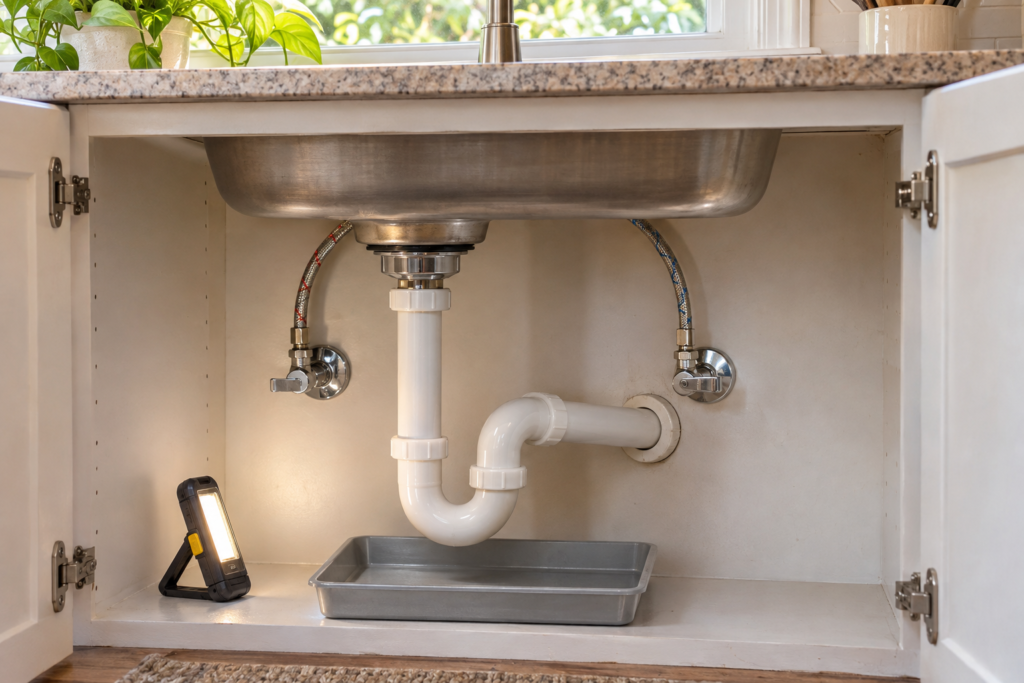
A bad smell near a sink does not automatically mean the drain is blocked. Accessible deposits, a dried-out trap and a faulty connection can call for different responses. The first decision is whether a simple observation is appropriate or whether you need to leave the area.
When should you stop checking and leave?
If you suspect a combustible-gas leak, leave immediately and call 911 from outside. Do not operate switches or devices near a possible leak. A rotten-egg smell does not let you distinguish odorized natural gas from a sewer-related smell yourself. Follow Énergir’s emergency instructions before investigating any plumbing problem.
Dizziness, breathing difficulty, feeling unwell or headaches in this situation also mean you should stop the exposure and get urgent assistance. Do not enter a pit, sump or confined space to find the source, or go in to rescue someone. CCOHS warns that hydrogen sulfide can dull the sense of smell. A smell becoming less noticeable does not establish that the air is safe.
The observations below apply only when there is no suspected danger, no illness and no active sewage backup. If wastewater is rising, stop using fixtures connected to the affected system, keep people away and arrange professional help. Do not open a cleanout or backwater valve during a backup.
Is the smell coming from the water or the drain opening?
A smell noticed while a tap runs may come from the drain rather than the water. Québec City explains this distinction in its sulphur-odour guidance (French). If none of the warning signs above is present, filling a clean container with cold water and moving it away from the sink can help clarify your observation. Do not taste the water to test it or breathe directly over the drain.
If the smell follows the water away from the sink, report a water concern to the building manager or your municipality’s water service. Mention whether you have already noticed it at several taps or only with hot water. Follow local advisories: this observation is not a drinking-water safety test or a way to identify a contaminant.
One sink or shower smells, but water still drains
Start with visible parts intended for routine care: hair caught on a grate, food in a strainer or residue on a removable stopper. A sink’s overflow passage can also collect deposits. These parts do not all have the same cleaning instructions, so check the model’s guidance before removing anything.
Stay with components accessible without taking the plumbing apart. Put debris in the garbage rather than pushing it down the pipe. For strainer surfaces, Oatey recommends mild cleaners and soft cloths or sponges. That is not a universal internal-cleaning procedure for drains or overflow passages.
Do not add several products to “neutralize” a smell. Transport Canada explains the hazards of mixing household cleaners. If a product has already been poured down the drain, keep its name and tell the plumber. Do not follow it with a homemade mixture, another drain cleaner or a tool that could splash the liquid.
An odour combined with slow or blocked drainage may justify an assessment for professional drain cleaning. Smell alone, with normal drainage, does not establish that this is the right service or that a blockage lies farther down the line.
A rarely used fixture: why water in the trap matters
A trap retains water that separates indoor air from the drainage system. That water can evaporate when a fixture goes unused for a long time. The County of Brant explains the roles of traps and plumbing vents.
For an identified, accessible fixture that drains normally, with no suspected danger or chemical product present, adding water can restore a dried-out water seal. Stop if water rises or drains poorly. Do not pour anything into an unidentified opening or remove a cleanout cap to look for a trap.
If the smell soon returns, do not assume that repeatedly adding water is enough. Water loss, a plumbing-vent problem or an installation issue may need checking. Plumbing vents balance pressures in the drainage system; they are not the bathroom exhaust fan.
Around a toilet or in several rooms: investigate the pathway
An odour near a toilet base can direct attention to its connection, but it does not prove the seal has failed. Report visible moisture, movement already noticed during ordinary use or recent work. Do not rock the bowl to recreate the problem. If water is present, see the guide to water leaking around a toilet base.
Adding caulk around the outside does not replace checking the connection. Likewise, fragrance does not fix an escape pathway. Persistent or multi-fixture odours call for distinguishing traps, seals, vents and damaged piping rather than buying a treatment at random.
The investigation method should answer the actual question. A camera shows the accessible pipe interior; it does not by itself prove watertightness or replace smoke testing. Read about drain camera inspection costs and limitations to understand what an examination can document. Smell alone does not call for a camera or excavation.
What information helps avoid guesswork?
- The first affected room and fixtures, without exposing yourself to investigate further.
- When the smell appears: after an absence, during normal use or since plumbing work.
- Observed drainage, gurgling and any visible moisture.
- Products used, previous cleaning and how long any improvement lasted.
- In a shared building, other affected units as reported by the manager, without working on common piping.
Ask what has been confirmed and what still needs checking before authorizing further work. A backwater valve intended to address reverse wastewater flow is not a general odour remedy and does not replace finding the cause.
Use the pattern to choose the next question
A useful description connects the place, timing and associated symptoms. “The downstairs shower smells after several weeks without use” is more informative than “the sewer is broken.” The first description leaves several possibilities open and helps the person assessing the problem choose a starting point. The second turns an unconfirmed explanation into a conclusion.
Begin with what you already noticed during ordinary use. A single fixture with normal drainage, several fixtures gurgling together and wastewater appearing at the lowest opening are different situations. Do not deliberately run a washing machine or fill a bathtub to see whether a backup happens again. A history of an event is enough to report; reproducing it can cause damage.
If the smell appeared after work, give the date and describe the work without assuming fault. A changed fixture, an unused opening or an unrelated water concern may need separate assessment. Keep invoices and any photographs from before the area was closed. These records can be helpful even when the person who attends did not perform the earlier work.
After an absence
List the fixtures that were unused, including a guest bathroom or an identified basement floor drain. Mention roughly how long the building or room was empty. If adding water to a suitable fixture removes the smell, record that response and whether it lasts. This supports a possible dry-water-seal explanation; it does not certify the entire drainage system.
During normal fixture use
Note whether the smell occurs at the same fixture being used or elsewhere. For example, an odour noticed in a bathroom while laundry normally drains is worth reporting. It does not identify a specific vent defect or common-line blockage. The relationship is useful because an assessment can consider connected piping rather than treating every opening independently.
At apparently random times
Write down a few ordinary occurrences instead of keeping a continuous watch in the affected area. Include whether doors were open, whether the room was occupied and whether work was underway in the building. Weather or ventilation observations can be context, but they do not prove the source. Avoid purchasing equipment or authorizing pipe replacement on that association alone.
Understand what a trap and vent can explain
The water held in a trap is a barrier, rather than a disinfectant or deodorizer. A sink can look clean while that barrier is absent, and a dirty strainer can smell while the trap still holds water. This distinction explains why surface cleaning and assessment of drainage connections answer different questions. One improvement should not be taken as evidence about every possible cause.
The visible curved pipe under a sink is only one example of a trap arrangement. A shower or floor drain may have its trap below the floor, out of sight. Do not interpret the absence of a visible curved pipe as proof that no trap exists. Similarly, the visible water level in a toilet does not let a homeowner assess every seal connecting the toilet to the drain.
Plumbing ventilation helps the drainage system manage air and pressure. A room exhaust fan removes room air and is a different system. Replacing that fan, leaving it running or buying an air freshener does not establish that the plumbing pathway has been corrected. If an odour repeatedly returns after a simple water addition, ask for the reason the water seal may be losing its effectiveness.
Keep roof checks and alterations out of the homeowner investigation. Do not climb onto a roof, insert a hose into a vent, dismantle an air-admittance device or cap a pipe that seems unused. The apparent opening may have an essential function. A professional needs to identify the arrangement and assess it before recommending changes.
Cleaning: define a small, safe stopping point
When no warning condition is present, ordinary cleaning can start with a removable strainer or stopper designed for routine maintenance. Look up the actual fixture instructions. Some stoppers lift out; others are attached to mechanisms that should not be forced. If the part does not come away as instructed, stop and ask rather than turning a surface-care task into plumbing disassembly.
Use the cleaner and method suitable for the finish and part. A method suitable for a stainless-steel strainer may damage another finish, seal or accessory. Remove visible debris to the garbage and rinse only as directed for that component. Do not assume boiling water is suitable for every fixture or that a strong chemical is necessary because the odour is unpleasant.
Overflow passages deserve the same care with model instructions. A small opening is not permission to push wire, a powered tool or a chemical mixture inside. If accessible cleaning does not help, report that result. It is useful information, not a reason to repeat increasingly aggressive treatments.
Health Canada’s household-chemical guidance says to follow product labels and avoid mixing cleaners. Keep the original container when a product has been used. Tell the attending plumber what it was, when it was added and whether liquid remains in the fixture. That information helps the person avoid an unexpected splash or chemical exposure.
Shared buildings: report a pattern without intervening
In a rental or condominium, tell the landlord, building manager or designated maintenance contact which fixtures and rooms are affected. Give the timing, ordinary drainage behaviour and any visible water. If there is an immediate hazard, follow emergency instructions first; routine building reporting should not delay leaving an unsafe area.
Ask the manager whether another unit has already reported a similar problem. You do not need to visit other units, collect private details or investigate common plumbing yourself. A manager can coordinate access and pass a relevant pattern to the responsible contractor. Work on a shared stack, mechanical room or locked access point needs appropriate coordination.
Clarify who will authorize the assessment, provide access and receive its findings. Avoid arranging overlapping work by separate contractors without telling the manager. If the symptom occurs intermittently, a concise dated record can help explain why the fixture may appear normal during the visit. An absent smell on that particular morning does not erase a documented recurring concern.
What to ask about a proposed investigation
Start with the question the investigation is intended to answer. Is the person checking an accessible connection, tracing a possible air pathway or looking for an obstruction associated with poor drainage? Ask what observations support that starting point. A useful proposal connects the method to the symptom and states what it cannot establish.
A camera may document visible conditions within an accessible pipe, but access and water can limit what is seen. An odour can involve a connection or pathway outside that view. Ask whether the proposed camera work is relevant before treating a video as the whole answer. If another test is recommended, ask how its result would change the next decision.
For any specialist test, confirm the preparation, affected areas, access and who must be notified. Do not improvise a home smoke test or use an open flame to search for escaping gas. A defined professional procedure and its interpretation differ from releasing smoke into an unknown system.
Before work expands, ask for the finding, the proposed correction and the cost basis. Distinguish an initial assessment from a repair authorization. A written explanation should identify the location and limit of the confirmed problem without implying that all concealed piping has been examined. Keep any recommendation for later work with the invoice.
After the visit: check the outcome that matters
Ask what was actually found, what was changed and what was checked afterward. If deposits were removed, that does not automatically mean a damaged connection was repaired. If a connection was corrected, that does not establish that every drain needs cleaning. Tie the follow-up to the work performed and the original symptom.
Agree on what should prompt another call: the same odour returning, new moisture, a change in drainage or a symptom in another room. Describe the expected follow-up in practical terms. Do not continue adding products to an unresolved fixture while waiting, and do not delay urgent help if warning signs develop.
Retain the date, affected fixture, findings, products used and any maintenance instructions. These details make a future discussion more useful than relying on the name of a treatment. The goal is a sound explanation and an appropriate correction, followed by care suited to the actual installation.
Common questions about drain and sewer smells
Does a strong smell mean a worse blockage?
No. Smell strength cannot identify a blockage, locate a defect or measure air safety. Report drainage behaviour separately. Follow the emergency instructions when a gas leak or harmful exposure is suspected, even if the smell later fades.
Should every drain be cleaned when one room smells?
No blanket treatment follows from that symptom. Accessible deposits, trap water and connections need different checks. Describe the affected room and timing, then ask why the proposed work fits the findings. Avoid buying a whole-house procedure simply because the odour is difficult to locate.
Can I seal a floor drain to stop an odour?
Do not permanently seal or alter a drainage opening without identifying its purpose and obtaining appropriate advice. Covering an opening can hide a symptom while changing how the installation functions. An identified dry trap and an unused abandoned pipe are different conditions.
What if the smell disappears before the appointment?
Keep the appointment discussion focused on its previous pattern, any response to safe routine care and relevant work history. Explain that it is intermittent. A dated record can guide assessment; it does not replace testing or prove that an invisible fault exists.
Prevent recurrence without hiding the symptom
Keep food scraps, grease and hair out of drains. Clean accessible maintenance parts according to their instructions and ask how to maintain water seals in rarely used fixtures. The next step should follow the identified problem, not the same treatment poured everywhere.
For ongoing prevention, continue with drain maintenance based on observed problems. Explore the other topics in Drains and sewers.