
Leaks, faucets and fixtures
Leaking pipe: first steps and the limits of temporary repairs
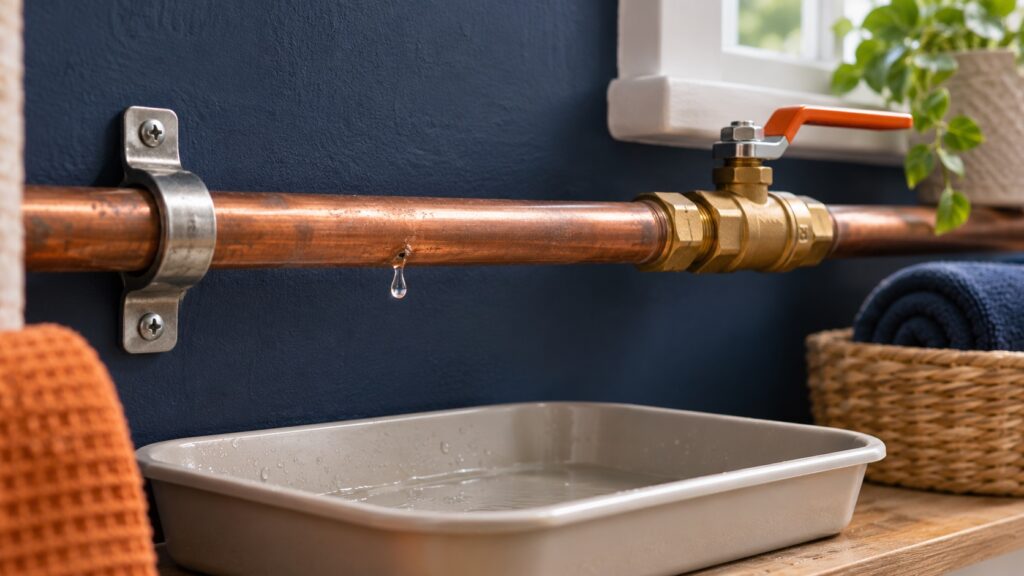
Leaking pipe: what should you do first? Keep people away from water that has reached an outlet, appliance, electrical panel or wiring. Do not cross wet flooring to reach a switch. If the route is safe, close the shutoff that supplies the leaking pipe; otherwise, ask someone who can safely reach the main water valve to close it. Protect belongings and arrange a repair suited to the actual fault. Tape, putty or a clamp may occasionally contain a small visible leak while help is arranged. None restores the strength of a damaged pipe.
“Pipe” may mean a pressurized supply line, a flexible connector, a drain or even a cold surface collecting condensation. Each calls for a different response. This guide helps you sort visible clues without opening a wall or working beside electricity. It cannot establish that a temporary patch will be safe for your particular installation. If water is spraying, a ceiling is sagging or another unit is affected, prioritize shutting off water and getting immediate help.
The first five minutes: a practical sequence
- Look at where the water is travelling and whether electrical equipment is involved. Stay out of an unsafe area and contact the appropriate emergency service.
- Find a known, accessible water shutoff. Turn it gently; a seized or corroded valve may fail if forced.
- From a safe position, check whether the flow is slowing. Continued flow may mean the valve serves a different line.
- Set a container under accessible drips and move dry belongings only when the area is safe. Photograph the leak and affected surfaces.
- Tell the owner, building manager or affected neighbour if water may leave your unit. Arrange inspection and drying of wet materials.
Do not spend the critical minutes shopping for tape while the line is still supplied. A modest drip can change as pressure varies or a fitting moves. Reducing the incoming water matters first. If you cannot use a shutoff, say so when you call. For a rupture and uncontrolled flow, our guide on what to do if a pipe bursts addresses the broader emergency.
When you should not approach the leak
Hydro-Québec warns that water damage can create an electrocution hazard. Keep clear of an electrical panel next to water. Avoid touching any wet outlet, switch, extension cord or appliance. Never enter a flooded area just to reach a valve on the far side. If you cannot reach the panel with completely dry hands, feet, footwear and floor, leave the area and contact Hydro-Québec or emergency services as the circumstances require. A master electrician should inspect affected electrical equipment before anyone uses it again.
Very hot water can scald. Avoid grasping a pipe, fitting or puddle whose temperature you do not know. A leak near a water heater also requires distinguishing a supply-line leak from a fitting, the appliance itself or its relief valve. Never block a safety discharge to stop a drip. A smell of gas, smoke or sewage changes the response: leave the hazard and contact the proper emergency service. Make the following observations only after you address immediate dangers.
Finding the right water shutoff without making matters worse
A small stop valve near a sink or toilet may isolate that fixture. It may not isolate the pipe you see inside the wall. A home’s main shutoff can be near the incoming service, but the location varies. In a multi-unit building, some valves affect shared supply, so building staff manage them. If you cannot tell what a valve serves, ask before operating it. Coordinate a shared shutoff so other occupants know that water service may be interrupted.
Operate only a control you can identify and safely reach. Do not rely on a handle that spins without closing, leaks around its stem or resists strongly. Do not apply extra force with a tool to win another turn; the valve could break and increase the leak. Once it is closed, watch the leaking point and an accessible nearby tap. The pipe can release a little residual water. Sustained flow suggests that the source remains supplied or that another part of the system is involved. Tell the plumber which valves were tried and what changed, without experimenting with unidentified controls.
Supply pipe, drain or condensation?
A water supply line can leak when no tap is running because it remains pressurized. A drain often leaks as a fixture empties; the water may come from a trap, a joint or even a different floor. Condensation forms on cold surfaces under humid conditions, but it should not be assumed without observing when moisture returns. Wipe an accessible dry surface only if it is safe, then note whether moisture reappears with no water use, only during use or with changes in humidity. Do not open a wall or ceiling yourself to prove a source.
If water appears only while a fixture runs, stop using that fixture and see whether the leak subsides. That pattern helps a professional but does not prove the visible pipe is the sole source. Moisture beneath a sink may travel from a tap, supply hose, drain joint or sink rim. Water can follow framing and stain a ceiling far from the failure. When the source remains uncertain, our article on signs of a hidden water leak explores the clues. Inspection is still the safer choice when building water is reaching building materials.
What the shape and location of the leak may tell you
A drip at a threaded joint, a crack in a valve body, a pinhole in a straight pipe and a leak at a flexible connector can require different lasting repairs. Describe where water first emerges rather than assuming the lowest drip is the source. If water and electricity are controlled, you can observe accessible surfaces with a light and take a wide and a close photo. Do not put your hand in a pressurized stream or move an unstable pipe to see behind it.
Green staining on copper, white deposits, rust or older water marks are reasons to inspect the surrounding installation; none alone identifies the precise failure. A bulging hose, crushed tubing, mobile joint or multiple stains on one run justify more than a surface patch. Weak adjacent material may defeat a local repair. The choice to replace a connector, a section or a longer run depends on pipe material, access, condition and applicable requirements, rather than on the appearance of one droplet.
Why temporary fixes have a limited role
An emergency product acts on the surface or compresses a seal around a defect. It does not remove corroded material, repair an unstable fitting or confirm that a pipe can safely return to normal service pressure. SharkBite’s guide to pinhole leaks treats epoxy and wraps as temporary approaches that leave weakened pipe in place. Product instructions and permitted uses vary. A product advertised for several pipe types is not automatically appropriate for potable water, hot water, an inaccessible location or a pipe that moves.
A patch can appear dry for a few minutes and leak again when water returns, heat cycles or pressure changes. Covering the point can also conceal the source and delay drying. Do not close a wall or cabinet around an emergency patch before inspection. Keep water isolated if the defect cannot be observed, the maker does not approve the application, or the nearby pipe is deteriorating. Even when dripping stops, arrange a lasting repair based on the underlying condition.
Tape, putty and clamps: why the label matters
Self-fusing tape and repair wraps have product-specific instructions about surface condition, stretch, overlap, temperature and approved use. Epoxy putty generally requires preparation and a curing period set by its maker. A clamp needs to fit the diameter and geometry; it may not address a crack close to an elbow or incompatible joint. These are product categories, not a universal repair procedure. Read the complete label before use and follow the maker’s limits. There is no single safe pressure rating or service life for every patch.
If the pipe is inside a wall, carries hot water, requires reaching around wiring, or cannot be isolated, do not try to apply a patch. Do not solder, heat or cut an unidentified line that remains supplied. A water supply system calls for compatible parts that meet applicable requirements. In Québec, the RBQ explains that contractors entrusted with plumbing work need an appropriate licence, notably subclass 15.5. Hardware-store packaging cannot diagnose the rest of a weak run or establish that a repair satisfies those requirements.
Signs to call a plumber promptly
- Water continues after the known shutoff is closed, or the shutoff does not work.
- Water reaches electrical equipment, a ceiling, a wall cavity or another unit.
- The pipe has a crack, several pinholes, swelling, extensive corrosion or an unstable fitting.
- You do not know the material or source, or the work would require opening a finished surface.
- A temporary measure seeps, moves or cannot be kept in view.
- The leak returns after work, or water pressure changes unexpectedly.
For those situations, request water leak detection and repair. Explain observations rather than ordering a particular method from a photograph. The plumber can distinguish a failed fitting from a damaged pipe section or water emerging from somewhere else. State whether the supply is closed and whether other materials are wet; those details help plan the visit.
What a lasting repair needs to address
A lasting repair addresses the failed component and considers adjacent connections. Depending on the diagnosis, this may involve replacing a section of pipe, a fitting, a valve or a flexible connector. The plumber then restores service appropriately and observes accessible joints. Material, diameter, access and use matter; a photo of a drip cannot identify a universal replacement part. Manufacturer instructions for the selected components and applicable rules guide the work.
Ask which section was examined and why a local repair is sufficient, particularly if small leaks have recurred. A new pinhole near an old one does not, by itself, prove the whole building needs repiping. It does justify discussing the condition of the wider run. Our planned guide on assessing the condition of plumbing pipes explains replacement factors without presenting one magic age for every home. Keep the installed part details and observations for future follow-up.
Limiting damage while you wait
When the area is safe, move documents and water-sensitive belongings out of the path. A container can catch accessible drops but does not replace shutting off water: it has limited capacity and can overflow unattended. Mop water from safe, non-electrical surfaces. Do not use an ordinary vacuum in a wet area. Photograph the extent before moving belongings, then record when you noticed the leak and closed the water. Notify building management or an insurer as your arrangements require without waiting to know the exact cause.
Québec government guidance advises cleaning and completely drying water damage within 24 to 48 hours to help prevent mould. That is a drying goal, not proof that a hidden cavity is dry on schedule. Drywall, insulation, wood and finishes can retain water while their surfaces look normal. If water entered a cavity or several rooms, arrange an assessment of materials and drying. Do not use electrical drying equipment in a space that has not been made electrically safe.
Different responsibilities in a house, condo or rental
In a detached house, learn the location of the main shutoff before an incident and keep access clear. Condo residents should know that a line that looks private may connect to shared supply; contact the association or manager if a shutoff could affect other units. Renters should report the problem to the owner or building contact and keep a record of what you observed and when you reported it. Liability and insurance depend on facts and contracts; this guide does not determine them.
If water is travelling toward a lower unit, make that clear in the first call. A ceiling without visible drips is not necessarily dry. In every setting, clear access to the leak, the shutoff and any installation documents you have. Do not hide a temporary patch behind a finish merely to turn the supply back on. The person making the final repair should be able to see the defect, the interim measure and the surfaces that were affected.
A useful description when requesting service
Give five facts: location, timing, approximate flow, shutoff status and wet materials. For example: “A droplet forms on a visible copper tube beneath the sink when the tap is off. The under-sink valve does not stop this tube, but the main shutoff reduces the flow. The cabinet floor is damp.” A wider photo shows the context; a close photo shows the water. Avoid declaring that a pipe is punctured if water might have travelled from a higher joint.
Add any prior repairs, the suspected material and any temporary product already used. Explain if children, neighbours or other occupants can enter the area. Mention hot water, electrical equipment or a wet ceiling at the start. Ask what conditions must be met before the supply can safely be restored and what to watch after the repair. A clear description helps the plumber prepare, though a remote diagnosis remains uncertain.
After the repair: observe before closing the area
After the responsible person restores water, observe accessible joints and the area that was wet. Check again after normal use, including a hot-water cycle if that line carries hot water. Do not immediately seal the area behind a panel if drying or monitoring remains. Another joint or still damp material may cause a returning stain; record the time and any change. The end of dripping does not prove the ceiling has dried.
Keep the invoice, description of work and part details, and before-and-after photos. Follow maintenance advice relevant to your installation. Identify and label shutoffs that the plumber has confirmed so a later incident is easier to manage. Continue drying affected materials and arrange assessment for hidden damage when needed. If water reached electrical equipment, do not use it again without the appropriate professional assessment.
Frequently asked questions
Can I leave the water on if it is only one drip?
A drop on a pressurized pipe is an active leak. Flow can change, and water may wet concealed materials. Isolate the line safely if you can, then arrange repair. A monitored container can protect a surface briefly; it does not make the pipe dependable.
Will repair tape hold until next week?
No general duration can be promised. Results depend on the product, pipe, preparation and operating conditions. Read the manufacturer’s instructions and keep the area visible. If water returns or the line cannot be isolated, leave it off and request prompt help.
Should I turn off power when a pipe leaks?
First avoid all contact with water and electrical equipment. Hydro-Québec permits approaching a panel only under fully dry and safe conditions. If water is near the panel or you would cross a wet area, do not approach. Leave and seek help. A master electrician should inspect equipment that became wet.
Why is the leak continuing after I closed a valve?
It may serve another fixture, fail to close fully or allow residual water to drain from the pipe. If the flow does not soon diminish, do not disassemble anything. Check only another known and accessible shutoff or ask building management and a plumber for help.
Does a ceiling stain prove the pipe immediately above it is leaking?
No. Water can travel along framing or come from an appliance, drain or other source. Protect the area, safely stop the relevant use or supply, and have the source located. Stay clear of a ceiling that is bulging or sagging.
What should I ask the plumber after repair?
Ask what source was confirmed, which portion the plumber replaced, which nearby joints were checked, and what was observed about the surrounding pipe. Confirm whether a temporary patch was removed. Keep part references and monitor the area during the first normal uses.
Useful sources
- Hydro-Québec — water damage and electrical safety: conditions for accessing a panel and what to do when the area is hazardous.
- Québec government — mould in the home: prompt cleanup and drying of water damage.
- RBQ — plumbing contractor licensing: requirements for contractors entrusted with plumbing work.
- SharkBite Canada — pinhole leaks: limits of patching and the need to assess weakened pipe.
For more on related problems, browse Leaks, faucets and fixtures. If the leak is active or inaccessible, describe what you can safely observe so an appropriate inspection of the line and affected materials can be arranged.