
Drains and sewers
Tree roots in sewer pipes: diagnosis, clearing and repair
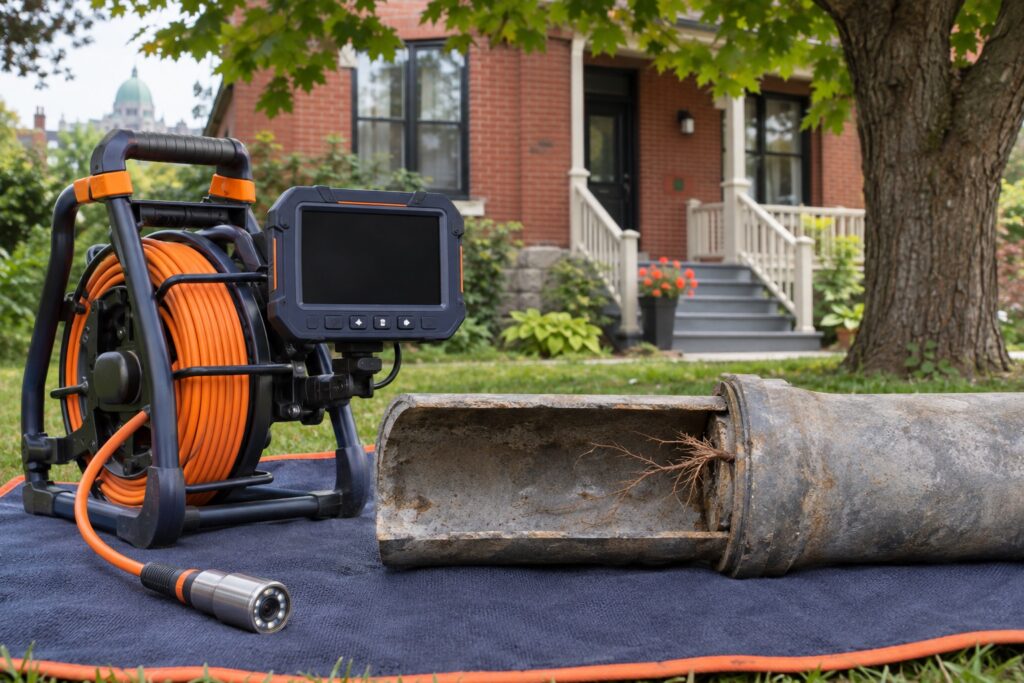
Tree roots in sewer pipes: clear the blockage and investigate the opening
Tree roots in sewer pipes call for a diagnosis before a treatment is chosen. Clearing a blockage may restore drainage, but it does not necessarily seal the joint or crack where the roots entered. The useful decision has three parts: make the situation safe, confirm what is obstructing the line and where it enters, then compare clearing with a repair of the damaged section.
A tree beside your house and a slow drain are not enough to establish the cause. In Montreal and across Greater Montreal, several drainage problems can produce similar symptoms. Observations inside the building need to be connected to evidence from the actual pipe. This guide explains what to record, what inspection footage can tell you and which questions help you compare options without pouring in a product or starting an improvised excavation.
Start here if wastewater is backing up
When wastewater rises through a floor drain, shower or toilet, stop using fixtures connected to the affected system. Postpone laundry, dishwashing and repeated toilet flushing. Adding more water to see whether the blockage has cleared can make a backup worse. Tell everyone in the building, especially where several apartments may discharge through the same pipe. A problem at one low fixture can involve water used somewhere else.
Keep children and pets away from contaminated water. Do not cross a flooded area to reach an outlet, pump or electrical panel. Stay clear of wet electrical equipment and seek appropriate help when electricity may be involved. Leave an area if a strong odour is accompanied by feeling unwell. Do not loosen a cleanout cap or open a chamber that could release wastewater under pressure.
From a safe location, record which fixtures are affected, when the backup began and what water use came immediately before it. Photos can help if they can be taken without entering the affected area. Tell the plumber about any drain cleaner already used, including the product and approximate time. Where several fixtures are involved, main drain unclogging requires a different assessment from a blockage at a single sink.
Why roots enter a sewer line
The City of Montreal explains the relationship between roots and damaged pipes on its French information page. Root intrusion can reveal an existing opening in the line. A nearby tree therefore does not, on its own, establish the original cause of damage or who is responsible. The defect and its location need to be assessed before decisions about the pipe or tree.
This distinction changes the result you should ask for. Removing an obstruction addresses the immediate drainage problem. Sealing or replacing a defective part addresses an entry route. Depending on the findings, these may be separate stages rather than one operation. Ask the professional to explain what can be restored during the initial visit and what would need a further inspection, quotation or repair appointment.
Do not arrange to remove a tree simply because it stands above the suspected sewer route. Avoid digging around the pipe and cutting substantial roots yourself. Tree stability, local requirements and nearby buried services also matter. An arborist and a plumbing professional answer different questions, and both assessments may be useful. Work on the sewer should not become an unplanned intervention on a public or neighbouring tree.
Which symptoms help narrow the investigation?
One slow fixture or several affected fixtures?
If one sink drains slowly while everything else works normally, a local restriction deserves attention first. Water rising at the lowest fixture after another appliance empties points towards a shared drainage issue that needs assessment. These observations help determine where to start. They do not identify tree roots in sewer pipes without further evidence, and they do not establish how much pipe is affected.
Describe sounds, odours and water-level changes in plain language. “The shower fills when the washing machine empties” is more useful than “the whole sewer is broken.” Explain whether this has happened once or repeatedly. Tell the plumber whether the pattern changed after a previous cleaning. Separating a direct observation from an earlier suggestion prevents an unconfirmed explanation from becoming the starting assumption for every visit.
A blockage that returns after clearing
A recurring problem is a reason to compare previous records. Were roots actually seen? At what recorded distance? Was the pipe inspected again after cleaning? An invoice that only says “drain clearing” may not answer those questions. Repeated blockages can justify an inspection, but they do not automatically prove that the entire lateral needs replacement. Ask which evidence supports the recommended scope.
Keep a short history with dates, affected fixtures, work performed and how long the improvement lasted. Add the recordings and reports you already have. If symptoms return quickly, contact the professional instead of repeating the same home treatment. This timeline helps distinguish an unresolved defect, incomplete clearing and a new incident. It also gives a second contractor useful context without requiring you to diagnose the line yourself.
What a camera inspection should establish
A drain camera inspection observes the accessible interior of the pipe. Ask where the recording starts, how far the camera travelled and which areas could not be seen. Footage ending at an obstruction is not a condition assessment of everything beyond it. Standing water, deposits and restricted access can all limit the useful view and the conclusions that can be drawn.
Separate three findings in the report: visible roots, a visible pipe defect and the extent of the inspected section. A recording may show fine roots without clearly revealing the opening behind them. The professional may recommend suitable clearing before another camera pass. Ask whether that second look is included and how the result will be recorded. You need to understand both the evidence obtained and the remaining uncertainty.
The distance displayed on a camera needs to be connected to the starting access point. It does not automatically establish an excavation location or confirmed depth. Before comparing repair quotations, ask how the suspected defect was located at the surface. A sketch showing the access, route and limitations makes it easier to see whether competing proposals are based on the same section rather than different assumptions.
Our guide to drain camera inspection costs and limitations explains questions about access, inspected length and deliverables. The inspection charge is not necessarily the price of clearing roots, repairing the pipe or restoring the yard. Ask for those stages to be distinguished before authorizing work. A clear record can remain useful even when a repair is planned for a later date.
Compare clearing, repair and a documented follow-up plan
Clearing creates room for drainage
A professional may consider a mechanical method or another cleaning approach suited to the observed system. The appropriate choice depends on access, pipe size, condition and the obstruction. More force is not automatically a better solution. Ask what the proposed method can remove, what it may leave behind and which precautions apply to your line. An equipment name alone does not describe the expected outcome.
Improved drainage after clearing is useful, but it does not show that the root entry point has been eliminated. Ask for a description of the achieved result: restored passage, visible pipe walls, remaining roots or an area that is still inaccessible. A written explanation helps you understand why a repair or further check is recommended even though the fixtures appear to work normally again.
Repair addresses a defective part of the line
If the assessment reveals an open joint, damaged section or another structural issue, sewer and drain line repair is a separate decision. Ask exactly which portion needs correction and why. A localized repair, a longer replacement and another rehabilitation method do not have the same scope or suitability. The recommendation should connect the observed defect with the proposed work.
If a trenchless option is suggested, ask about eligibility, access requirements and limitations. Do not assume it can correct every collapsed section, connection or slope issue. Ask who confirms the proposed method is suitable and which checks will follow. A technique being available somewhere in the industry does not establish that it is offered for your property or that your line meets its conditions.
Follow-up should match the actual history
Periodic maintenance may sometimes be discussed as part of temporary management. You should understand what remains defective and what symptoms require an earlier call. A maintenance calendar does not turn a damaged line into a repaired line. Compare the proposed monitoring with repair options, disruption, costs and the consequences of another interruption. Ask what finding would change the recommendation rather than accepting an indefinite sequence of identical visits.
The City of Ottawa describes targeted preventative maintenance for certain confirmed sewer problems. That program is an example of case-specific management, not a Montreal policy or an entitlement to municipal cleaning at your address. Your own plan must be based on your inspection and the local responsibilities that apply to the affected portion.
Root-killing products are not a substitute for diagnosis
Do not pour garden herbicide, salt, copper sulphate or a homemade mixture into a toilet to treat an unknown sewer problem. A chemical does not seal a defective joint or show the pipe condition. Retained liquid behind an obstruction can also complicate the next intervention. Never add another chemical to neutralize the first. Tell the professional what has already entered the drain before any tool is used.
For pest control products, Health Canada’s public registry provides registration information and access to label requirements. An overseas advertisement or social-media demonstration does not establish an authorized Canadian use. No product or dose can be recommended simply because a package or video mentions roots. The actual product, approved use and local restrictions need verification.
If you have already applied a product, retain the original container and describe the timing and circumstances. Avoid handling the trapped liquid or using a tool that could splash it. Seek appropriate medical or poison-control advice promptly if exposure or symptoms occur. Investigation of the sewer can continue once the immediate situation is safe. Do not assume that waiting for a while makes an unknown mixture harmless.
Montreal: locate the defect before assigning responsibility
A building’s sewer connection leads to the municipal system, but the procedure depends on where the problem is located. Montreal’s French page on requesting repair of a sewer connection directs owners to borough-specific requirements. Check the instructions for the property concerned. A document list for one borough should not be treated as a uniform rule for every address in the city.
Before sending a file, ask which documents are needed and in what format. Prepare the available recording, report, approximate route and professional observations. Confirm the current procedure with 311 or the relevant borough. Roots near a publicly owned tree do not, by themselves, establish who pays. Keep a distinction between reporting a suspected municipal issue and receiving confirmation of responsibility for a particular defect.
In Laval, on the South Shore or on the North Shore, contact the municipality responsible for the address. A report or approval used for a Montreal property does not authorize work elsewhere. For a condominium or rental building, also involve the person responsible for the property. Access arrangements, approval and the affected pipe may extend beyond your individual unit, even if the first visible backup happened inside it.
When excavation is being considered
Check permits, access and buried utility locating before digging. An Info-Excavation locate request is a prevention step, and owners of networks outside its membership also need to be contacted. A camera location mark does not replace all these checks. Do not start digging to help the contractor before the required precautions have been completed and the work area has been confirmed.
Discuss the surfaces that may need opening: lawn, driveway, steps, concrete or landscaping. Ask what will be protected, removed and restored, and what belongs to a separate contractor’s scope. Identify equipment access, vehicle access, permitted working hours and neighbouring-property constraints. These factors can change organization and cost even when everyone agrees on the defect inside the pipe. They belong in the quotation rather than being discovered during excavation.
Where work approaches a tree, arrange the necessary assessment before roots are cut. Tell the borough if a public tree may be affected. Sewer repair does not provide blanket permission to alter a tree or work on public land. The work plan should coordinate plumbing, buried infrastructure, tree protection and a safe route for occupants. Ask who handles each coordination step and which approvals must be in place.
Ask for a quotation you can compare
Separate diagnosis, initial clearing, permanent repair and surface restoration. A single total can conceal very different scopes. Ask about taxes, travel charges, access conditions and how unexpected work will be brought to you for approval. There is no reliable repair price that can be inferred from the amount of root material in one image. Location, depth, length and restoration requirements all need an actual assessment.
For each option, identify the intended result, exclusions, treated section and documents supplied. Ask for written warranty terms without assuming they cover the entire drainage network. If another inspection is needed before a repair can be priced, request its charge and deliverables. You can then approve a defined diagnostic stage instead of authorizing a project whose boundaries are still unclear. Keep a copy of the agreed scope.
Distinguish a preliminary estimate from a quotation prepared after inspection. A price difference may reflect a different depth, repair length or restoration assumption. Ask for those assumptions to be written down before choosing. The lowest figure is only comparable when the work and exclusions are sufficiently similar. Also ask how completion will be checked and what information you will receive if part of the line remains unexamined.
After the visit: records and useful monitoring
Before the professional leaves, ask how normal fixture use should resume and which signs warrant a call. Keep the invoice, report, footage and location information together. Note which accesses need to remain clear. A retrievable recording with its starting point and inspection limits is more useful for a later assessment than an isolated screenshot. Store a copy somewhere you can find without depending on an old message link.
Keep wipes, paper towels, grease and other waste out of the drains. This does not repair a damaged pipe, but it avoids adding material that can contribute to a blockage. For follow-up planning, read our guide to drain maintenance based on observed problems. The next examination should reflect the documented history rather than an assumed universal cleaning interval for every home.
If a new slowdown develops, revisit the records before attributing it to the same roots. Record the date, fixtures affected and any changes since the work. You do not need to wait for another overflow to ask for advice. Useful monitoring recognizes a change and revises the plan. It should not become repeated emergency clearing with no explanation of what has been observed or why the recommendation stays the same.
Prepare access without opening the sewer
From a dry, safe area, remove ordinary objects blocking the route to the basement or utility room. Gather previous invoices and available plans. Mention access points concealed by furniture or finishes, but do not remove a cleanout cap to demonstrate the problem. In a shared building, arrange for the person with keys and authority to provide access. This preparation helps the visit proceed without adding a risky test or disturbing the evidence beforehand.
Frequently asked questions
Should I remove the tree to solve roots in the sewer?
Not simply because it is nearby. First confirm root intrusion and the pipe defect. A decision about the tree requires its own assessment and compliance with local rules. Removing a tree does not seal an open pipe joint. Ask what plumbing correction is needed and how the tree will be protected during the proposed work.
Does drain clearing permanently solve root intrusion?
It can restore passage without repairing the entry point. A post-clearing report should explain what was seen and what remains to be examined. Repair decisions depend on the actual pipe condition, recurrence and suitable options. Normal drainage alone therefore does not establish a lasting solution or a guarantee against further blockage.
Who should I contact if the defect appears to be under the street?
In Montreal, contact 311 or the relevant borough for the procedure and document requirements. Elsewhere, check with your municipality. Have the defect located and retain the report before assigning costs. During an active backup, stop water use and keep people away from contaminated areas while appropriate assistance is arranged.
To discuss the next step, contact ProDrain with the affected fixtures and previous inspection details. Find related explanations in Drains and sewers.