Pipes and water supply
ABS vs PVC drain pipes: differences and compatibility
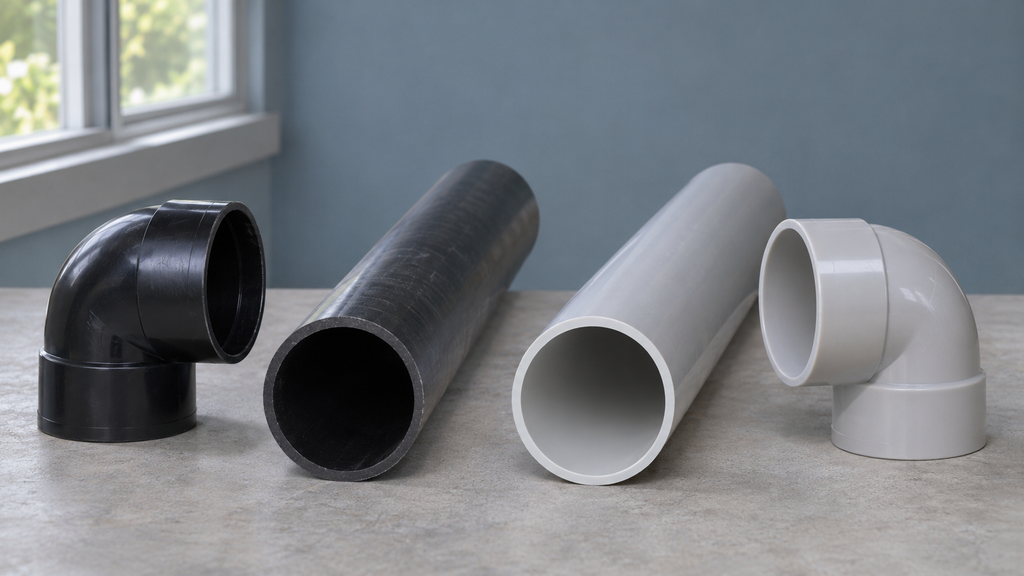
ABS or PVC for a drain? Both materials can be used in appropriately specified drain, waste and vent (DWV) systems, but the letters alone do not tell you which pipe belongs in a particular Canadian building. Start with the function of the line, the markings on the pipe and fittings, and the construction requirements at that location. If an existing ABS run needs to meet PVC, the joint calls for a documented transition method suitable for those exact products and a non-pressure drainage application. Ordinary ABS cement, ordinary PVC cement, a similar colour, and a fitting that happens to slide on are not proof of compatibility.
This guide concerns interior drainage and venting, especially an existing home being repaired or renovated in Quebec. It is not an installation manual. A sewage backup or water near electrical equipment needs attention before any material comparison: stop using the affected fixtures, keep people away from contaminated water, and do not enter water near energized equipment. If several fixtures are backing up at once, the question may involve a shared drain rather than the visible pipe beneath one sink.
The short answer: identify four things first
ABS stands for acrylonitrile-butadiene-styrene; PVC stands for polyvinyl chloride. Both names cover products manufactured for particular uses. DWV pipe carries wastewater and vents the drainage system; it is not automatically a potable-water supply pipe, an appliance exhaust vent, an exterior sewer product, or a foundation drain. The distinction matters because a product that is acceptable in one system may have different standards, joints and placement restrictions in another. Our guide to identifying plumbing pipe materials puts this drainage comparison alongside supply piping and other materials.
Before choosing a replacement part, ask four questions. First, what does the line actually do: receive waste from a fixture, vent a trap, carry potable water, or serve another system? Second, what are the full markings on the accessible pipe and fitting, including the standard and nominal size? Third, where will the new joint be made, and what building assembly or other system does it pass through? Fourth, which pipe, fitting and joining-product instructions cover that specific combination? These questions are more useful than asking which plastic is generally “better.”
Quebec rules and product documentation work together
Quebec’s Chapter III, Plumbing, of the Construction Code is based on the National Plumbing Code of Canada 2020 with Quebec amendments. The Régie du bâtiment du Québec’s explanatory guide describes the amended requirements and the July 11, 2024 coming into force, including transitional conditions for work begun earlier. The National Research Council’s Quebec plumbing code publication is the place to check the applicable text rather than importing a rule from a different jurisdiction.
A RBQ good-practice sheet concerning fixture waste piping refers to CSA B181.1 for ABS DWV and CSA B181.2 for PVC DWV in its specific context. A standard printed on a tube is an important identification clue, but it does not certify the rest of an installation. The fitting must be suitable, the joining method must match, and slope, support, venting, fire protection and location requirements still matter. The installer needs to assess the complete assembly, not a single line of print.
Why a general material rule is insufficient
Requirements can change with the building and the route. An exposed run, a concealed wall, a fire separation, a buried segment and an exterior connection raise different questions. A product intended for a combustible building cannot be assumed acceptable in every other building. Quebec’s amended provisions also address certain cellular-core PVC products within defined conditions; that change does not make every cellular-core PVC pipe interchangeable with solid-wall PVC or ABS. Ask for the product’s applicable standard and the reason it is appropriate at the actual location.
First distinguish drainage from water supply
At a sink, the small lines feeding the faucet carry water under pressure. The trap and the outlet leaving the sink carry wastewater; another concealed portion may vent the drainage system. A larger pipe crossing the basement could be a branch, stack or building drain. Its visible position does not reveal every fixture connected upstream. Drawing a simple sketch of the accessible run and noting affected fixtures helps a plumber identify the right system without opening a joint.
Do not use a DWV description as evidence that a pipe is approved for drinking-water supply. PVC appears in multiple product families, and CPVC is a different material again. Plastic venting for fuel-burning appliances is subject to separate requirements. A nominally matching elbow from a different family may not be the correct fitting. If the pipe is painted or hidden, a photograph of a similar-looking product online will not establish the specification. Keep the question tied to the markings and the product literature.
Likewise, slow drainage, gurgling or sewer odour does not prove that ABS or PVC is the cause. A blocked trap, inadequate venting, a poor slope, a shared downstream restriction or another defect could create similar symptoms. Avoid mixing chemical drain cleaners or opening a cleanout that could release backed-up wastewater. Note which fixtures are slow, whether they react when another fixture runs, and whether any overflow has occurred. Those observations are safer and more useful than an improvised material test.
ABS and PVC DWV: a practical comparison
Both are rigid plastic pipe-and-fitting systems sold for drainage applications. Neither corrodes like metal, but neither is immune to damage from an unsuitable installation, impact, movement, excessive temperature or a failed joint. ABS DWV is commonly black. PVC DWV may be white or another colour depending on the product. Colour can tell you where to look for a marking; it cannot substitute for reading one. Paint, age and dirt make appearance even less reliable in an older renovation.
The practical advantage of staying within a documented system is that compatible pipes, fittings and joining materials can be selected together. Manufacturers maintain distinct catalogues, such as IPEX’s ABS DWV line and Canplas’s PVC DWV fittings. These are examples of product families, not endorsements or proof that two unrelated catalogue items can be joined. Dimensions, wall construction, fitting geometry, application and certification all need to match the selected assembly.
Questions that matter more than a slogan
People sometimes hear that one plastic is always stronger, quieter, easier to work with or better in the cold. Those claims cannot rank every pipe for every building without naming products, test conditions and installation details. Acoustic and fire requirements, movement, support, fitting availability and the existing route may influence a real choice. In a multi-unit building, the surrounding construction can matter as much as the pipe itself. Ask what system is proposed and what documentation supports it instead of choosing by reputation alone.
Wall construction deserves attention. The RBQ’s explanatory material describes a defined provision for certain light-grey cellular-core PVC pipe meeting ASTM F3128 and CSA B181.2, subject to specified building limits. That is a narrow allowance, not a blanket rule for all hollow or foam-core products. A nominal size shared by two pipes does not settle whether one may replace the other. The full marking and the applicable code section tell a more precise story than the colour of the cut end.
How to read markings without making a guess
On an accessible, undisturbed section, photograph the entire printed line if possible: material letters, DWV or another application, standard, nominal diameter, manufacturer and certification mark. Markings repeat along a pipe, so a second accessible spot may reveal missing text. Include a wider photograph that shows the fitting and nearby fixture. Do not remove finished wall material, insulation or fire protection merely to expose a label. A professional may need to identify concealed portions by other appropriate means.
A black pipe is not automatically ABS; a white pipe is not automatically PVC DWV. Paint or a different product line can disguise the material. Even a clear label on one piece says nothing certain about the next fitting or a concealed repair. If the writing is illegible, record that uncertainty. It is better to identify the pipe before specifying a solvent than to order a part based on a colour convention that might not apply.
Size and fittings are part of the marking question
Nominal pipe size is not simply a tape measurement around the outside. It describes a particular product series, and fittings have their own intended connections. Two pieces may seem to fit while leaving an unapproved interface or a wall-thickness mismatch. A shopping list based on “it looks like two inches” can produce a fitting that cannot be used. Photograph any packaging or moulded fitting marks you can see and have the actual series identified before a repair is specified.
Why an ABS-to-PVC joint needs special care
A change of material in a drain is not automatically prohibited, but sliding two ends together does not establish an approved connection. The installer must identify both pipe systems, confirm that this is a non-pressure DWV application, locate the joint, consider access and support, and use a transition method suitable under the applicable requirements. A connection to an exterior sewer, a buried joint or a fire-rated penetration may call for a different assessment from a visible indoor branch.
Specially formulated ABS-to-PVC transition solvent cements exist for certain non-pressure applications. For example, IPS describes a Canadian transition cement with CSA certification for non-pressure components. The existence of that product is not permission to use ordinary ABS cement on PVC, ordinary PVC cement on ABS, or any transition cement on a pressurized drinking-water line. The exact product listing, both pipe types, code provision and manufacturer directions have to fit the actual joint.
Mechanical transitions depend on their listing
An appropriately approved mechanical transition fitting may be another option for specified materials, sizes and locations. “Rubber coupling” is not a sufficient specification: dimensions, certification, support and intended use need to match. A concealed joint, buried connection or fire separation can introduce additional constraints. Ask the professional to explain which listed component is being proposed and where it is permitted, rather than treating a general video or retail label as a construction detail.
Solvent cements also have their own safety, ventilation and handling instructions. This article does not give an application sequence or drying time, because those depend on the documented products and conditions. A poor joint can leak quietly inside a cavity and damage finishes well before anyone notices. Ask for the references of the two pipes, fitting or cement and installation instructions used. A credible answer is specific to this joint and building, not “universal glue works on everything.”
Repairing an existing branch without overreacting
A small damaged branch near one fixture does not by itself require replacing an entire stack. Conversely, a visible leak may be one sign of a broader problem with nearby joints, slope or support. First locate the defect and describe what is actually known, including what remains concealed. Our guide to assessing pipe condition before replacement explains why age and appearance alone do not diagnose the condition of a whole plumbing system.
A house with several renovation phases may contain both materials without a record of when each transition was installed. A photograph cannot establish that those joints comply or are watertight. Find out which fixtures use the branch, where the material changes, and whether the joint will remain accessible. If a wall must be opened for an authorized repair, keep a record of the accessible condition and product references before it is closed. The material choice should address the actual repair, not distract from an unresolved cause.
Neither ABS nor PVC can correct a bad route by itself. A sagging horizontal run, poor slope, inadequate support or unsuitable bend may contribute to repeated deposits regardless of polymer. Changing a short section to a different plastic may leave the geometry unchanged. Venting and fixture connections are part of the same drainage system. When several fixtures back up together, an assessment of the common line takes priority over comparing one visible elbow beneath a sink.
What to ask before work begins
Ask which section is proposed for repair and what evidence points to it. Which markings have been confirmed on the existing pipe and fitting? Which new system and series will be used? Where will the transition sit, and what specific component or cement is suitable there? How will slope, support and leak-tightness be checked? Which portions are still hidden, and what uncertainty remains? Clear answers help you compare plans without assuming a higher quote means an inherently superior plastic.
Mention a multi-unit building, shared drain, fire separation or concealed chase early. The work may need coordination beyond one suite, and a detail accepted in a detached house cannot simply be carried into another building type. If a line crosses an assembly meant to resist fire, the surrounding protection has to be considered along with the pipe. Ask how access and documentation will be handled. Avoid accepting a vague assurance based solely on a similar job elsewhere.
After the repair, retain product references, photographs of the accessible joint before closing and a description of the transition method. Note the symptoms that prompted the work and whether they resolve under the checks agreed with the contractor. Persistent sewer odour, new moisture or another backup deserves follow-up; none proves by itself that ABS or PVC was intrinsically the wrong material. The diagnosis concerns the complete drainage system and the actual installation.
Frequently asked questions
Can you glue ABS directly to PVC?
Do not assume an ordinary solvent cement can join them. Certain transition cements are specifically listed for some non-pressure DWV applications, while another situation may require a suitable mechanical fitting. The materials on both sides, product certification, location, Quebec requirements and manufacturer instructions determine the answer. A pressurized water-supply line is outside this comparison.
Is every black drain pipe ABS?
No. Colour is a clue, not a specification. Paint, dirt and different product lines can mislead. Look for material, application, standard and certification markings on the pipe and fittings. If these cannot be read safely, have the system identified before choosing a joining method.
Is PVC always better for a house drain?
No universal ranking applies. Both ABS and PVC have DWV systems for defined uses. The certified product, building conditions, fittings, fire requirements and workmanship matter more than a blanket preference. Compare documented systems for the actual location.
Can PVC drainage pipe supply a faucet?
Never infer that from the material name. Potable-water supply under pressure has different product and certification requirements. PVC includes multiple product families. A pipe marked DWV does not become a water-supply pipe because the nominal diameter appears to fit.
Must all piping be replaced if ABS and PVC are both present?
Not automatically. Their coexistence alone proves neither a defect nor compliance. The transitions, application, symptoms, condition and route need assessment. A local repair can be appropriate in some circumstances, while a common-line problem may call for broader evaluation.
What photographs help with an assessment?
Show the accessible run in context, the fixture it serves, fittings, full markings and any visible leak. Note when the symptom occurs and whether other fixtures are affected. Do not open a joint, remove protective material or approach electrical equipment or sewage to obtain a photograph.
For related guidance, browse Pipes and water supply. The official and manufacturer sources above explain the governing principles; identifying the actual products and installation is still necessary before choosing a transition.