Drains and sewers
Drain camera inspection: cost, inclusions and limitations
UNDERSTANDING YOUR QUOTE · DRAIN CAMERA INSPECTION
Start with a clear assignment and findings you can use after the visit.
Drain camera inspection cost depends on access, the section to be examined, conditions inside the pipe and the documents you receive. Compare quotes by asking what each visit actually covers. A camera inspection, clearing followed by a camera inspection, and locating a problem to prepare a repair are different assignments.
There is no confirmed ProDrain price here that applies to every property. An online figure cannot replace a proposal for your installation. This guide helps you describe your needs, compare the work offered and understand the limits of the images before making a larger repair decision.
Which drainage system are you asking about?
This guide concerns pipes that carry wastewater, including sanitary drains and a building’s sewer connection. Start by describing the affected fixtures and the reason for the inspection. A slow kitchen sink, recurring backups at several fixtures and a pre-purchase investigation do not necessarily require the same scope of work.
A French drain, also called a foundation or perimeter drain, serves a different drainage question. Inspecting that system does not replace inspecting the sanitary sewer. Read what a French drain inspection includes when your request concerns foundation drainage. Keeping the systems separate prevents misleading comparisons between prices for different access conditions and objectives.
You do not need to map every pipe before calling. Describe what you know: “Water came up through the floor drain during laundry,” or “I need information about this line before deciding on a repair.” The professional can then explain which part is accessible and whether a camera can answer the question you want resolved.
In a rental building or condominium, say whether one unit or several units have reported symptoms. Share observations without deciding that a common stack must be defective. Confirm access and authorization with the person responsible for the building. A visit delayed by an inaccessible room cannot deliver the same result as an assignment prepared around the actual conditions.
What changes drain camera inspection cost?
A suitable access point
A visible cleanout does not establish that it provides access to the entire section you want examined. Its direction, condition and working space can affect the inspection. Describe where it is and ask whether a photo taken from a safe distance would help. Do not remove a cap or disconnect a fixture to improve a photograph.
If storage blocks the area, explain what can safely be moved. If a different entry point is needed, ask what additional work would be involved and who would approve it. Removing and reinstalling a fixture, restoring finishes or creating access should not become an assumed inclusion simply because the quote contains the word “camera.”
The intended route and conditions inside it
Ask where the inspection will start and which section the contractor intends to examine. The advertised length of a camera cable does not promise coverage of every pipe at your property. Bends, branches and obstructions can affect progress. A useful proposal explains what happens if the camera cannot reach the intended endpoint.
A planned visit and an active backup involve different circumstances. Explain your availability and ask about travel charges, minimum visit fees or after-hours charges, where applicable. Confirm taxes and payment terms. None of these items should be inferred from a number quoted in an old article or from a price for an unrelated building.
Cleaning and other work
Inspection and clearing have different purposes. An obstruction may need attention before useful images can be obtained, but that does not make every camera inspection a cleaning package. Ask how professional drain cleaning would be proposed and charged if it becomes relevant to your situation.
Agree on an approval point before the visit: who will contact you, what information you will receive and how you will approve an extra charge. You can ask for a revised written description before deciding. This matters especially when you will be away. The person providing access should not have to improvise a financial decision on your behalf.
Compare the quotes in the same order
The total price matters, but it does not describe the assignment by itself. Write each company’s answers beside the same set of questions. A blank answer is a reason to ask for clarification; it is not evidence that the item is included. Also ask when the records will be ready and who will receive them.
- Purpose: the system, the question and the section to be examined.
- Access: the assumed entry point and the plan if it is unsuitable.
- Work: inspection, any separate cleaning and approval of additions.
- Deliverables: a saved video, still images, written summary or detailed report.
- Location: a video distance reference, surface locating or another clearly described task.
- Limitations: the handling of incomplete coverage or poor visibility.
- Charges: the pricing method, travel, taxes and payment terms.
Québec’s Office de la protection du consommateur explains written estimates as a way to compare proposed work. For your inspection request, the practical exercise is to have companies describe the same need. Keep the original request and their clarifications so you can check what you accepted.
Read the exclusions as carefully as the headline price. A modestly priced limited inspection may be appropriate for one question while failing to provide a document needed for another purpose. Conversely, the longest report is not automatically the right purchase for every concern. Choose the records around the decision you need to make, rather than the number of pages promised.
Watching the screen versus receiving a file
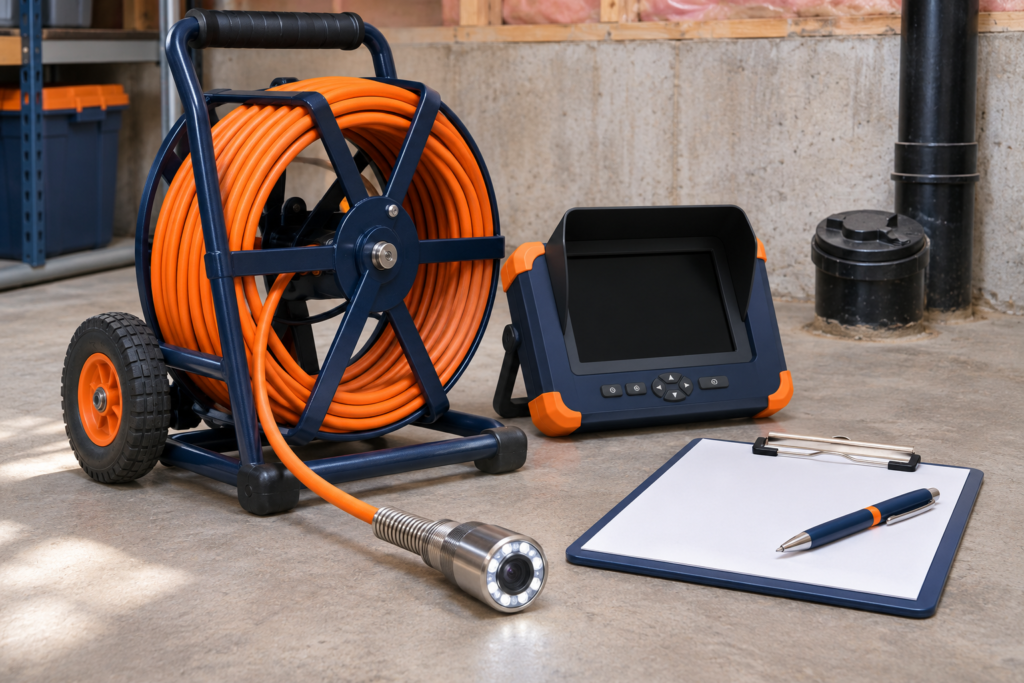
Watching the monitor during the visit lets you ask questions, but it does not necessarily leave you with a recording. Confirm whether a saved video is included, how it will be sent and how you should retain it. If the company uses a temporary download link, save the file within the stated period. Check that the file opens before considering the handover complete.
A usable record identifies the property, visit date, entry point, direction of travel and section observed. Ask how comments and distance readings relate to the video. A single image becomes difficult to interpret when its location and surrounding conditions are unclear. Keep the original recording with the written explanation rather than separating them into unrelated folders.
What camera images can and cannot establish
A camera provides a view inside the accessible part of a pipe under the conditions present during the visit. It can help document a visible obstruction or abnormality. It does not automatically examine obscured areas or reveal everything outside the pipe. Conclusions should match the visibility and coverage actually obtained, rather than the level of certainty you hoped to receive.
The manufacturer’s RIDGID SeeSnake operating instructions discuss camera movement, distance counters and equipment precautions. They help explain why operating conditions matter. They do not establish which equipment ProDrain will use or that every function described by that manufacturer forms part of your proposed visit.
A pipe video alone is not a watertightness test, a complete slope survey or a service-life guarantee. If a conclusion concerns one of those subjects, ask what method and observations support it. This separates a visible finding from an interpretation or a recommendation for another type of investigation. You can ask for that distinction in plain language.
An incomplete inspection should be described as incomplete
If the camera stops, ask where the inspection began, how far it progressed and why it could not continue. The report should distinguish viewed sections from sections that were not examined. An inaccessible pipe has not been declared sound, but failure to pass the camera does not, by itself, establish that the pipe is broken.
Ask what next step would answer the unresolved question. Would it involve clearing, another access point or a different assessment? Find out what new information the proposed step could add. That gives you a concrete reason to decide, instead of paying for an essentially repeated visit that leaves the same uncertainty unresolved.
Video distance and surface location are different questions
A distance shown on a recording helps find an observation within the camera’s route. It does not necessarily replace locating that point at the surface. If a repair is being considered, ask how its location will be confirmed and what accuracy can reasonably be expected. Do not convert a cable reading into instructions to dig at a guessed spot.
A surface mark also needs context: what does it identify, how was it established and what are its limitations? Confirm whether locating is included or requires another assignment. Keep a sketch with useful permanent reference points. Do not assume a temporary mark will remain readable until a later project begins, or that it identifies other buried utilities.
Turn the findings into a practical decision
Begin with a simple explanation of what was actually seen, where it appeared and how clearly it could be viewed. Then discuss its possible effect on drainage and the available options. A useful conversation separates the observation, its interpretation and the recommendation. That makes a second opinion or a repair comparison more meaningful.
If roots are observed, the related guide on tree roots in a sewer line explains the separate questions involved. Clearing roots and addressing their entry point are different decisions. Ask what supports the recommendation for your line. A nearby tree is not enough to explain every drainage symptom without observations inside the relevant pipe.
Before accepting major work, ask which section the proposal covers, what alternatives were considered and what remains to be confirmed. Retain the recording so later discussions use the same evidence. If the recommendation is urgent, ask for the observed risk and the reason for the proposed timing. Urgency should be explained in terms you can understand.
In Montréal, check the municipal documentation requirements
When a concern may involve a sewer connection beneath public property, check the procedure for the relevant borough. The City of Montréal’s sewer connection repair procedure describes conditions and documents to provide. Some procedures require a recording with visible distance progression and a report. Confirm the applicable requirements before commissioning the documents.
A problem beneath the street does not automatically mean that the City will undertake or pay for every part of the work. Do not apply Montréal’s procedure to Laval, Brossard or another municipality without checking. Contact the responsible municipal service and ask how your particular report should be handled. This article does not determine legal responsibility for a pipe or repair.
For an insurer, condominium syndicate or property transaction, ask the intended recipient what records are required. A video useful for a technical discussion is not automatically sufficient for another process. Obtain the requirements before the visit and pass them to the company. A report cannot guarantee acceptance of a request, insurance coverage or reimbursement.
Prepare the visit without opening the drainage system
Gather previous invoices, available reports and dated observations. Note the fixtures affected, how often the problem occurs and any recent work. Tell the professional about products poured into the drain, even if you are unsure of their ingredients. Do not mix products or add a drain cleaner to “prepare” for the camera inspection.
Clear only a safe, dry route to the known area. Keep pets away and describe building entry or parking constraints. When several people occupy the property, agree on who will communicate any instructions about fixture use. Do not ask someone to recreate a backup to demonstrate it. A description and existing photos are safer than deliberately releasing more wastewater.
Choose who will receive the findings and who can approve a change in scope. Arrange a way to reach that person. In a rental or condominium setting, settle permissions with the appropriate people before the visit. Clear communication keeps a technical question from becoming an improvised decision made by someone who was only supposed to unlock a door.
A short question list for the visit
- What question is this inspection intended to answer?
- Which section was actually viewed, and from which entry point?
- Which images support the explanation?
- What remains unknown after the visit?
- Which files or documents will I receive, and when?
- What decision is needed now, and what can wait for clarification?
Afterward, compare the invoice with the accepted scope and any approved additions. Store the quote, messages, report and recording together. Add your own notes about the explanation without changing the original files. A clear record helps if symptoms return or another person needs to take over responsibility for the property.
Use the report to organize follow-up
Before closing the conversation, ask which signs should prompt another call and whom to contact about a question in the report. Separate a recommendation to monitor conditions from a recommendation to undertake work. If follow-up is proposed, ask what its purpose would be and what information should be available by then. Avoid treating an undefined future visit as an automatic requirement.
If you seek another proposal, provide the same original recording and scope to the next company. Ask it to identify any missing information before recommending its own investigation. This does not mean a second inspection can never be justified. It means the additional assignment should have a stated purpose, such as resolving a documented coverage gap, rather than being ordered without discussing the existing evidence.
For planned work, keep your priorities separate: restoring drainage, understanding an unexplained symptom and preparing a structural repair are related but distinct goals. Write down which goal you are authorizing now. That simple record helps you understand the next estimate and prevents a discussion about one problem from quietly becoming an open-ended commitment to several projects.
Keep a separate list of questions that remain unanswered. Bring those back to the professional instead of trying to diagnose a paused image on your own. If explanations seem inconsistent, ask which point in the recording supports each one. A timestamp can make that conversation much easier to follow. When sharing the file with another professional, include the written limitations as well as the images. This helps preserve the difference between an observed section and an area nobody was able to examine. It also gives the next person a fair opportunity to explain what the existing record can resolve before proposing more work.
Common questions about price and scope
Does a camera inspection always include unclogging?
No. Ask for the two tasks to be described separately. A blockage may limit visibility or progress; if that happens, ask what intervention is proposed, how it is priced and how you will approve it. Do not assume one quoted amount covers every possible intervention.
Can the camera guarantee the line will never leak?
No. The images document the accessible section under the conditions of the visit. They do not replace every other assessment or guarantee future performance. Ask for clear findings, stated limits and practical signs to watch for afterward.
Should every plumbing system be inspected before a purchase?
Define the question with the relevant professionals and account for the transaction’s deadlines. A targeted sanitary inspection is not an inspection of every system in the building. Confirm scope, authorized access and expected documents before booking.
How do I obtain a relevant drain camera inspection cost?
Describe the symptoms and purpose, identify any known access and request written inclusions. To arrange a drain camera inspection, prepare observations instead of selecting a repair in advance. The assignment can then reflect the actual installation and the decision you need to make.
Continue with Drains and sewers for related topics. The OPC’s advice before hiring a plumber provides another Québec reference when choosing a company. Aim for a clear assignment, accessible findings and a next decision supported by what was actually observed.