
Toilets
Water around a toilet base: how to find the source
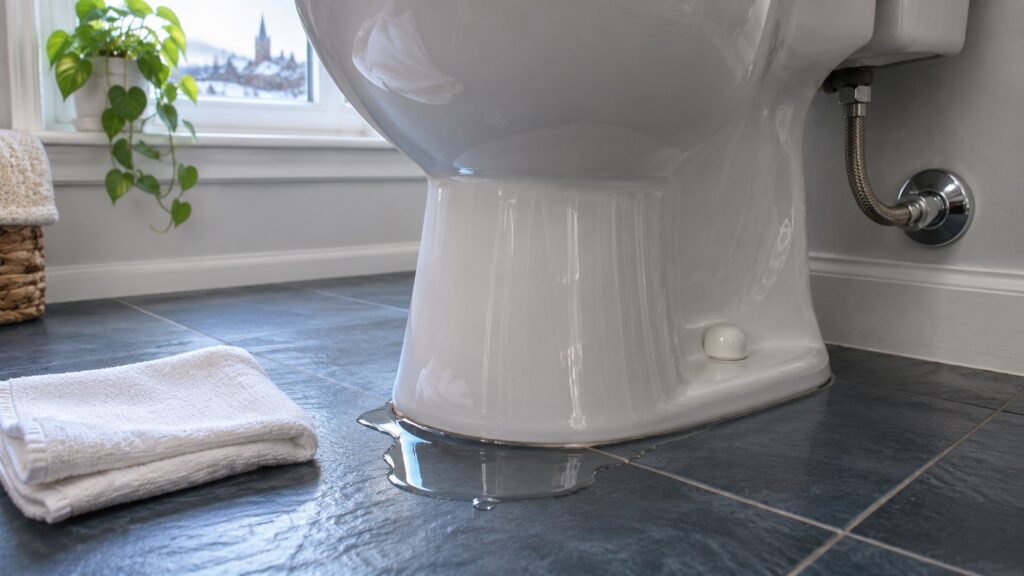
Water around a toilet base does not automatically mean the seal beneath the bowl has failed. A supply connection, tank, condensation or water from another fixture can travel down to the floor. A leak that appears during a flush is a different clue from one that continues while the toilet is idle. Start by limiting the water and observing safely, not by dismantling the toilet.
First steps when the floor is wet
If water is accumulating quickly, close the toilet’s shutoff valve gently if it is accessible and works normally. It is usually near the wall where the supply line connects. Do not force a seized or corroded valve. If water continues, the local valve leaks, or you cannot reach it safely, use the main water shutoff only if you know where it is and can operate it without risk. Tell other occupants because it can interrupt water elsewhere.
Stop flushing if the water returns, the toilet overflows, or its source is unclear. Keep children and pets away from potentially contaminated water. If there is a sewage smell, visible waste or backups at other fixtures, avoid contact and arrange professional help. Never step into water near an outlet or electrical appliance. If water threatens electrical equipment, keep clear and have power isolated safely by a qualified person or the utility as appropriate.
When the situation is stable and the water appears clean, use towels to dry accessible surfaces so that a new drop is easier to locate. This is not a substitute for professional cleanup of sewage-contaminated water. If water is reaching another room or the ceiling below, notify the building manager or affected occupants promptly. Photographs taken before cleanup can help document the progression for the property owner or insurer.
Why water at the toilet base can be misleading
Water follows gravity and the contours of the fixture. A drop at the underside of the tank or supply connection can travel down the porcelain and emerge at the floor on another side. Water splashed from a shower or bath can also move under a mat before appearing beside the toilet. The puddle’s position is useful information, but it is not proof of the failed component.
Supply line and shutoff valve
Look at the accessible valve, flexible line and connections, including their undersides. A drop that reforms while no one uses the toilet may point toward the pressurized supply or the tank. Do not tighten a connection at random. A fitting may be cracked, worn or difficult to reach, and excessive force can make damage worse. Note where the first new moisture appears and whether it continues after the valve is closed.
Tank and tank-to-bowl connection
A leak from the tank, a fitting or the connection between tank and bowl can run down to the base. Examine the visible outside surfaces for a wet trail. Some leaks are most noticeable during refill; others continue while the tank is full. Do not remove the tank or disturb corroded bolts to confirm a theory. Record what you can see and let a plumber assess components that are not safely visible.
Condensation or splashes
In a humid bathroom, a cold tank can collect droplets that run onto the floor. Look for widespread moisture on the outside of the tank after a hot shower, rather than a single wet fitting. Ventilate the room where possible and check that the bathroom fan operates. Still, do not assume condensation explains a recurring puddle. Water that returns on a dry day, follows a connection or persists after the room dries needs further assessment.
Observe the timing without creating another spill
Once the leak is controlled and the area is safe, dry visible surfaces and place separate pieces of absorbent paper beside the supply connection, behind the bowl and near the puddle. Do not obstruct the valve or put anything where it could fall into the toilet. Wait without using the fixture. A new mark appearing high on a connection before the floor becomes wet can help describe the path of water.
Do not flush to reproduce a leak whose source is unknown, even if the water looks clean. Stop using the toilet and ask a plumber for advice. If the leak is substantial, the bowl is overflowing or water is approaching electrical equipment, stay away from the hazardous area. Instead, describe what you have already observed: water discovered after use, a mark present beforehand or moisture appearing without any known use. A leak noticed during a flush can involve the outlet or another component affected at that time. That timing does not establish the cause and is not a reason to test again.
Record what happened before the floor was wet: the fixture was idle, the tank was refilling, a flush occurred, or a nearby shower was used. If you cannot inspect behind the toilet without moving heavy furniture, touching wet electrical equipment or putting yourself in an awkward position, do not insist. A photograph from a safe distance may help, but it does not replace inspection.
Is a toilet base leak always caused by the seal?
No. A failed seal below the bowl is one possibility, especially if water appears during a flush, but supply and tank leaks must also be considered. A rocking toilet, a damaged floor or recent installation gives the plumber useful context. It does not reveal the condition of the flange or seal without removing the fixture.
Do not cover a leak with fresh caulk as a surface fix. That does not repair the source and may make the water harder to observe. Do not tighten floor bolts without a diagnosis: porcelain can crack, and tightening may not correct an unstable support or damaged seal. If the toilet rocks, stop using it and have its stability assessed. American Standard notes that an unstable toilet can compromise its seal; that does not diagnose a particular leak.
What a toilet base leak can do to the floor
Water can spread under a floor covering where it is difficult to see. A musty smell, swelling at seams, warped flooring or a stain on the ceiling below warrants prompt investigation. A dry-looking surface does not prove the material underneath is dry. After the plumbing source is corrected, wet materials may still need assessment and drying.
Health Canada advises addressing moisture and leaks promptly to prevent mould. Significant water damage or water contaminated with sewage may need specialists rather than ordinary household cleanup. Its guide to moisture and mould explains how to assess and address the underlying problem. Avoid removing unknown flooring or wall materials yourself when you do not know their composition or the risks.
What to tell the plumber
Describe the first wet location, whether the leak is constant or occurs at refill or flushing, and whether the toilet moves. Mention odours, backups in other fixtures, the condition of the shutoff valve, recent installation, and any damage to the room below. These details help prepare for the visit, although an inspection is needed to identify the actual source.
See our toilet repair and installation service, browse related toilet guides, or read about drain and sewer smells when odour or other fixtures are involved.
What a plumber may check during an inspection
The inspection begins with the visible evidence. The plumber can examine accessible supply components, the outside of the tank and bowl, the position of water on the floor and the fixture’s stability. A record of when the water appears can help distinguish a continuous supply-side problem from a symptom associated with flushing. The actual checks depend on the toilet and the condition of the surrounding room.
If the source is not visible from above, the professional may discuss whether removing the toilet is necessary. Once the fixture is lifted, the condition of the seal, flange and nearby support can be assessed directly. A seal replacement alone may not resolve an unstable fixture or damaged mounting surface. Conversely, removing a toilet is not automatically the first step when a visible supply connection is the source.
Ask the plumber to explain what was found before work proceeds. A crack in porcelain, deterioration around a fitting or damage concealed below the floor may change the proposed solution. The technician should distinguish an observed defect from something that remains a possibility. Photographs can be helpful if a component becomes inaccessible after reassembly, but the need for documentation depends on the situation.
Repair choices depend on the confirmed source
A supply-side issue may call for attention to a valve, connection or line; a tank-related leak may involve a different component. If the outlet seal or mounting surface is involved, the work may require lifting the toilet and assessing how it is supported. The appropriate repair depends on the fixture, its condition and the applicable installation instructions. This is why a photograph or symptom alone cannot establish a fixed repair method.
If a floor is soft, discoloured or visibly deteriorated, ask whether repairs to the supporting material are outside the plumbing scope. A plumber may identify the concern, while a separate contractor assesses or restores the surrounding construction. Agree on the sequence: the water source must be resolved, and affected materials may need to be dried or repaired before finishes are closed.
Keep questions about the quotation together in the proposed-work section below. For the leak itself, prepare a short sequence: first discovery, last known use, any water shutoff and whether moisture returned. Separate what you personally saw from what another occupant reported. For example, “the floor was wet when I arrived” does not mean the leak began at that moment. If the start time is unknown, say so. This gives the person assessing the fixture a more reliable account than an apparently precise timeline built from assumptions. You do not need to reproduce the leak to fill a gap in the record.
How the toilet design affects what you can see
Not every toilet exposes the same connections. A conventional two-piece model has a separate tank and bowl, while a one-piece model joins those surfaces into a single fixture. A skirted bowl can conceal the outline of the trapway and mounting points. Those differences change what is visible from the room; they do not change the need to find the source before selecting a repair. The Kohler toilet guide illustrates several fixture configurations.
A concealed-tank or wall-hung installation can have a service opening rather than the exposed tank and floor-mounted base shown in many guides. Follow the manufacturer’s instructions for access and do not remove wall panels or disturb a concealed carrier to investigate a leak. Describe the installation when calling so the professional can plan access and identify the correct components.
Similarly, the shutoff may be hidden behind a cabinet or finish rather than immediately beside the fixture. If it cannot be reached safely, do not dismantle the enclosure or force a control. Ask the property manager or a qualified professional for the appropriate isolation point. The useful observation is what you can see safely, not a diagnosis based on a photograph of a different model.
Preparing for a repair visit
Clear a dry, safe route to the bathroom and shutoff if possible. Move personal items only when you can do so without crossing contaminated water or disturbing electrical equipment. If a heavy cabinet blocks the valve or the room is unsafe, explain the situation rather than moving it yourself. Mention stairs, building access rules and whether the main water supply has already been shut off.
If the toilet was installed or repaired recently, locate any available paperwork and tell the technician approximately when the work occurred. Do not remove the toilet, loosen bolts or open walls to prepare for the appointment. The person assessing the fixture can choose the necessary checks after seeing its actual configuration and the condition of the surrounding materials.
Questions to ask about the proposed work
Ask which observation identified the source and whether the proposed work includes removing and reinstalling the toilet if that proves necessary. Ask whether the support and surrounding floor will be assessed, and what findings might change the scope or quote. A telephone description cannot establish every concealed condition. Request an explanation of how unexpected damage will be communicated before additional work proceeds.
Plumbing repair and water-damage restoration are separate tasks. Ask who will assess wet flooring, dry affected materials and determine when the area can be closed or used again. If a claim is involved, contact your insurer for its requirements. A plumber’s invoice or the existence of a leak does not guarantee coverage. Our guide to homeowners insurance questions after plumbing water damage helps you prepare. Separate the toilet repair from floor damage and keep records of both. Tenants and condominium occupants should coordinate access and decisions with the person responsible for their building.
After the source is repaired
Before the visit ends, ask which changes should prompt another call and who should receive that call. Useful instructions concern this installation: when can the fixture be used again, which areas should remain accessible, and is another visit planned? If plumbing and drying work involve different people, clarify which task is complete and which still requires assessment. Keep those answers with the service record. That avoids treating the end of one appointment as proof that every aspect of the water damage is resolved. It also avoids assuming that additional work is necessary when no one has established that need.
Routine visual checks can help you notice changes. Look at accessible connections, the shutoff and the floor behind the toilet, particularly after work in the bathroom. A visual check cannot guarantee that a concealed leak does not exist. Keep the bathroom ventilated and maintain its fan according to the manufacturer’s instructions. Report a recurring damp patch rather than repeatedly covering it with a mat or towel.
Distinguishing a new leak from an old mark
A discoloured grout line or an old ceiling stain does not by itself establish that water is currently escaping. Conversely, a clean-looking floor does not prove there is no moisture underneath. Record whether a mark changes in size or becomes damp, and describe any recent repair. If the mark is on a ceiling, do not press, scrape or puncture a swollen area. Keep people away and contact the building manager or a qualified professional.
If you first noticed water after washing the floor, include that circumstance. Do not assume either that cleaning explains the puddle or that a plumbing part has failed. Say whether the surface was already wet, whether anyone used the bathroom and whether moisture returned without further cleaning. Do not flush to obtain an answer. A wider photograph can show the puddle in relation to the shower, bath and toilet, rather than only a close-up of the base. This helps explain the layout but cannot determine the source or establish that the water is safe to touch.
Compare observations made from the same safe position rather than interpreting two unrelated photographs as evidence of growth. Note whether a mat was moved or the floor was cleaned between images, because those changes affect what can be seen. A photograph is a record of a particular moment, not a measurement of moisture below the flooring. If the mark is inaccessible, explain that limitation instead of opening a wall or lifting flooring. The professional can decide whether further inspection is needed. Do not delay requesting help simply to obtain a more complete set of pictures.
Working with a shared building
In a condominium or apartment building, water may travel beyond the bathroom where it first appeared. Give the manager the location, the time you noticed it and whether the water is still spreading. Ask how to reach the appropriate emergency contact after hours. Do not assume that a neighbour’s ceiling stain identifies your toilet as the source; the path through a building can be hidden.
Identify one person who can provide access to your unit and answer questions about the observations. If another unit may need inspection, pass the request to the building manager rather than promising access you cannot authorize. Mention whether another toilet is available and whether occupants have accessibility needs that affect the visit. These practical details help arrange the work without assigning fault to a neighbour or predicting an insurer’s decision. Keep the message focused on the current situation and the access needed. A suggested route for water through the building must remain a possibility until it is actually investigated.
Frequently asked questions
Can I use the toilet if the puddle is small?
A small visible puddle can conceal a larger leak under the floor. If it returns, the source is unknown or water appears contaminated, stop using the toilet and arrange an inspection. A supply leak can continue even without flushing.
Does a sewer smell prove the seal has failed?
No. Several drainage and venting problems can produce odours. A smell together with contaminated water or backups warrants prompt attention. Avoid repeated testing and contact with the water.
What if the leak stops when I close the valve?
This can help direct attention to the supply or tank, but it does not identify a particular failed part. Tell the plumber what changed. If the valve is seized or begins leaking, do not force it.
Who should a Montreal tenant notify?
Tell the landlord or building manager promptly and keep a description of what happened. The City of Montréal describes the dwelling inspection process, including problems involving a leaking toilet.
In summary
In short, take water around a toilet base seriously without assuming the seal is the cause. Limit the water safely, avoid possible sewage and electrical hazards, and record the timing and first visible wet location. A plumber can investigate the supply, tank, fixture and outlet in context. If you need assistance in Greater Montréal, see our toilet repair service to contact ProDrain.