
Pipes and water supply
Pipe corrosion: visible signs and useful tests
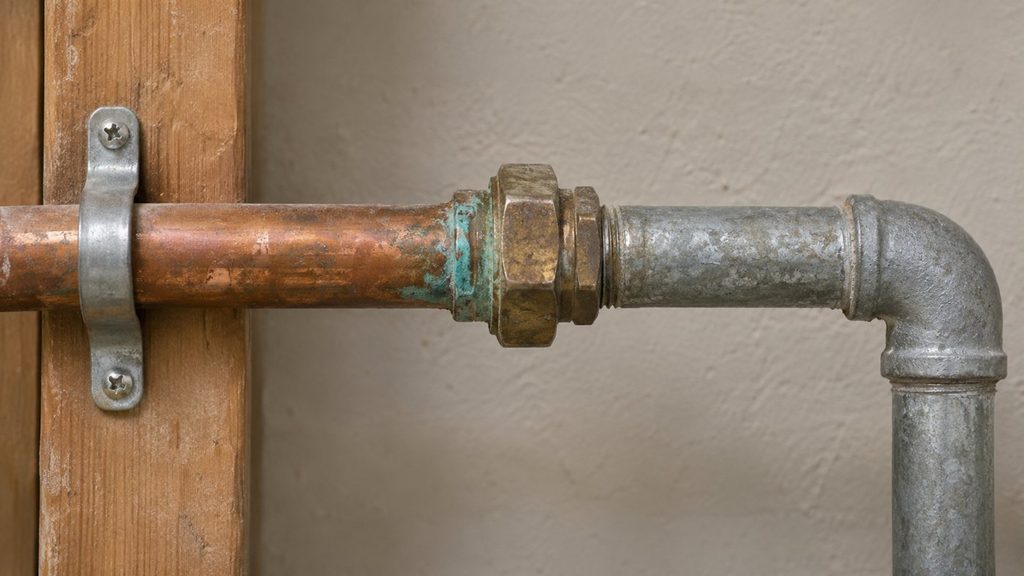
How do you test a pipe for corrosion? First identify what the pipe carries and what it is made of. Observe accessible surfaces for deposits, moisture, staining and changes in performance without disturbing the pipe. Those clues guide an inspection. They do not measure remaining wall thickness, show the inside of a concealed line, or establish whether tap water is safe. An active leak, a recurring wet fitting or visibly weakened section calls for timely assessment. Suspected lead in drinking water requires a separate service-line investigation and an appropriate tap-water sampling protocol.
Put safety first. If water has reached electrical equipment, a receptacle or a panel, keep away and have the appropriate professionals make the area safe. Do not touch wet energized equipment. A known shutoff may be closed from a dry, safe position if it moves normally; do not enter floodwater or force an old valve. Never drill, cut, scratch or overpressurize a line to “test” it. A surface photograph can be useful evidence of a visible symptom, but it cannot diagnose an entire plumbing system.
Three different questions behind a corrosion test
“Corrosion” may mean a change visible on the outside, deterioration of the pipe that affects its ability to hold water, or the release of metals into drinking water. These are related but different questions. A water sample measures specified substances at a particular tap under a defined sampling method; it does not tell you the thickness of a pipe behind a wall. A thickness reading at one accessible spot does not describe every concealed segment. A clean exterior is no guarantee that the inner surface is sound. The right examination depends on the question you are trying to answer.
Health Canada explains that there is no single reliable method or index that captures corrosion and exposure to released metals across a drinking-water system. Lead measured at the consumer’s tap, together with water-quality information, can inform an exposure and corrosion-control investigation. That public-health approach is not a substitute for a physical inspection of a leaking domestic line. Water chemistry, including pH and alkalinity, as well as temperature, stagnation time and materials can influence metal release. None of those factors can be reliably established from the colour of a fitting.
Identify whether you are looking at a potable-water supply pipe, a wastewater drain, a heating loop or the service line entering the building. Their pressures, risks and appropriate examinations differ. A building may contain several generations of materials and joints. The guide to identifying plumbing pipe materials helps put an observed surface in context. Resist treating every stain near plumbing as evidence of a corroded supply pipe.
A safe observation record for homeowners
Start in a well-lit, accessible area. Do not remove a wall, insulation of uncertain composition or a heavy appliance to see more. Take one photograph showing the pipe’s location and another of the detail, and record the date. Note the likely material, the nearby fittings, whether a support is wet and whether the area is dry when the fixture is idle. If ordinary use cannot worsen a leak, note whether the moisture returns after use. A repeated drop at the same spot, a growing stain or new dampness gives a professional more to work with than a single isolated image.
Look for the starting point, not just the colour. Water may travel down from a fitting, condense across a cold surface or drip from another component above. A ceiling stain need not be directly beneath the source. Similar-looking marks may have different causes, and several defects may coexist. Do not touch a hot line or repeatedly operate a fragile valve to reproduce a symptom. If the pipe is actively leaking, focus on safe isolation and protecting occupants before building a detailed record.
Record changes in flow as well: one faucet, several fixtures, only hot water, or both hot and cold. A clogged faucet aerator can affect one outlet without implying a building-wide restriction. A shared reduction across fixtures needs a broader investigation. Note when discolouration appears, whether there have been nearby water-main works, and whether a repair was made in the same area. These observations help locate an examination; they do not turn a homeowner into a pipe inspector. Give dates and direct observations instead of announcing a cause that has not been confirmed.
Copper: patina, deposits and pinhole leaks
Copper can develop brown or greenish surface changes over time. A dry, even patina alone does not establish a failure. A concentrated blue-green deposit around a fitting, especially with recurring moisture or a drop, deserves closer examination. The water could be coming from a joint, the tube itself, an adjacent component or condensation. A tiny hole may produce a small intermittent drip or a stain on a surface below; the apparent size of that leak says little about the condition of other pipe segments.
A green mark in a sink is not proof that the exposed copper pipe has corroded internally. The faucet, water chemistry, drain, cleaning products and time of contact all matter. A physical examination can locate the leak and assess the fitting; if the concern is water quality, a properly selected analysis answers a different question. Neither copper nor lead concentration should be declared from the appearance of a pipe. Avoid applying acidic cleaners to old fittings or hiding recurring moisture with a temporary patch without finding its source.
Galvanized steel, cast iron and other ferrous parts
Galvanized steel may look dull, show reddish-brown rust or collect deposits at threaded connections. The protective coating can age and corrosion products may build up inside older supply lines. Reduced flow, discoloured water after stagnation or deteriorated fittings justify investigation, but none independently locates the source. An opened section can reveal a condition quite different from its exterior. Dismantling an old pressurized assembly is not a homeowner test; isolation, access and the possible consequences need to be planned by a qualified person.
Cast iron is often associated with older drains. An exterior rust mark on a drain is not interpreted in the same way as corrosion of a pressurized drinking-water pipe. A crack, seepage at a joint, odour or recurring backup may require drain assessment. A tap-water metals analysis cannot evaluate a drain. Conversely, brown tap water does not show that the drain is corroded. Rust on a bracket, clamp or nearby appliance also does not automatically mean the pipe it supports has lost strength. Identify the component that is actually affected.
Transitions between different metals, damp locations and localized deposits are worth documenting. The phrase “galvanic corrosion” is sometimes applied too quickly to any mixed-metal connection. Materials, electrical contact, water and the assembly details matter. A transition is not automatically defective merely because two metals are visible. If a leak is located there, ask which findings support the proposed mechanism and whether the repair addresses the whole connection. The goal is a reasoned diagnosis, not a label attached to a photograph.
Plastic and multilayer systems can leak without rusting
Plastic pipe does not rust like steel. It may still leak at a joint, suffer physical damage, be used outside its intended conditions, or connect to a corroding metal fitting. A brown mark on the wall behind plastic is a reason to trace moisture, not evidence that the plastic itself has undergone metal corrosion. Multilayer systems also include fittings that must be assessed separately from the pipe body. Identifying each component prevents a whole system from being condemned because of a stain with a different source.
Moisture across a cold-water line may be condensation in a humid room. That possibility should not be used to dismiss a leak. From a safe position, note when the wetness appears and where it starts. Condensation may cover a wider cool surface, while a persistent seep from a joint may remain localized, but the distinction is not absolute. A container or surface protection may limit minor damage if it can be placed safely; do not let it delay safe isolation of a continuing leak.
Discoloured water and drinking-water safety
Yellow or brown water can follow sediment disturbance, distribution-system work, iron-bearing materials or a building-specific issue. Its colour alone neither identifies the source nor certifies potability. Check the local water supplier’s notices and ask whether the issue is wider than your building. Compare affected cold-water taps only if there is no instruction to limit use. Keep a record of when it began and which outlets are affected. The separate guide to precautions for brown tap water covers safe first checks in more detail.
Lead dissolved in water is not reliably visible, smelled or tasted. Clear water does not rule it out; brown water does not prove it is present. Some service lines, solder and plumbing components may contain lead. Québec explains that lead at the tap can come from the dissolution of lead-containing materials, particularly certain service lines. The building’s age is a clue for an inventory, not a diagnosis of concealed material. A photograph of a pipe cannot establish exposure at a kitchen faucet.
If lead is a concern, ask the municipality or water supplier about its service-line records, testing program and recommended tap-water sampling. Local public health can advise on exposure concerns. The protocol must fit the question: a sample after a specified stagnation period can mean something different from a flushed sample, and the location of collection matters. Record the instructions, tap, time and circumstances rather than collecting an improvised bottle. A pH strip, household magnet or colour check does not prove the water contains no lead or is safe to drink. Health Canada’s lead guidance recommends testing tap water when lead-containing plumbing may be present.
Lead service lines: what visible identification cannot settle
The service line entering a home is not the same as the distribution pipes visible under a sink. Its public and private portions may have different materials. Montréal describes visual clues and a screening program for eligible buildings, but a visible copper segment cannot rule out a concealed lead portion or lead-bearing components elsewhere. Identification of the line, municipal records and water testing answer related but distinct questions. A Montréal program’s criteria and availability do not automatically apply in Laval, on the South Shore or elsewhere in Québec.
Observe an accessible entry point without scratching, striking, bending or removing an old fitting for this exercise. If the material is uncertain, ask the water supplier or a plumber to identify it. Dismantling a connection for a better picture may create a leak and will not tell you what lies underground. The City of Montréal explains how eligible residents request service-line screening. Other municipalities have their own procedures. A service-line screening result is not automatically a regulatory laboratory analysis of consumed water.
What a professional assessment can include
A focused inspection usually begins with the material and circuit, the accessible surface, the location of moisture, and whether a trace is active. The professional can distinguish the pipe wall from a joint and decide whether neighbouring finishes need examination. A pressure measurement or controlled test of an isolated section may be useful when it answers a defined question and the assembly can be made safe. An ill-chosen pressure test can worsen a weak line. A normal reading at one moment does not prove there is no localized corrosion or predict years of trouble-free use.
Where material and access permit, thickness measurement or examination of a section already removed during repair can provide more direct evidence of metal loss. Coatings, geometry, the chosen measurement point and the operator’s interpretation limit what can be concluded. A single reading does not map an entire building. A drain camera may reveal some interior defects or deposits in a drain, but a picture is not necessarily a reliable wall-thickness measurement and says nothing directly about drinking-water chemistry. Ask what each proposed examination can confirm, what it cannot exclude and how the findings will be documented.
A laboratory test measures particular substances in a sample collected under a stated protocol. It characterizes that tap and moment, not the mechanical condition of every pipe. Water suppliers use parameters such as pH and alkalinity to understand conditions that can promote metal release, but one household pH value is not a standalone safety verdict. Health Canada’s corrosion and sampling guidance emphasizes matching the sampling method to its purpose and notes the limitations of any single index.
Monitor, repair or replace?
A stable dry patina might be documented and watched. An actively wet fitting may call for a local repair once its source is identified. Repeated leaks, a weakened segment or persistent restrictions can justify a wider assessment and perhaps phased replacement. The choice depends on material, accessibility, distribution of defects, water use and consequences of failure. Neither an estimated age nor the number of marks in a photograph supplies a universal replacement threshold. See the related discussion of assessing pipe condition before replacement.
Ask the professional to separate observed facts, hypotheses and proposed work. Which sections were actually inspected? What indicates a tube leak rather than a joint leak? Is a local repair appropriate in the observed installation? Which concealed sections remain unknown? Would a staged replacement interrupt another service? A broad recommendation may be justified in some buildings, but it should rest on documented findings. Ask about the condition after the work, the remaining uncertainty and which symptoms would require follow-up.
Before invasive work, clarify authorization for water isolation, opening surfaces and restoration. In a condominium, a common line may require building coordination. A service-line concern also involves the local municipality’s responsibilities and procedures. If an analysis raises a water-quality concern, follow the water supplier’s or public-health authority’s consumption advice. A plumber can assess and repair an installation; that is different from issuing a public-health determination for a particular water supply.
Prepare for the visit without creating a new hazard
Collect dated photographs, the location of stains, a simple timeline and records of earlier repairs. Note which taps have changed flow or colour, when the change occurs and whether a municipal notice exists. Identify the main shutoff if you already know its location; do not force it to demonstrate operation. Clear access only when doing so keeps you away from electricity, sewage, heavy objects and hot piping. Tell affected occupants that water may need to be shut off during an assessment.
Ask about the scope and limits of the inspection, whether an opening is proposed and how results will be explained. A photo can show a visible fitting and help plan the visit; it cannot verify potability, dissolved lead or remaining metal thickness. Keep laboratory results with the sampling method and tap location. A clear record supports future comparisons when a symptom appears only after water has stood overnight, after another fixture runs, or as temperature changes.
Frequently asked questions about pipe corrosion
Does green colour on copper mean every pipe must be replaced?
No. A dry patina or localized deposit does not by itself establish remaining wall thickness or strength. Document recurring moisture, identify where it starts and ask for a focused assessment. A joint repair, monitoring or a wider examination may be appropriate depending on the actual findings.
Can I tell whether tap water contains lead from the pipe or water colour?
No. Dissolved lead cannot be confirmed by appearance. A concealed service-line section, solder or a fixture can matter. Ask your water supplier or public health about service-line investigation and a sampling protocol suited to exposure at the tap.
Will a pressure test prove an old system is sound?
No. A controlled test can help a professional investigate a prepared, isolated circuit. It does not measure all wall thicknesses, exclude future failure or replace inspection. Testing an already weak line without a suitable plan can create damage.
Does brown tap water prove my home’s pipe is corroding?
Not necessarily. Distribution work, sediments, equipment and interior piping are among the possibilities. Check local notices, document the affected taps and seek assessment if it persists. Do not judge drinking-water safety or lead content from colour alone.
What if a leak is close to electrical equipment?
Stay out of the affected area and do not touch the equipment or panel. Have qualified responders make electricity and water safe. Do not enter standing water to reach a valve or run another test merely to capture the leak on video.
Browse more guidance in Pipes and water supply. If an active leak or confirmed defect calls for work, consider residential plumbing help after taking the appropriate immediate safety steps.