
Pipes and water supply
Brown tap water: checks and precautions
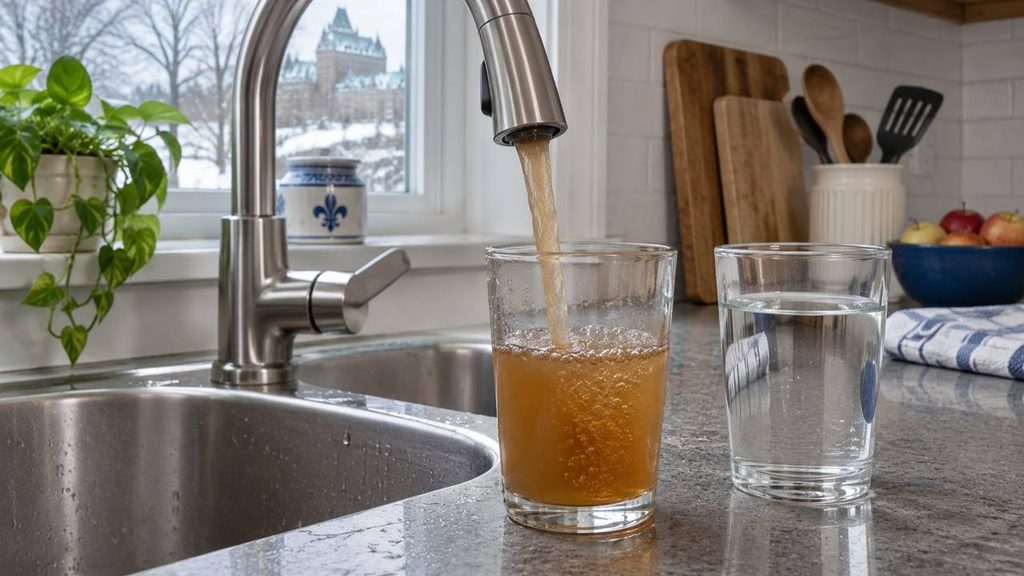
Brown water from the tap? Pause drinking it and check your water supplier’s current notices first. Find out whether the change affects cold water, hot water, one tap, or several homes. Instructions for your address take priority over any household experiment. Disturbed deposits in a water main are one possible explanation, but colour cannot identify every contaminant or establish that the water is safe. Clear water after a brief episode does not cancel an active advisory.
This guide helps you gather useful observations without dismantling plumbing, risking a scald, or going near wet electrical equipment. The next steps differ for a municipal supply and a private well. The Québec government advises people who doubt the quality of municipal water to contact the water supplier before consuming it. For a private well, a sudden change in appearance warrants appropriate testing by an accredited laboratory.
Brown tap water: first steps for household safety
Until the situation is clarified, do not drink discoloured water or use it for infant formula, ice, food preparation, or brushing teeth. Use a reliable alternative source of drinking water, such as bottled water or water provided according to local instructions. Put off laundry while brown water is flowing because particles may stain fabrics. Likewise, avoid running an ice maker or another water-fed appliance until you have checked the applicable notice and confirmed the supply meets the instructions for its use.
Look up notices for your municipality and your particular address. A boil-water advisory, a do-not-consume advisory, and a do-not-use advisory are different. The Québec description of advisory types says that a do-not-consume notice may prohibit drinking even after boiling; a do-not-use notice can restrict bathing and other uses. Do not turn a do-not-consume instruction into a home decision simply to boil the water.
If a leak accompanies the colour change, stay away from appliances, outlets, and electrical panels that water has reached. Never walk into a flooded area to reach a valve or breaker. You may close an easily accessible shutoff only if you can do so safely and the leak calls for it; otherwise seek appropriate help. A colour change without a leak is no reason to open a water heater, touch electrical connections, or operate a panel.
Brown tap water and local advisories
Maintenance on a water network can alter the direction or speed of flow and disturb deposits. The City of Montréal explains these mechanisms and gives instructions for its own network. That does not mean every brown-water episode begins in a municipal main. A neighbour can be affected while your home is not, and private plumbing can contribute to a localized problem.
Read the current notice page for your actual supplier rather than relying on an old search result or social-media post. Check the affected streets, type of notice, start time, and most recent update. In Montréal, the City’s notices and 311 are useful starting points when discolouration persists. In Longueuil, Brossard, Laval, or another Greater Montréal municipality, use that municipality’s own channels and service contacts. Montréal’s flushing directions and 311 process are not automatically the rules for a different supply.
No notice may be visible when you first look. That is neither proof that the water is safe nor proof that your plumbing is defective. Report unusual, persistent discolouration to the supplier, especially when several taps or neighbouring homes are affected, pressure has changed, or street work has occurred. Ask whether there is an ongoing intervention, whether flushing is appropriate at your address, and whether sampling or other precautions are needed before consumption.
Map the pattern without drinking a sample
To describe brown tap water accurately, use a clean clear glass to observe cold water from one tap, then compare it with a second tap. Do not taste either sample. Record when the problem began, how dark the water looks, whether particles are visible, and whether the colour fades or returns. A photograph against a light background may help the supplier or an inspector. Neither a photograph nor a visual comparison measures a metal concentration or diagnoses where material entered the system.
Several taps, including cold water: consider the supply network or building entry and check advisories first. Ask the supplier what to do. Only one tap: note whether the aerator has trapped debris, if it is easily removable under the manufacturer’s instructions. Material at the outlet does not identify its original source. Hot water only: compare carefully with cold water, avoiding a scald. The hot-water circuit or heater may deserve assessment, but a discoloured hot tap does not automatically justify a new tank.
In a multi-unit building, ask the manager whether other occupants see the same change and on which floors. A shared riser may be relevant, but do not assume every unit has the same arrangement. In a house, note recent work on the service line, a water shutoff, or an extended vacancy and pass those facts on to the supplier. Water that changes after a long period without use may help frame questions, yet it is not a reason to label the episode harmless.
Brown tap water: should you run the cold tap?
When brown tap water appears, do not flush automatically. If no notice forbids it and your supplier recommends the step, cold-water flushing may help clear particles from a network disturbance. For its network, Montréal advises using a cold bathtub tap, or the kitchen sink if there is no bathtub, and removing a removable aerator before flushing. Follow the City’s complete local guidance; call 311 if the colour persists there. There is no single flushing time that can be promised for every street, building, and incident.
Use cold water at a manageable flow while watching the drain. Stop if the sink backs up, pressure behaves abnormally, the water has an unusual odour, or an advisory tells you not to use it. Do not run hot water to “flush the heater” as a first step: hot water can scald, and incoming particles may enter the tank. If discolouration returns after following the supplier’s directions, record the time and contact the supplier instead of endlessly running water.
Water that looks clear again provides one observation, not a laboratory result. Dissolved substances and microorganisms may be invisible. Health Canada’s residential plumbing water-quality guidance warns against treating discoloured water as merely an aesthetic issue because particles can carry other contaminants. Keep obeying an active advisory until the responsible authority officially lifts it, even if a glass now appears clear.
Brown tap water: boiling, filters, and alternatives
Boiling brown tap water addresses a microbiological risk when a boil-water advisory calls for it. It does not remove all chemical contaminants and does not establish that brown water is safe. Under Québec’s advisory framework, a do-not-consume notice means the water must not be drunk even after boiling. If a boil-water advisory applies, follow its stated uses and instructions. The Québec emergency water guidance specifies at least one minute at a rolling boil for that type of notice and cautions against burns while handling hot water.
A pitcher filter, refrigerator filter, or softener does not replace an advisory. A treatment device can address only the contaminants it is designed, installed, and maintained to handle. If a filter received heavily particle-laden water, consult its instructions and the supplier before using it again. Do not infer that filtered water is drinkable because it looks clearer. Ask a health professional or local health authority for advice if exposure has occurred and a person’s symptoms or circumstances raise concern.
Keep an alternative source available for drinking and food. Use clean containers that have never held chemicals. Read the applicable notice for infant formula, pets, ice, raw produce, and teeth brushing; all can involve ingestion. When a notice is lifted, follow the supplier’s post-advisory flushing and appliance instructions rather than assuming every ice maker, filter, and tap can immediately return to normal. The steps can vary with the cause and type of notice.
If only the hot water is brown
Compare the cold side of the same fixture with cold water at another fixture. To observe hot water, collect only a small amount in a heat-resistant container, keep hands out of the stream, and let it cool before examining it. When cold water remains clear while hot water is discoloured at several taps, the heater or hot-water piping becomes a possible source. Age, recent installation, or a recent service visit alone cannot confirm that diagnosis.
Do not drain a tank, remove a relief valve, or touch gas or electrical connections to test a hunch. A water heater can contain scalding water under pressure. If there is a leak, unusual noise, or another concerning symptom, follow the manufacturer’s instructions and arrange qualified assessment. Our separate guide to water heater warning signs helps organize observations; it does not replace a diagnosis or tell you to replace the unit on the basis of colour alone.
A network event can also affect water that has entered the heater. If the supplier reports a main break, shutdown, or flushing, ask what it recommends before attributing every hot-water symptom to the tank. Tell the person assessing the system whether the cold water was briefly discoloured, whether the event followed a supply interruption, and whether the hot-water colour persists after the supplier’s instructions have been followed.
If the problem is at one tap or in one unit
An aerator can hold visible particles and change the flow. If it unscrews easily, the tap is cold, and the manufacturer permits removal, you can inspect and clean it according to those instructions. Put a cloth in place so small parts do not disappear down the drain. Stop if the aerator resists; force can damage a finish or fitting. Compare with another tap afterward, while remembering that one clear sample is not a water-quality test.
A single fixture may be fed by a branch with its own flexible connector, filter, or appliance. Note any recent change, but do not undo a pressurized connection simply to investigate. In an apartment, notify the owner or manager and ask whether work was done on a shared supply riser. Discolouration confined to a unit may originate in shared or private components. Its location does not by itself settle responsibility or the remedy.
Once the supplier’s notices and directions have been checked, an indoor problem that persists may justify a plumbing inspection. Bring the timeline, affected taps, cold/hot comparison, recent work, and advice already received. A plumber can assess the installation; the plumber does not replace the water supplier or required water testing. The residential plumbing page provides context for that work without claiming a particular cause in your home.
Brown tap water versus fixture stains
Orange-brown particles may suggest iron or rust, especially after a change in flow, but other materials and processes can produce similar appearances. Health Canada describes the release of accumulated material and metals in distribution systems and inside buildings. A phone image cannot quantify lead or manganese, detect microorganisms, or tell where a particle originated. Debris caught in an aerator may have travelled from farther upstream.
After checking municipal notices, repeated symptoms such as poor flow, recurring particles, or a localized colour change can inform a discussion about signs of pipe corrosion. The apparent age of a building, a visible pipe’s colour, or a rusty spot cannot reveal the condition of concealed pipework. Ask which inspection or analysis would actually distinguish a distribution issue from one in the building before approving a repair.
Brown tap water and a rust stain already deposited on a sink, tub, or toilet is a different issue from the water currently flowing from a tap. A cleaned surface says nothing about potability. If your concern is the surface, read about cleaning rust stains without damaging fixtures. If the tap water remains brown, the supplier’s advice and consumption precautions still come first. Cleaning products should not be put into a drinking-water line.
Who should you contact, and what should you tell them?
For municipal water, contact the municipality or water operator if the colour persists, multiple taps are affected, or you doubt the quality. Have your address or sector, start time, photographs, affected fixtures, cold/hot pattern, pressure changes, and known work ready. Explain what advice you have already followed. Ask about network work or an outage, whether an advisory covers your address, and what should happen before you consume the water.
For a private well, a municipality cannot certify the quality of your well water. Québec recommends an accredited-laboratory analysis when taste, smell, or appearance changes suddenly. Ask the laboratory or relevant authority which parameters and collection method fit your circumstances. A home test strip or a clear-looking glass cannot stand in for appropriate results. Avoid opening, dosing, or disinfecting the well without a reasoned plan and competent advice.
If someone drank the water and has symptoms, contact Info-Santé at 811 in Québec or emergency care according to severity. Plumbing advice is not medical advice. When a supplier says distributed water is compliant but an indoor problem remains, a professional can assess the affected branches, fixtures, and equipment. Keep notices, dates, and photos together; a specific history supports a useful conversation and can prevent a premature recommendation to replace pipes or a heater.
After the water looks normal again
Confirm whether an advisory remains active and wait for its official cancellation. Québec describes cold-tap flushing and appliance care after an advisory is lifted; your supplier may give instructions specific to the event. Inspect filters and equipment according to their manufacturers’ directions. Restart laundry only when both the water appearance and the applicable instructions allow it. Check the first use of a water-fed appliance for a recurrence.
If brown tap water appears again, record dates, times, duration, taps, and notices. Recurrence after work in the street frames a different discussion from repeated hot-water-only discolouration. A normal-looking interval does not prove that no follow-up is needed. A concise history helps the supplier or inspector decide what to check and avoids repeatedly wasting water or replacing parts by guesswork.
Frequently asked questions
Is brown tap water always rust?
No. Iron and disturbed deposits are possible, particularly around network work, but colour cannot identify the substance or its source. Report persistent discolouration to the supplier; testing or inspection may be needed.
Can I drink it as soon as the water runs clear?
Not automatically. Check whether an advisory applies and follow the operator’s instructions. Contact the supplier before consuming the water if its quality is in doubt. Clear appearance cannot rule out invisible contaminants.
Is boiling brown water enough?
No. Boiling is a measure specified for particular microbiological risks. A do-not-consume notice can prohibit drinking even after boiling, and boiling does not remove chemical contaminants. Use another source of drinking water and obey the relevant notice.
Why is only my hot water discoloured?
The heater or hot-water piping is a possibility, but a distribution event may also have affected water that entered the heater. Compare cautiously with cold water, check notices, and arrange an assessment if it persists. Avoid improvised draining or disassembly.
Should I delay laundry and dishwasher use?
Yes, while water is visibly discoloured. Particles may stain fabric or affect equipment. Check any advisory’s use restrictions and the appliance instructions before resuming after the supply has cleared.
Who handles this in Montréal, elsewhere, or at a private well?
For public water, check notices and contact your own municipality or supplier; Montréal says to call 311 if discolouration persists. For a private well, arrange appropriate accredited-laboratory testing. If supplied water is confirmed compliant but the indoor problem continues, plumbing inspection may follow.
For related explanations of supply components and their symptoms, browse Pipes and water supply. The supplier’s current instructions remain central: a plumbing diagnosis alone cannot certify drinking water.