
Water heaters and hot water
Water heater lifespan: when to repair or replace
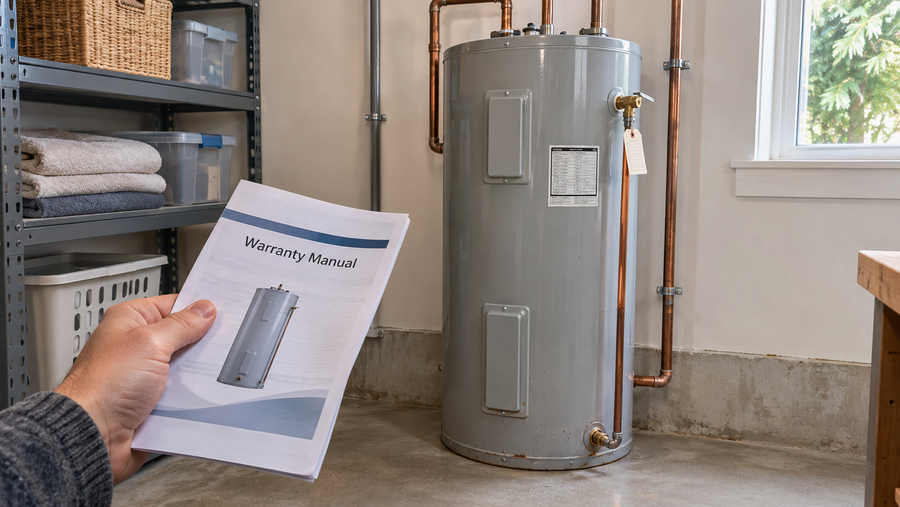
A domestic water heater has no universal expiry date. Its water heater lifespan depends on the particular model, water conditions, installation, maintenance, and what the tank and components are doing now. An age estimate helps you plan, but it cannot tell you whether a tank is sound or a part is repairable. A confirmed leak from the tank usually points toward replacement. A single replaceable component on a sound tank may justify repair. Between those cases, ask for a diagnosis and compare the total cost, warranty, and risk of each option.
This guide covers equipment supplying domestic hot water to taps, showers, and household appliances. It does not cover a central heating boiler. Deal with immediate hazards before considering a purchase: keep clear of water near wiring or an electrical panel, a suspected gas leak, or uncontrolled hot water. Do not open energized covers, work on gas components, or stand in water to operate electrical controls. Hot water can scald. Have a qualified person assess an unsafe installation or active leak.
Water heater lifespan: how long can it last?
There is no single number for all technologies. In Quebec, Hydro‑Québec gives a general comparison of about ten years for a standard two-element electric tank and about twelve for an ECOPEAK model on a page for installation partners. Those figures are estimates for those categories, not a guarantee, an insurance rule, or a deadline for your unit. Gas storage, heat pump, and tankless water heaters have different parts, use patterns, and service requirements. Consult the manual and warranty for the exact model.
A water heater lifespan estimate is only a planning range. A relatively new heater can fail prematurely. An older one can still supply hot water, while presenting more uncertainty about future repairs and water damage. Using water heater lifespan alone misses the practical question: what is the condition of the tank, what caused the present symptom, and what would a failure mean in this location? A tank above a finished room raises different damage concerns than a tank in a drained utility area. Neither example lets someone certify its hidden condition by looking at a date on a label.
Find the actual age without guessing
Look for an accessible rating plate with the manufacturer, model, and serial number. Do this without moving the heater, removing a cover, or touching hot pipes or electrical parts. Search for the purchase and installation invoices, the warranty card, and past service records. Manufacturing and installation dates may differ. If the unit came with the home, the construction year is not evidence of when it was installed. If a label is unreadable or inaccessible, ask a technician or the manufacturer to identify it safely.
Manufacturers may provide serial-number tools. Giant’s warranty validation page, for example, distinguishes the tank and parts warranty and gives a manufacturing date for its products. Its terms should not be generalized to every brand. For another heater, use that manufacturer’s documentation and support. If the unit is rented, review the rental agreement before authorizing work because the service process and responsibilities may differ from those of an owned heater. Record uncertainty instead of creating a false precise age.
Water heater lifespan depends on condition
From a safe, dry place, note whether water appears repeatedly at the base, around visible joints, or in a pan. Observe loss of hot water, inconsistent supply, visible corrosion, or a recurring fault without taking the heater apart. A wet fitting does not prove that the tank is perforated; the source could be a connection, valve, condensation, or another pipe. A dry exterior does not prove that corrosion is absent inside. The cause and location need to be established before a repair-or-replace recommendation.
If water spreads rapidly or approaches electrical equipment, keep people clear and request prompt qualified help. Closing a clearly identified, safely accessible water supply valve may limit damage, but do not approach wet electrical equipment or manipulate unfamiliar gas controls. If gas is suspected, leave the area and follow the gas utility’s emergency instructions; do not use switches. Tell other household members about scalding or slip hazards. Photos taken from a safe position and a timeline of when the moisture appeared can help the technician.
A rumbling tank, a shorter shower, discoloured hot water, or a tripped breaker can have different explanations. None establishes the tank’s remaining life alone. The separate guide to noisy water heaters explores sounds; water heater warning signs provides more detailed symptom triage. This article uses those findings only as inputs to the broader decision involving age, condition, warranty, and repairability.
A fitting, a relief valve, or the tank?
Water at a top connection or near a pipe can call for a different repair than water emerging through a tank wall or base. A temperature-and-pressure relief valve discharge may reflect temperature, pressure, or a valve problem; never plug its outlet to stop the flow. Water in a pan could be from an old event or a continuing leak. Observe when and where water appears, how quickly it accumulates, and whether the surrounding floor was dry beforehand. Let a professional trace the source.
A leaking storage tank itself is generally replaced, while an external fitting or component can sometimes be repaired if the tank remains sound. Smearing sealant, wrapping a pressurized tank, or concealing water under a pan is not a reliable fix. It may postpone discovery of a worsening leak. Ask for a clear distinction between a confirmed tank failure and a repairable connection, and for the limits of any diagnosis. The distinction affects safety, cost, warranty, and how soon the household can resume normal use.
Why water heater lifespan varies
Water heater lifespan can be affected by water chemistry and mineral deposits. Their impact varies with the model and local conditions. Heating cycles, household demand, pressure, installation quality, and maintenance also matter. Many storage tanks use a sacrificial anode to protect the metal tank. Whether and when it should be checked depends on manufacturer instructions and access. Do not infer anode condition from a single sound or external rust mark, and do not remove it without the appropriate skills and precautions.
Heat pump water heaters have filters, condensate handling, and refrigeration components in addition to water-side equipment. ENERGY STAR advises owners to follow the manufacturer’s maintenance directions and to plan replacement choices before an emergency. A heat pump filter schedule cannot simply be imposed on every conventional electric or gas tank. Tankless models also have distinct service and venting requirements. The exact model manual is the starting point for any maintenance plan, not a generic checklist from another technology.
Location changes the consequences of a leak and the installation details to review. The RBQ and CMMTQ technical sheet PL‑18 addresses storage-water-heater replacement in existing Quebec buildings, including relief-valve discharge, pans, and manufacturer directions. It notes that manufacturer instructions may be more stringent than a baseline requirement. Have the installer apply the current rules to the actual building; the sheet is not a universal instruction to replace every tank at a particular age or a statement about all insurance policies.
Warranty length is not water heater lifespan
A six-, eight-, or ten-year product warranty, where offered, is a contractual coverage period for specified defects. It is not a forecast that the heater will fail at its end or work without trouble throughout it. Tank and parts coverage can have different terms; labour, travel, and installation may be treated separately. The applicable document, proof of purchase, use, and installation requirements determine a claim. Do not assume a warranty applies until the manufacturer or authorized representative confirms the model and circumstances.
Giant’s validation page, for instance, says its warranty information assumes installation, use, and maintenance in accordance with the owner’s manual, and that proof of installation by a licensed contractor may be requested. Those are Giant’s stated conditions, not a universal rule for other brands. Before paying for a major part, collect the serial number, purchase and installation evidence, and warranty terms. Ask who submits the claim, whether a tank or part is provided, and which labour or transport costs may remain with you.
Water heater lifespan may extend beyond warranty coverage. A heater outside warranty can still be worth repairing. A heater under warranty can still require replacement if the tank has failed or the manufacturer’s resolution calls for it. Home insurance is another contract entirely. Ask your own insurer what, if anything, applies to your situation and location; do not rely on an asserted automatic ten-year limit. Keep invoices and photographs where they can be found later. They help you assess the unit and support any legitimate warranty or insurance discussion without promising a particular outcome.
When is a repair sensible?
Repair is a real option when a qualified assessment identifies a specific replaceable component, the tank appears serviceable, a compatible part is available, and the work can restore safe operation. Depending on the model, an element, thermostat, control, or fitting may be repairable. This list is not a remote diagnosis. A hot-water complaint may also involve an electrical supply issue, another plumbing fault, or demand that exceeds the heater’s capacity. Identify the actual cause before spending on a part.
Ask for a written explanation of the likely failure, observations or tests supporting it, the proposed part, total labour, applicable warranty, and what happens if further damage is found. Compare the full repair price with an appropriate replacement quote, not just the price of a component. A succession of expensive repairs on an ageing tank can change the calculation, while a first isolated fault need not trigger an immediate purchase. Water heater diagnosis and repair fit the case where a sound tank has a treatable defect.
A technician should explain the limits of an exterior inspection and why a repair is likely to address the complaint. No visual check can guarantee that hidden corrosion will never cause a leak. If several independent problems remain, request a quote that makes that uncertainty plain. Consider the disruption of another service call, parts lead time, household need for hot water, and the possible damage should the tank fail. These factors are personal to the installation; there is no honest percentage rule that decides for every home.
When should you plan or choose replacement?
A confirmed leak through the tank, advanced tank corrosion, unavailable compatible parts, or repeated costly repairs usually shifts the decision toward replacement. You may also choose a planned replacement of an older working heater because the location makes a leak particularly consequential or because the household’s capacity and efficiency needs have changed. That is a risk and value decision, not proof that all units of that age are defective. Planning before failure allows time to compare equipment and installation details.
Review capacity, energy source, dimensions, access, piping, relief discharge, and pan or drainage arrangements with the installer. An existing Quebec building may need details addressed differently from its original installation. Ask which current requirements and manufacturer directions apply. Water heater installation or replacement should reflect the site rather than an assumed standard photograph. Do not reuse an old connection or venting layout without a qualified assessment merely to make the new model fit.
Compare written quotes for the appliance, capacity, removal of the old unit, connections, protections, commissioning, and distinct labour and product warranties. The guide to what a water heater installation quote includes explains those cost factors without claiming a universal ProDrain price. A more efficient system may need more space or a different maintenance routine. Its future savings depend on household use, energy costs, and the chosen model, so ask for assumptions instead of accepting a blanket payback claim.
A practical five-step decision
- Address immediate hazards. Spreading water, electricity, suspected gas, or dangerously hot water takes priority over price shopping. Leave a suspected gas leak area and follow the utility’s emergency guidance; do not operate switches.
- Gather records safely. Note the accessible model and serial number, known installation date, invoices, service history, and a timeline. Photograph visible conditions only from a safe dry position.
- Have the cause identified. A fitting leak and a tank leak lead to different recommendations. A lukewarm shower does not by itself prove that the tank is beyond repair.
- Compare realistic options. Include total cost, warranty terms, part availability, likely disruption, location, and potential water damage in repair and replacement scenarios.
- Keep the outcome documented. Retain the invoice, model and part details, warranty paperwork, and model-specific maintenance instructions after the work.
If the heater is stable, use the time to ask questions and compare models. If water is actively escaping, prioritize people and damage limitation. In a rental or property transaction, clarify who can authorize work before ordering it. A remote photograph of a rating plate can establish a model or approximate age, but it cannot prove the condition inside a storage tank. A qualified on-site assessment remains the basis for a consequential repair-or-replace recommendation.
What to record between service visits
Keep a simple dated record of visible changes rather than attempting to perform tests that require training. Note whether the hot-water supply changes gradually or suddenly, whether moisture reappears at the same location, and whether a breaker or error display has activated. Include who observed it and whether several fixtures are affected. This history can prevent a technician from treating a one-time symptom as a permanent tank failure. It also helps compare the outcome of a repair with the original complaint.
Follow the manufacturer’s operating and maintenance instructions for your specific model, including any required professional servicing. Do not treat a web checklist as permission to drain a hot tank, test a relief valve into an unsafe space, remove an anode, alter temperature settings, or work around combustion and venting equipment. If you are unsure what a maintenance instruction entails, ask the installer to explain it. A record of model-specific care is useful when reviewing warranty terms, but it cannot guarantee a longer service life.
Frequently asked questions
Must I replace a water heater at ten years?
No. Hydro‑Québec’s roughly ten-year figure is an estimate for a standard two-element electric model, not a universal deadline. Evaluate the actual tank, symptoms, location, warranty, and service history. An older working heater may justify planning while a younger failed tank can require replacement.
Does an expired warranty mean the heater has reached end of life?
No. A warranty period describes contractual coverage. It does not set mechanical life. A straightforward repair can make sense after expiry if the tank is sound and a compatible part is available. Compare total cost and uncertainty before deciding.
Does a puddle underneath always mean a new tank?
No. Water can originate at a fitting, relief valve, pipe, or tank. A confirmed leak from the tank generally favours replacement. Keep away from wet electrical equipment and have the source located promptly rather than assuming the least costly cause.
Can a leaking tank be patched?
A pressurized storage tank leaking through its wall or base is generally replaced rather than patched locally. First confirm the water is actually coming from the tank. Never obstruct a relief valve or conceal a continuing leak with sealant.
How can I determine age without a receipt?
Record the accessible rating-plate information and ask the manufacturer how to read its serial number. Manufacturing date is not necessarily installation date. An installer label, prior invoice, or maintenance record may narrow the range; preserve the uncertainty if proof is missing.
Does home insurance impose an age limit?
Terms vary by insurer and policy. Ask your insurer about your exact home and water heater, preferably in writing. Distinguish any insurance terms from Quebec plumbing requirements and the manufacturer’s installation and warranty directions. Avoid relying on a purported universal limit.
Continue learning
The water heaters and hot water category collects related guides. For this decision, keep three points in view: the tank’s condition, a demonstrated repair path, and the consequences of a leak in this location. Lifespan estimates and warranty dates provide useful context, but neither can replace a diagnosis of the installed appliance.