
Leaks, faucets and fixtures
Rust stains on bathroom fixtures: clean without damage
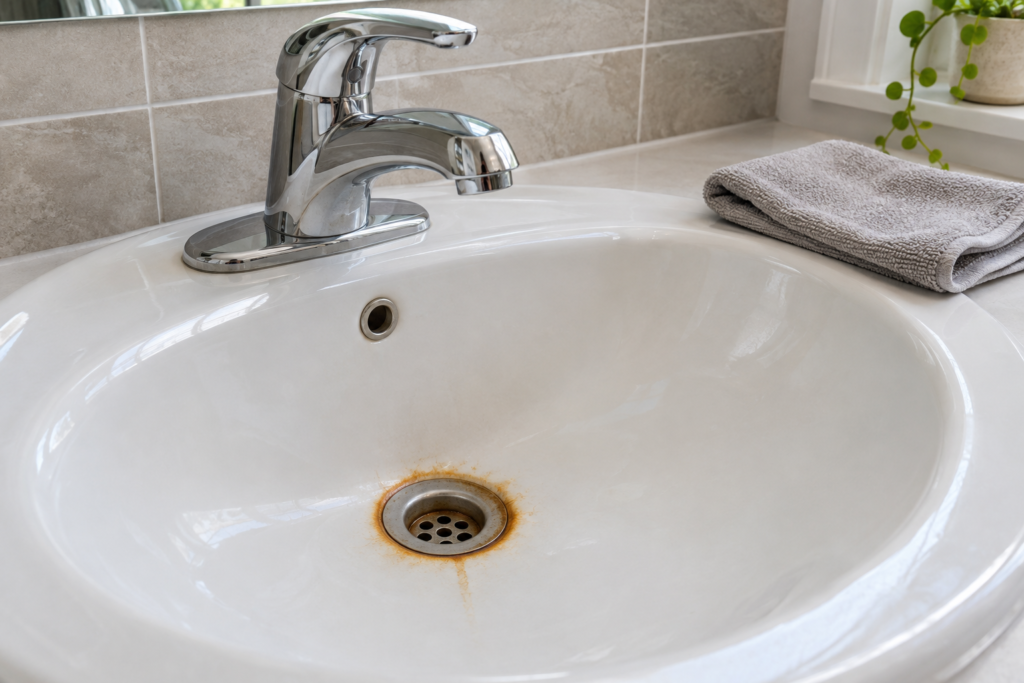
Rust stains on fixtures: clean without damaging the finish
Rust stains on a sink, bathtub or toilet call for a material check before a stronger cleaner. Identify the fixture, choose a product its manufacturer permits, and follow the label. Stop if the finish changes. An orange mark does not prove that the water pipes need replacing. A white bowl after cleaning does not establish that the water is safe to drink, either. This guide helps you organize a careful cleaning attempt, track returning marks and decide when the issue belongs elsewhere.
A stain beneath a metal container is a different starting point from discolouration appearing across several fixtures. Before scrubbing, photograph the dry surface and record the location. If the water itself looks unusual, compare its appearance in a clean, clear container. This is an observation, not a water quality test. Keeping the two questions separate makes the next conversation more useful: are you removing a deposit from a finish, or investigating a change that arrives with the water?
First, rule out an unsafe chemical combination
Never add a stain remover to another product already in use. Check for a tank tablet, a bowl hanger, a gel applied earlier and residue on the brush or sponge. Shared bathrooms can have an uncertain cleaning history. If you cannot identify the previous product, pause and obtain guidance from its label or manufacturer. Do not assume that a quick rinse guarantees compatibility. Adding vinegar, baking soda or another cleaner to neutralize an unknown preparation creates another variable instead of resolving the uncertainty.
Health Canada advises against mixing bleach with other household cleaners. Some rust removers contain acids, and a product described as natural can still react with another chemical. Use normal ventilation and the protective equipment specified on the label. If fumes or irritation develop, leave the area and seek appropriate help. For breathing difficulty or an immediate danger, call 911. Do not re-enter an irritating atmosphere to retrieve a bottle. Product identification can wait until it can be obtained safely.
Read the pattern without treating it as a diagnosis
A mark beneath a metal object may originate from that object rather than a pipe. A streak below a faucet suggests checking whether the faucet drips between uses. A ring in a toilet bowl identifies a location where deposits collect, but not their exact composition. These patterns guide follow-up; they do not identify every substance from a photograph. Colour alone cannot distinguish all mineral deposits, surface damage and ordinary soil. A cleaning decision needs the material information as well as the appearance.
Compare other fixtures using the same supply. Record whether the issue affects only one sink, appears with hot water only, or also shows up in the laundry. Consider recent changes such as a different cleaner, an object left on the rim, announced water work or a long period without use. You do not need to disconnect plumbing to gather this information. A clear history gives the manufacturer, building manager or plumber a better basis for choosing a proportionate check rather than an unnecessarily broad intervention.
Identify the material before selecting a rust remover
Porcelain is sometimes used loosely to describe several bathroom finishes. Look for the actual brand, model and care instructions. Glazed vitreous china, enamelled steel, acrylic and a refinished bathtub do not necessarily accept the same products. An older surface repair can introduce another set of restrictions. If you rent, ask the owner for the fixture information before applying a strong stain remover. A photograph can help locate the documentation, but it cannot reliably establish the material or reveal a previous coating repair.
Examine the dry surface in ordinary light. Cracks, chips, rough patches and peeling change the decision. What appears to be a stubborn stain may include exposed metal beneath damaged enamel. Cleaning cannot rebuild a missing protective layer. Avoid extending the soak or increasing abrasion when the surface is already compromised. Ask the fixture manufacturer or an appropriate refinishing specialist what can be repaired and what cleaning remains suitable around that area. This protects the remaining finish while you decide whether cosmetic work is worthwhile.
Set up a small, controlled cleaning attempt
Remove toiletries, fabrics and loose accessories from the work area. Keep the original packaging where you can read it without handling a wet container. Prepare a soft cloth or nonabrasive sponge permitted by the care instructions. Choose a time when nobody needs the fixture during application. Tell other household members that cleaning is underway. In a shared home, that brief notice prevents someone else from adding a second product to a bowl or basin that already contains a treatment.
Start with the routine cleaning method permitted for the fixture, removing loose soil without scraping the deposit. Rinse and dry as directed, then inspect again. Some apparent staining may disappear with this basic step. If a targeted treatment remains necessary, check every material the product might touch: drain flange, stopper, faucet finish, sealant and nearby countertop. A cleaner suitable for the basin surface may be unsuitable for a metal fitting beside it. Plan the application around those limits before opening the bottle.
Choose compatibility rather than a stronger promise
Look for explicit permission for both the material and the intended use. Bathroom cleaner and limescale remover are broad descriptions, not guarantees for every finish. Read the exclusions, application method, contact time and rinsing instructions. Establish whether the formula is ready to use or requires a specified dilution. Do not invent a stronger concentration. More chemical exposure does not establish better results, and an improvised dose makes it harder to assess what caused a change in appearance or texture afterwards.
KOHLER’s care guidance for certain vitreous china sinks identifies rust-removal options and cautions against abrasive cleaning tools. That advice belongs to the relevant surfaces and fixtures. It does not make those products suitable for every refinished tub, natural stone surface or coated faucet. Use the documentation for your own model as the starting point. If the fixture instructions and the cleaner label appear inconsistent, ask for clarification before applying it. A short product question is easier to resolve than damage caused by an incompatible treatment.
Test without turning a deposit into finish damage
Where the instructions call for it, begin on a small, inconspicuous area. Follow the specified method and timing. Do not let a product dry if its label requires a wet application, and use a timer instead of estimating the exposure. Apply only light pressure with an approved tool. Do not add an abrasive powder because the stain is slow to lift. Changing several variables at once prevents you from knowing whether the chemical, the tool or the extra contact time altered the surface.
After the required rinse, inspect the dry test area beside an untreated section. Look for dullness, a colour change, roughness or lifting of a coating. Stop if the finish changes, and retain the product details. If the surface remains sound but the mark persists, check whether another application is explicitly permitted. The goal is to remove a deposit within the material’s care limits. It is reasonable to leave a cosmetic mark while seeking advice instead of sacrificing a sound finish to make the colour uniform.
Adapt the work to a sink or bathtub
At a sink, keep the treatment away from neighbouring materials unless their instructions allow it. Runoff can reach a countertop, sealant or decorative fitting that has different restrictions. Do not unscrew the drain to reach a cosmetic mark. If a stain starts beneath a loose flange and the cabinet below is damp, investigate the moisture instead of concealing it with another cleaner. Take photographs and describe both the surface mark and the dampness when requesting help with the fitting or connection.
At a bathtub, convenient access does not make it appropriate to kneel in a cleaning product. Keep your footing stable and the surrounding floor dry. Avoid splashes onto wall finishes, slip-resistant textures and trim. Permission for a smooth area may not cover the rest of the fixture. Marks around an enamel chip deserve particular caution because a cleaner cannot repair exposed material. Establish the condition of the coating and the suitable repair options rather than repeatedly treating the same damaged spot as removable dirt.
Treat the bowl without improvising inside the tank
Check the toilet’s cleaning history before applying a rust remover. A bowl can receive several products between household cleaning sessions. Use only a product allowed for that application and follow its instructions. Do not pour bowl cleaner into the tank to reach stains from above. Tank seals and mechanisms have separate care requirements. A cleaner-looking surface is a poor trade if an incompatible product damages a part responsible for keeping water contained or stopping the refill at the proper level.
Do not lower the water or manipulate the mechanism merely to imitate an online recipe. The manufacturer’s procedure determines suitable application conditions. If a stain returns along a continuous trickle, record that operating symptom as a separate issue. Removing the mark and repairing an internal leak are different tasks. Likewise, a bowl that drains poorly has not been unclogged because its ring looks cleaner. Keep surface treatment and drain-clearing products out of the same experiment, especially when you cannot establish what remains in the fixture.
Leave improvised scraping and mixtures aside
Avoid knives, screwdrivers, wire brushes and other improvised scrapers. A scratch can hold future deposits and make routine care more difficult. An abrasive stone or a sponge marketed for effortless cleaning is not automatically compatible with your finish. Apparent softness in the hand does not establish how it affects a glaze or coating. Check the material-specific permission, particularly on an older or refinished surface whose protective layer may differ from the fixture’s original factory finish.
Avoid unattended soaking and recipes that combine several ingredients. A neighbour’s successful method may involve another fixture or a different product formula. Keep the cleaner in its original container; do not use a beverage bottle or a container with residues from another chemical. Store it away from children and pets. Keeping the label intact also helps if you need to explain a product incompatibility or exposure. Do not rely on the bottle’s colour or your memory to identify what was used during cleaning.
Track returning rust stains along the water path
After cleaning and drying, take another photograph in similar lighting. Record the date, treated area and product. Observe normal use without setting up a lengthy water-wasting test. A streak returning beneath a supposedly closed faucet makes the drip pattern useful to record. A mark remaining beneath the same metal accessory suggests removing that object from contact. This follow-up narrows possible sources before you commit to wider plumbing work or a water treatment purchase that may not address the original problem.
If several fixtures develop marks, distinguish surface observations from changes in the water. Note the affected taps and timing. Where tap water itself is discoloured, consult our guide to precautions for brown tap water and follow current notices from the water supplier. Do not select a filter solely from the colour of a toilet bowl. Choosing treatment requires understanding the substance or condition being targeted, the water characteristics and the maintenance needed for the selected system to remain effective.
Keep appearance and water testing separate
Water’s appearance alone cannot confirm its quality. Québec’s public guidance explains, for example, that manganese can affect colour, but the appropriate response depends on the water source and testing context. For a private well, obtain advice about relevant parameters and an appropriate laboratory. For a municipal supply, follow the distributor’s instructions and current notices. A fixture cleaner does not treat incoming household water and cannot replace public-health advice. A successful cosmetic result answers a different question from whether water is suitable for consumption.
Keep the complete laboratory report and sampling details instead of focusing on one isolated result. An analysis describes particular parameters from a sample collected at a particular time. If treatment is suggested, ask which result it is intended to improve and how that improvement will be checked. A promise that fixtures will stain less is not a general drinking-water safety guarantee. Separating these objectives helps you compare proposals without confusing an appearance benefit with evidence about every possible water quality concern.
When a plumbing assessment becomes useful
Persistent moisture beneath a fixture, a leaking connection, deteriorating metal or an unusual operating change can justify an assessment. A ceramic stain by itself does not prove pipe corrosion. Our guide to observing possible pipe corrosion explains how to prepare information without dismantling the supply. Do not scrape a weakened pipe to improve a photograph or force a stuck shutoff valve. Report what you can see safely and allow the condition of the equipment to determine the next inspection steps.
If a leak or a damaged fixture accompanies the staining, send ProDrain the photographs and symptoms to clarify suitable faucet or fixture repair. Separate the cleaning result you want from the repair that needs assessment. Ask what can be examined, what access is required and what remains uncertain before authorizing work. Replacing a fixture or a water line should not follow automatically from an orange mark. A proportionate decision depends on the actual condition, the confirmed source of the problem and the practical options available.
Prepare useful questions and a manageable care routine
Before buying another cleaner or arranging a visit, collect the fixture model, confirmed material, before-and-after photographs and a list of products already used. Include any known refinishing and how quickly the marks return. In a condominium, note whether other units report a comparable change and notify the appropriate building contact under the building’s procedures. That information helps organize access and responsibility without assuming that every similar stain originates in a shared pipe or requires work throughout the building.
For routine care, keep a simple method consistent with the fixture instructions. Remove objects that leave marks, rinse permitted residues and dry accessible surfaces where suitable for the material. Adjust the frequency to actual use rather than expecting a permanent cleaning result. If the same deposit returns quickly, revisit the observations and possible source before increasing product strength. Our leaks, faucets and fixtures advice category offers related guidance when the issue includes moisture, a dripping fitting or another change in the fixture’s operation.
Frequently asked questions
Is vinegar always suitable for rust stains?
No. Familiarity does not establish compatibility with a finish, seal or previous cleaner. Read both the fixture’s care instructions and the product label. Never add vinegar to bleach or an unknown preparation. If suitability remains uncertain, contact the manufacturer rather than extending the soak or combining it with something stronger.
Does a stubborn stain mean the toilet needs replacing?
Not necessarily. Distinguish a deposit from altered glaze, a crack or a leak. A persistent cosmetic mark has different implications from a damaged fixture. Ask what options suit the exact material and what each can reasonably improve. A replacement decision should address a confirmed need rather than the stain’s colour alone.
Can water treatment prevent every new mark?
A system cannot be selected reliably from a photograph. Establish where the marks originate and arrange water analysis when appropriate. A metal accessory touching the sink, a local drip and a constituent in the supply call for different responses. Clarify the proposed system’s maintenance, verification and limitations before deciding whether it fits the problem.