
Plumbing costs and projects
Bathroom plumbing: repair or replace during renovation?
The short answer: let the condition and access decide
Bathroom plumbing does not automatically need replacing during a renovation. If a leak comes from an accessible washer, the fixture still suits the new layout and the inspected connections are sound, a focused repair may be enough. If several joints have confirmed defects, a hidden section is damaged, or the new arrangement requires a change to supply and drainage, replacing the affected section may make more sense. The decision should follow an examination of the actual installation. Neither a pipe’s apparent age nor a stain on a wall identifies the failure on its own.
Separate the visible fixture, its connections and the piping inside the structure. A new faucet will not cure a leak behind the wall. Conversely, water near a shower may be escaping through the enclosure or waterproofing rather than a supply pipe. The distinction prevents two expensive mistakes: concealing a known defect under new finishes and removing sound piping because the tile is being changed.
Safety comes first. If water reaches an outlet, light fitting or electrical appliance, stay clear of the wet area and have it made safe by a qualified person. Hydro-Québec warns that damp rooms increase shock risk. For an active leak, close only a shutoff you can reach safely; do not touch wet electrical equipment. Sewage backing up, substantial water flow or a soaking ceiling needs prompt attention before design choices resume.
Bathroom plumbing inventory before opening walls
Write down each symptom separately: a drip under the basin, water at the toilet base, slow shower drainage, an odour, a recurring stain or a change in flow. Take photos of accessible areas when dry and after the activity that seems to trigger the problem. Do not open a wall solely to photograph it or move a hazardous fitting. A useful record says when moisture appeared, which fixture was in use and where it first showed. It does not claim to prove the cause.
Locate the basin and toilet shutoffs and the building’s main water shutoff. Check only that they are identifiable and accessible; do not force a seized valve. Note whether a connection can be reached through a cabinet, service opening or already open ceiling. Repairing a fitting behind an access panel is a different scope from removing a tiled shower wall. Access often matters as much as the small part that failed.
Next, draw the future layout. Will the toilet and shower stay put? Is a vanity moving? Is a tub becoming a shower? Confirm the actual dimensions and installation instructions of the selected fixtures before framing and finishing are finalized. Drain position, trap space, faucet reach and clearances have to work together. A purchase made from a showroom photograph can create avoidable changes once the rough-in is measured.
Keep previous repair records, product manuals, photographs and any water-damage report in one place. A dry-looking patch today does not prove a wall cavity is dry. Equally, an old stain does not prove water is still escaping. Ask the person assessing the work to distinguish present moisture, past damage and the condition of the components that can actually be seen.
When a focused bathroom plumbing repair makes sense
A leaking faucet washer, serviceable cartridge, accessible flexible connector or exposed drain fitting may be repairable without rebuilding the bathroom’s entire supply. The rest of the assembly must still be suitable. A running toilet can have a faulty tank mechanism; dampness at its base is a separate question. Parts availability, model compatibility, cracks and corrosion at mating surfaces affect whether a small repair is likely to last.
Ask how the source was identified. A drip at a trap after the basin empties, condensation on a cold pipe and water escaping past a shower enclosure have different remedies. A new seal will not correct a poorly supported fixture or failed waterproofing. Our guide to water leaking below a shower or behind the wall explores the distinction between plumbing and the building envelope.
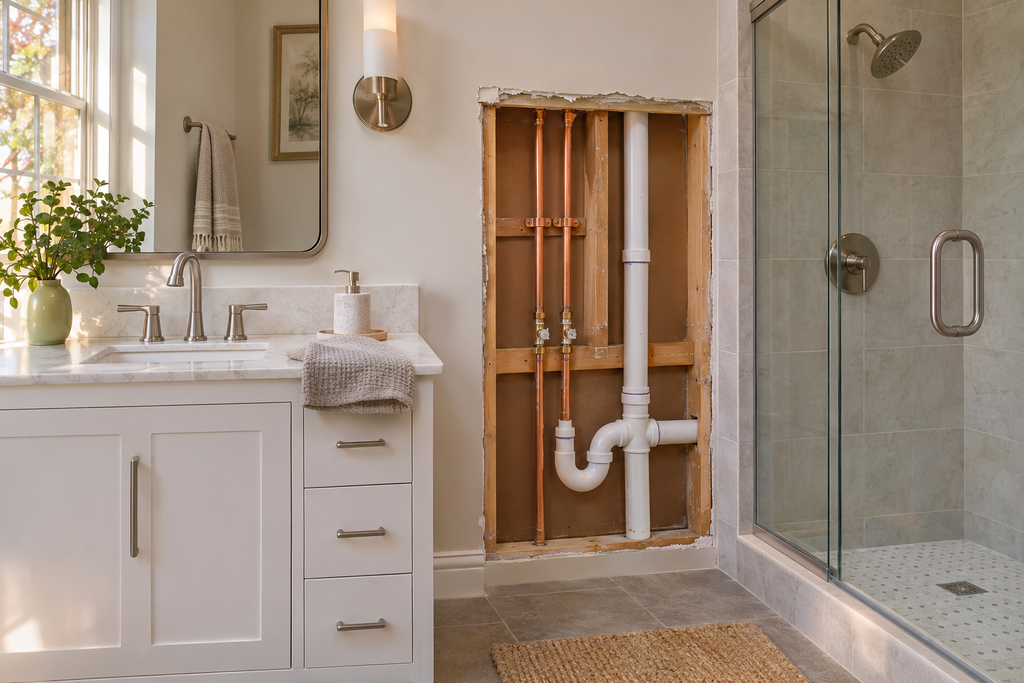
If the wall will stay closed and there is no evidence of a fault, opening every surface just because a bathroom is being refreshed may add demolition and restoration without a clear benefit. If the wall is already open, however, accessible piping can be examined with less disruption. Record the joints, supports, moisture marks and routes, then decide section by section. Age alone is not an instruction to discard a working line.
Small repairs also need a defined endpoint. Ask whether the repaired part was tested under the relevant normal use and whether neighbouring parts were examined. Keep an accessible shutoff and any required service access. A repair that works only while the cabinet door is open, or a connection that cannot be inspected before it is enclosed, may need a different plan.
When bathroom plumbing needs a partial replacement
Consider replacing an affected section when several accessible points on the same run leak, a damaged joint cannot be repaired reliably, or a new fixture cannot be connected properly to the existing arrangement. The plumber should identify the limits of the section and the transitions to materials that remain. Replacing only the conspicuous inch while ignoring adjacent defects can leave the problem in place. Replacing the whole house for one localized issue is another unsupported leap.
Repeated staining, swollen wood, a persistent musty smell or dampness behind a shower calls for source-finding before finish work. Québec advises correcting the cause of water damage and drying affected materials. Fresh tile is not a treatment for a wet wall. If mould is extensive, returns after cleaning or sits in hard-to-reach material, obtain an appropriate assessment. The plumbing repair and the restoration of damaged materials are related tasks, but neither automatically performs the other.
An open wall may reveal an inadequately supported line, a damaged connection or an arrangement that will not fit the chosen fixture. Ask for an explanation of the defect, what can remain and how the changed work will be checked before the wall closes. Partial replacement has a defined reason and boundary. It should not be presented as a standard package that comes with every new vanity.
When a broader redesign is justified
A broader bathroom plumbing scope may be appropriate when the new layout moves supply points and drains, several accessible components have confirmed problems, or the inspection finds a design issue affecting the bathroom as a system. Work can be easier before new surfaces are closed. That practical advantage is a reason to inspect and compare options, not proof that everything behind the wall must go.
Ask the assessor to label what was directly observed, what was tested, what remains concealed and what is an assumption. Bathroom plumbing materials do not share a universal replacement age. Their condition reflects installation, joints, water characteristics, use and exposure. A clean exterior cannot certify the inside of a pipe; a superficial mark cannot establish failure. The guide to visible corrosion clues and useful tests explains these limits.
Lead in drinking water requires its own assessment. Québec notes that a service line, faucet or solder can contribute lead. A photo of a pipe in the bathroom cannot establish lead exposure, and replacing one bathroom tap cannot certify the kitchen supply. Follow local water-utility information and appropriate sampling advice when the concern is potable water. Keep this decision separate from a cosmetic renovation.
Future access can matter too. An uncertain connection that will soon be hidden behind a costly shower assembly deserves careful review if a defect is identified. An accessible connection in a removable vanity may be serviceable without wholesale replacement. Evaluate the risk actually found, the restoration that would be needed later and the useful life of the selected fixture without promising a fixed number of years.
Bathroom plumbing, drainage and shower waterproofing
Supply piping delivers hot and cold water. Drainage carries used water through traps, graded pipes and venting. Waterproofing protects walls and floors against water that leaves the bathing area. Bathroom plumbing supply can be sound while a shower membrane fails. A drain can leak while the tile and grout look tidy. Repair the system responsible for the evidence rather than choosing a trade from the location of the stain alone.
Low flow at one sink does not prove the concealed supply needs replacement. The aerator, faucet, local valve or a wider pressure issue may be involved. A slow tub may have a reachable obstruction near the drain or a problem farther away. Avoid harsh drain chemicals before an inspection, and tell the person working on the drain if any have already been used. Several fixtures backing up together can indicate a concern beyond this bathroom.
When the shower is rebuilt, clarify who connects and checks the drain, who installs the chosen waterproofing system and who verifies it before finishes are placed. Follow the selected manufacturer’s instructions and the applicable project requirements. A quick observation of water flowing away is useful, but it is not proof of future watertightness. Written responsibility between the plumbing and finishing work helps prevent an important step from being assumed by each trade.
Decisions at the basin, toilet and shower
At the basin, look at cabinet space, trap clearance, shutoffs and the new faucet’s reach. A different countertop can change fixture dimensions without requiring a new supply run in the wall. If the cabinet floor is swollen, identify whether the water came from the supply, drain, splashing or condensation. Replacing a fitting before finding the source may leave the damage mechanism untouched.
At the toilet, separate the tank mechanism, supply connection, seal at the floor and condition of the supporting floor. Moving the bowl can change the work substantially compared with replacing it in the same location. Confirm the rough-in and model dimensions before purchase. Our guide on checks before installing a toilet covers measurements and installation limits. It cannot determine whether a damp subfloor is sound.
At the shower, low flow, a valve leak, water escaping the enclosure and slow drainage point to different investigations. A new shower system may require a particular valve or outlet arrangement. Check the manufacturer’s installation details against the actual supply and available space. Plan service access where the chosen design requires it. Do not hide an unverified joint under new finishing materials.
If a tub is removed, ask how the new drain and supply will be routed, how the equipment will be supported and what structural or finishing work is included. A tub and a shower both use water, but their dimensions and connection details are not interchangeable. Confirm the whole assembly, including the shower base and drain, before final ordering.
The right time to inspect bathroom plumbing
Often the most useful decision point comes after a controlled opening and before walls close. Record symptoms and the intended fixtures before demolition. Examine only what is actually exposed. Confirm the new connections and appropriate checks before insulation and finish work. This sequence is more reliable than judging concealed pipe from paint, grout or a house’s construction date.
Older walls can contain hazardous materials. Québec recommends having suspected asbestos-containing material assessed and using qualified contractors for work on confirmed material. Do not disturb a suspicious board or insulation merely to see a pipe. If the opening reveals extensive dampness or contamination, pause finishing in that area until the source and restoration scope are established.
Photograph the new installation before it is enclosed, including the route of piping and shutoffs. Keep product instructions and a description of the checks performed. Those records can help a future repair, although they do not replace a required plan or inspection. Build room in the schedule for a real discovery. Otherwise, pressure to close a wall can turn an unresolved question into a hidden problem.
Québec bathroom plumbing paperwork and responsibility
The Régie du bâtiment du Québec distinguishes work that must be declared from repairs to parts and replacement of a fixture without adding or removing piping. Adding piping or installing a new sanitary fixture can change that answer. Ask the contractor responsible for the plumbing to explain the actual scope and the declaration that applies. Also check municipal requirements and, in a condominium, the syndicate’s rules. A provincial declaration is not the same document as a municipal permit.
An enterprise licence, the scope of its subcategories and the qualifications of the people doing the work are separate matters. Do not assume a person laying tile is authorized to alter piping. Ask who will isolate the water, make the connections, perform appropriate checks, waterproof the shower, restore the wall and put the room back in service. A clear handoff matters especially where one trade’s work will cover another’s.
Keep written records of approvals and the agreed scope. A replacement of a toilet in place may be treated differently from moving it and altering the drain. The RBQ’s guide to declarations of plumbing work gives examples, but the person responsible should apply the current requirements to the particular job.
Compare repair and replacement scopes without a guessed price
If the choice remains open, ask for comparable descriptions of a focused repair with restoration and replacement of the affected section with restoration. Have each option state its assumptions. A wall already open, an access route through an adjacent room, a selected fixture or the need to coordinate an electrician and tile installer all change the work. A single total without its scope cannot answer which option is sensible.
Request a distinction among fixture and material supply, demolition, plumbing work, checks, other trades, finishing and any discovery that requires a revised agreement. Ask how unexpected damage will be documented and approved before the work expands. Our guide on what to compare in a plumbing quote covers those questions. It does not supply a universal bathroom-renovation price.
Think about future access, not only immediate work. A serviceable connection in a removable vanity may remain a reasonable repair. A connection with a confirmed fault that will be buried behind a large shower merits a different discussion. Compare the known defect, the cost of reopening surfaces later and the parts actually involved. Avoid asking for a prediction of an exact failure date that nobody can substantiate.
Bathroom plumbing checks before accepting the room
Before permanent closure, ask which new or repaired connections were checked and how the drainage and shower waterproofing were assessed. The checks should match the work performed and the relevant manufacturer’s instructions. A photograph of a running tap does not document every concealed connection. Keep service areas accessible until the agreed checks are complete. Record any unresolved item before finish materials cover it.
After the bathroom returns to normal use, watch accessible points while the basin fills and empties, the toilet flushes and the shower runs. Check hot-water use without putting yourself near a scalding stream. Do not touch wet electrical fittings to look for a leak. A recurring stain, odour or unusual sound deserves a specific follow-up. Retain the invoice, product information, photos and the list of piping that was actually changed. Do not later describe a partial renovation as a whole-house repiping.
Frequently asked questions
Must every bathroom pipe be replaced during a renovation?
No. An opening creates an opportunity to inspect, but scope follows condition, access and the new layout. Ask for a reason for each proposed replacement and a record of what stays.
Can the plumbing stay if the toilet remains in place?
Often an in-place fixture change involves less piping work. The floor connection, subfloor condition and new model’s dimensions still need checking. A leak or instability changes the decision.
Does a mark near the shower prove a pipe is leaking?
No. Water may travel from the enclosure, waterproofing, a joint or the drain. Find the source before selecting a repair.
Does a new faucet solve a lead concern?
It may remove an identified source in some circumstances, but it says nothing about other components or a service line. Follow appropriate water-testing and Québec guidance.
Who confirms the project requirements?
The responsible contractor should identify the work, licence scope and applicable declarations. Municipal and condominium requirements may also apply. Resolve these questions before closing the walls.
Useful sources and related reading
The RBQ plumbing declaration guide explains which kinds of work are declared. Québec’s information on water damage and mould supports source correction before finishing. See Hydro-Québec’s electrical safety advice, Québec’s asbestos renovation guidance and its lead in drinking-water procedure where those risks are relevant.
For adjacent planning questions, browse plumbing costs and projects. These references guide questions and precautions. A conclusion about a particular installation requires its own observations and applicable local requirements.