Water heaters and hot water
Water heater temperature in Québec: storage, taps and safety
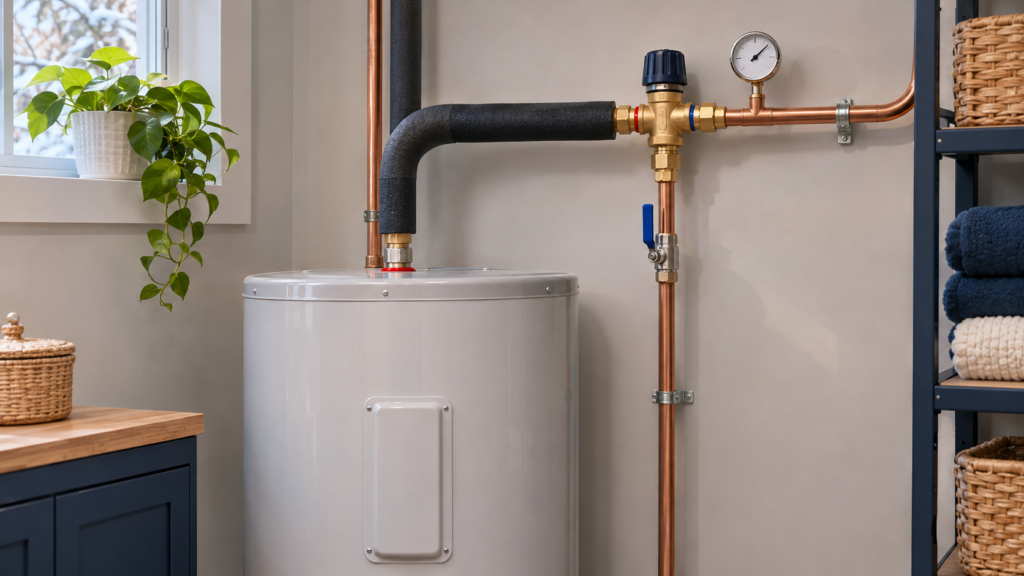
The short answer: for a Québec home, public health guidance calls for water stored in a domestic water heater to be kept at 60°C (140°F), while water delivered at bath and shower outlets should be limited to 49°C (120°F) or less with a suitable anti-scald device. These are temperatures at different points in the system. Hot storage helps control the growth of Legionella bacteria. A lower maximum at the bathing fixture reduces the chance of a severe scald. A young child’s actual bath water should be lukewarm, close to body temperature, and checked before the child enters.
This guide explains what the numbers mean, which observations can help when something seems wrong, and when to have the system assessed. It concerns domestic hot water, not a space-heating boiler. If a tap suddenly delivers scalding water, a mixing device appears to fail, or anyone has been burned, stop using the affected outlet and prioritize safety and appropriate care. Do not remove a heater’s access panels, work on wiring or gas, or change a control whose function you cannot verify.
Two temperatures at two places: tank and tap
“Keep the heater at 60°C” and “limit hot water to 49°C” sound contradictory only when the measurement location is left out. A storage tank holds a supply of hot water. Pipes carry it to fixtures. A thermostatic mixing valve or other suitable limiting device can mix in cold water or cap the temperature available at a bath or shower. The storage setting is therefore not the temperature you want on someone’s skin. Conversely, a pleasantly warm shower does not demonstrate that the whole storage system has reached a safe temperature.
The Institut national de santé publique du Québec’s burn-prevention guide says Québec’s Construction Code requires the water inside a household heater tank to be at least 60°C. The CMMTQ’s Legionella guidance warns against a lower storage setting. The Public Health Agency of Canada pairs 60°C storage with mixing devices that deliver hot water at 49°C. These are general reference points; the real installation, its age and its use still need to be considered on site.
A kitchen sink, hand basin, shower and bathtub do not expose people in precisely the same way. Existing valves, their positions and the building type can change the appropriate technical solution. In a home, it is more useful to ask where the water is too hot or too cool, and when, than to guess at one universal adjustment. Record the affected fixtures and whether the behaviour is constant without placing your hand under potentially scalding water.
Why stored water must remain hot enough
Legionellosis is an infection associated with Legionella bacteria in certain water environments. The Québec government’s prevention guidance recommends keeping a home water heater at 60°C; at that temperature, the bacteria cannot multiply in the tank. A brief reading at one outlet does not describe the whole risk. The concern includes water that stays lukewarm in parts of a system and equipment that creates airborne droplets, such as a shower. Lowering the entire storage tank to avoid scalds is therefore not the recommended way to protect a household.
The opposite conclusion is also unsound: turning the heater above the recommended setting without assessment is not a fix. It may make the water more dangerous at fixtures if anti-scald protection is missing or defective. A mixing valve, shower cartridge, demand that exceeds capacity, heater fault or distribution issue can each affect what users experience. One tap reading cannot isolate the cause or establish the internal tank temperature. If the storage setting is in doubt, ask for an assessment of both the heater and the protection at its outlets.
Québec’s public health advice also addresses water left unused for several days. That advice is distinct from an operating plan for a large building or care facility. A shared system can have multiple tanks, recirculation loops and building-specific maintenance responsibilities. An occupant who notices persistently lukewarm hot water should tell the building manager rather than adjust common equipment. The manager can determine which measurements and professional expertise are appropriate to the installation.
Why 60°C water is unsafe at the bath
Water stored at 60°C can cause a serious burn quickly, especially in a child. The INSPQ explains that young children’s skin is thinner and that deep burns at this temperature can occur in a second. An older person, someone with reduced mobility or sensation, or anyone unable to move away promptly may also face greater danger. A bath matters particularly because exposure can last longer and a child may reach and open a hot tap independently.
The solution is to control water as it leaves the bathing outlet, rather than leave stored water lukewarm. INSPQ recommends a device that lowers water at the tap used for a child’s bath to 49°C or less. The federal public health page describes automatic mixing devices at taps, showers or baths, or a mixing valve at the water heater, as ways to reduce exposure. A competent professional should select and check a solution compatible with the plumbing and its use. A different handle position, or a shower that feels comfortable today, does not prove the limit works when pressures change.
For a baby or young child, test the water with your elbow or wrist before putting the child in the bath; it should feel lukewarm, close to body temperature. Keep an adult supervising throughout the bath. An anti-scald device is an additional safeguard, not a substitute for supervision. If a shower suddenly becomes hotter when another fixture is used, stop using it and have the stability of its mixing assessed. Do not deliberately trigger that variation while a child is under the spray.
What the 49°C limit actually means
The 49°C figure describes a maximum temperature delivered at relevant outlets, especially baths and showers in an ordinary residential context. It is neither the tank temperature nor an ideal bathing temperature. Water within that limit can still be too hot for a baby; actual bath water must be mixed and checked. It also matters whether a protective device is near the heater or near the fixture. The layout, appliances and applicable requirements determine which arrangement is suitable.
The Régie du bâtiment du Québec describes specific rules for covered private seniors’ residences and care facilities: maximum water temperature at bath and shower outlets is 43°C. The regulator explicitly contrasts that value with 49°C for other building types. It would be misleading to call 43°C the rule for every house or to apply the ordinary residential figure without qualification to a care facility. A manager of a covered building needs the applicable requirements for devices, checks and records rather than a general homeowner guide.
A measured maximum at a fixture can change as incoming cold water varies, components wear or plumbing is altered. That is a reason to check performance after a repair or a newly noticed change. The number printed on a handle is not proof of the actual water temperature. If you rent or live in a condominium, send the responsible person a precise account of the affected outlets and conditions. The authorized party can arrange the right measurements and correction.
Identify the pattern without opening equipment
Start by observing behaviour while avoiding contact with water that may scald. Excessively hot water at only one fixture may point an assessment toward that outlet’s device. Excessive heat at several fixtures can suggest a more central issue, but it does not prove that the tank thermostat is at fault. A shower that swings from hot to cold when someone else draws water calls for a look at pressure and temperature control. Water that starts hot and then becomes cool is a different pattern from water that never reaches an adequate temperature.
Note whether the problem affects only the bath, the shower or also sinks; whether it began after recent work; whether it is constant or occasional; and whether hot water returns after a wait. A description based on how the water feels helps communicate the symptom, but it is not a substitute for a safe, properly interpreted measurement. Do not put your hand into a suspect stream just to test it. Keep others away from the affected fixture until the cause is understood.
If hot water runs out quickly after starting at a normal temperature, the question may concern storage capacity, simultaneous demand or heater operation instead. Our guide to a lack of hot water separates those patterns. Abnormal temperature together with a leak, unusual sound or visible deterioration deserves a different evaluation; see the water heater warning signs guide. These resources help you describe the issue. They cannot diagnose it remotely.
Safe observations a homeowner can make
Gather the model and approximate age from documents you already have, without removing a cover. An installation invoice, manual or photograph of an accessible label taken from a safe distance can help identify the type of heater. Notice whether mixing devices are visible, but do not operate them as an experiment. Record when the temperature behaviour changed and which fixtures are affected. If the heater is in a cupboard or shared space, leave access clear for the person who will inspect it.
Ask a plumber which measurements the visit will include: stored hot-water temperature, the hot side before mixing, the maximum at baths and showers, the stability of the mix, and the condition of anti-scald protection. Ask what was measured and where. A shower reading after mixing does not establish tank storage temperature. Equally, a thermostat’s indicated setting does not necessarily show the actual temperature reached throughout the tank.
Do not remove an electrical panel, disconnect wiring or intervene on a gas supply. The CMMTQ source includes steps for an electric heater; this article does not turn them into a homeowner procedure because those steps do not establish the safe condition of your particular installation. Do not bypass a mixing device to obtain more hot water. A qualified professional can assess the appliance, plumbing and applicable requirements, then explain options before changing a setting or component.
When the temperature changes, what might explain it?
The sensation of excessively hot water can have different causes. If sink water behaves normally but the shower is unpredictable, the shower valve and its protection deserve attention. A change at every fixture after a heater replacement calls for a system-wide look. Water that arrives lukewarm should not automatically be “fixed” by raising the tank setting: first determine whether storage, distribution, mixing or demand accounts for the result. A central mixing device can itself change what the individual taps reveal.
In a multi-unit building, hot-water production may be shared. One resident should not change a common installation based on one tap. Tell the manager the times, floors or units affected and how long the problem lasts. That helps separate a local fault from a distribution issue. A collective system, particularly one serving vulnerable people, may need operating expertise different from that required for a single family home.
If temperature changes abruptly and becomes dangerous, stop using the affected bath or shower. A burn or illness needs attention appropriate to its severity; a plumbing guide cannot replace medical advice. For unstable water, signs of a heater problem or a device that no longer seems to limit the outlet, request water heater diagnosis and repair. The assessment can establish whether the heater, distribution piping or a fixture is actually responsible.
After a holiday or a long period without use
A home closed for several days raises a different question from a shower that is too hot. Québec public health advises running hot water for several minutes if the water heater has not operated for a few days. The same guidance calls for following the manufacturer’s cleaning and maintenance instructions for devices that produce mist. These precautions address possible exposures; they are not a household test that certifies the absence of Legionella.
Give the situation more attention if the system was shut down, water stood for a long period, occupants are particularly vulnerable, or the system is shared. Ask the responsible person or a professional what procedure actually applies. Do not improvise thermal disinfection or a building-wide flushing sequence: very hot water at outlets can cause burns, and an unsuitable procedure may leave parts of a network untreated. A large building’s operating steps should not be copied into a single home without assessment.
On returning, observe the temperature and stability of the fixtures without placing skin under a stream whose condition is unknown. If water stays lukewarm during the appliance’s usual operation, do not compensate by removing anti-scald protection. Record how long the system was idle and what happened for an assessment. The goal is a working system that controls both stored-water temperature and exposure at taps.
Children, older adults and other vulnerable users
Prevention should reflect how each room is actually used. A child may reach a handle, stand under a stream before an adult has set the mix, or remain in a bath while temperature changes. Fill the bath cautiously, test it before entry and supervise continuously. Do not rely only on a sticker, a button or a family’s established routine. If a fixture can deliver scalding water, the hazard remains even when adults know how to avoid it.
An older person or someone with limited mobility may need more time to move away from water that is too hot. Reduced sensation can delay recognition of the danger. Valve choice, limiting devices and maintenance should reflect those users without assuming that one configuration suits every building. The RBQ has particular requirements for covered care facilities and private seniors’ residences. A manager should review the building’s specific duties with an appropriate professional.
Keeping stored water at 60°C and reducing delivered water at the bath or shower are not competing projects. They are two stages of protection. A useful inspection checks that both exist and perform under real conditions in the home or building. Where there is doubt, establish the facts before reassuring a family that a system is “safe” simply because one number appears on the appliance.
Questions to ask before and after a visit
A clear service request avoids guesswork. Describe the fixture, the temperature you experienced, time of day, frequency and recent changes. Mention children or vulnerable occupants if it affects the urgency of limiting exposure. Ask whether the visit will check both stored-water temperature and the outlet maximum at baths and showers. Those measurements answer different questions. Have the professional explain which components are involved and whether a fixture-level correction is enough or a wider system check is needed.
After work, ask for the measured temperature, where it was measured and what should be monitored. Confirm with the professional that protective devices work during normal use. Keep service documents and the device’s model information for a future owner or manager. If a recommendation calls for lowering the entire tank to 49°C to prevent burns, ask how it reconciles Legionella prevention with the public health guidance linked here before accepting it.
Frequently asked questions about water heater temperature
Is 60°C at the water heater too hot?
For water stored in a domestic heater, 60°C is the value recommended by the cited public health sources to control Legionella growth. It is far too hot for direct contact with skin. Suitable anti-scald protection at baths and showers reduces delivered temperature without leaving storage water lukewarm.
Can I set the tank to 49°C to protect children?
That is not the strategy recommended by the INSPQ, CMMTQ and federal public health guidance. They separate 60°C storage from limiting water at bathing fixtures to 49°C or less. Have the right devices for your installation assessed instead of lowering the entire stored supply or changing a thermostat without evaluation.
Is 49°C a good temperature for a baby’s bath?
No. It is a maximum outlet figure for scald prevention, not a target bath temperature. INSPQ recommends lukewarm water, close to body temperature, checked with an elbow or wrist before the child enters. Continuous adult supervision is still essential.
More questions about safe outlets
Why might a shower feel lukewarm if the tank is at 60°C?
A shower normally blends hot and cold water. A mixer, cartridge, simultaneous demand or another distribution issue can affect the result. A lukewarm shower does not establish the temperature inside the tank or identify a specific failure. Record the circumstances and arrange appropriate measurements.
What if the water suddenly becomes scalding?
Stop using the affected bath or shower and prevent others from being exposed. If someone has been burned, seek appropriate care. Have the temperature control and system checked before use resumes. Do not bypass the mixer or open the heater.
Does the 43°C rule apply to my house?
The RBQ page linked above presents 43°C for bath and shower outlets in certain covered care facilities and private seniors’ residences. It contrasts those places with other building types, for which it cites 49°C. A professional can check the requirements for your installation and how it is used.
For related questions, browse our Water heaters and hot water guides. If you are dealing with unstable temperature, an ineffective limiting device or signs of failure, describe precisely what you observed before any intervention.